
High-pressure injection injury of the hand
A paint or grease gun can fire fluid through a pinhole wound deep into the hand. It looks trivial but is a surgical emergency that can cost the finger.
What it is
A high-pressure injection injury happens when an industrial tool (paint sprayer, grease gun, hydraulic line, diesel injector, pressure washer) forces liquid or gas through the skin, usually of the non-dominant index finger or the palm. The entry wound is a tiny puncture, but the material spreads far along tendon sheaths, nerves and fascial planes, causing ischaemia, chemical inflammation and infection. It needs emergency surgical decompression and debridement.
Who gets it
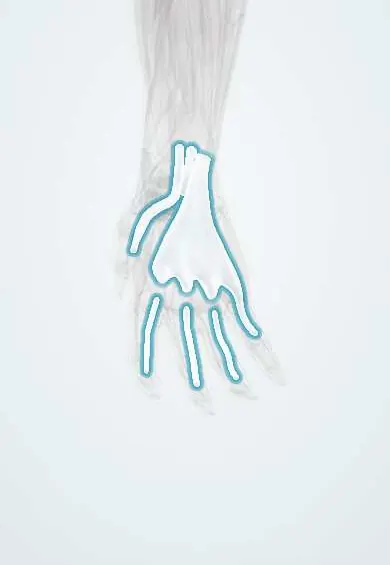
Rare but well known in hand surgery, typically in young and middle-aged men who work as painters, mechanics, machine operators or in industrial cleaning. The non-dominant index finger is the classic site, hit while steadying the gun or wiping a blocked nozzle; the palm and thumb follow. In Colombia these tools are common in car-painting and mechanic workshops, construction and industry, often in informal work without training or guards, and patients may first be seen in primary care where the pinhole is easy to dismiss.
Causes
- Paint sprayers (airless paint guns), especially with oil- or solvent-based paint
- Grease guns
- Hydraulic lines and fluid leaks in machinery
- Fuel injectors and diesel lines
- Pressure washers and water jets; compressed-air lines (air injection)
- Veterinary vaccine guns and other injector devices
Risk factors
- Clearing a blocked nozzle or testing the spray with a finger
- Steadying the tool with the free hand
- Missing tip guard or worn hoses on equipment
- Lack of training and protective gloves
- Work under time pressure or at night
Pathophysiology
Fluid at very high pressure punctures the skin → it spreads along the paths of least resistance: flexor tendon sheaths, neurovascular bundles and the palmar spaces, sometimes up into the forearm → the injected volume raises pressure in closed compartments of the finger → digital arteries are compressed and veins thrombose → ischaemia and necrosis. Chemicals add damage: organic solvents (paint thinner, oil-based paint, fuel) dissolve fat and cause intense inflammation, chemical necrosis and later fibrosis, whereas water, latex paint and air are less toxic. Retained material and dead tissue → infection, including necrotising infection. Late: oleogranulomas, fibrosis, stiff finger, chronic draining sinuses. Delay before decompression and solvent-based material are the main drivers of amputation.
Classification
- By material: organic solvents and oil-based paint, fuels (most toxic); grease (intermediate); water, latex paint and air (least toxic)
- By pressure and volume injected: greater pressure and volume mean wider spread
- By site: fingertip and digit (tight spaces, more amputations) versus palm (more room to spread)
- By time to surgery: early (within hours) versus delayed
Symptoms and signs
- Tiny puncture wound, often on the tip or pad of the index finger or in the palm
- Little pain at first, then increasing, severe pain over hours
- Swelling of the finger spreading into the palm and sometimes forearm
- Pale, mottled or dusky finger; numbness
- Paint or grease visible at the wound, or a smell of solvent
- Later: fever, redness tracking up the hand, discharge
Diagnosis
- Clinical
- The history makes the diagnosis: ask what tool, what material (check the product label or safety data sheet), pressure if known, time since injury, and hand dominance. Examine the entry wound, colour, capillary refill, sensation, the extent of swelling and tenderness along the flexor sheath and into the palm and forearm. Do not be reassured by a small wound or mild early pain. Call hand surgery at once.
- Tests
- Blood count and inflammatory markers as a baseline, and blood cultures if febrile. Pre-operative tests as needed for anaesthesia. Wound cultures are taken in theatre. Tetanus immunisation status is checked.
- Imaging
- Plain X-rays of the hand and forearm: radiopaque materials (lead-containing paints, some greases) show the extent of spread, and subcutaneous air shows the path of air or gas. Normal X-rays do not exclude spread of radiolucent material. Ultrasound or MRI is occasionally used, but must never delay surgery.
Differential diagnosis
- Simple puncture wound from a needle or nail
- Pyogenic flexor tenosynovitis from another cause
- Compartment syndrome of the hand from crush
- Cellulitis or early necrotising soft-tissue infection
- Chemical burn of the skin surface
- Retained foreign body
A small hand puncture that is getting worse: which problem?
| Problem | History | Timing | Findings | What to do |
|---|---|---|---|---|
| High-pressure injection injury | Paint, grease or hydraulic tool | Pain and swelling rise within hours | Pinhole, swollen pale finger, spread into palm; material on X-ray in some | Emergency decompression and debridement |
| Simple puncture wound | Needle, nail, thorn | Little change | Small wound, soft finger, normal colour | Clean, tetanus, review |
| Pyogenic flexor tenosynovitis | Small wound or bite days earlier | One to several days | Fusiform swelling, bent finger, pain on passive extension, tender sheath | Antibiotics and urgent sheath drainage |
| Compartment syndrome of the hand | Crush, fracture, tight cast, infusion leak | Hours | Tense hand, pain on passive stretch | Urgent fasciotomy |
| Necrotising soft-tissue infection | Minor wound, diabetes or drug injection | Hours to days | Pain beyond the visible redness, toxic patient, skin changes | Resuscitation, antibiotics and radical debridement |
Goal of treatment
Save the finger and its function by decompressing and removing all injected material and dead tissue as early as possible, preventing infection, and restoring movement with therapy.
Treatment
- Acute
- In the emergency department: splint and elevate the hand, give analgesia, tetanus prophylaxis and broad-spectrum antibiotics, keep the patient fasting and call hand surgery immediately. Avoid a digital nerve block, which adds volume to an already tense finger, and avoid ice or heat.
- Surgical
- Emergency surgical exploration under regional or general anaesthesia with a tourniquet: wide incisions along the path of spread, decompression of the digit and palm, opening of the tendon sheath when involved, and removal of all paint, grease and dead tissue while protecting nerves and vessels. Wounds are usually left open.
- Surgical
- Planned second look and repeated debridement within the following days, then delayed closure, skin grafts or flaps. Amputation is considered for a finger that is not viable or is destroyed by necrosis and infection.
- Medical
- Antibiotics adjusted to cultures. Corticosteroids have been used to reduce the chemical inflammation, but evidence is limited and they are not a substitute for surgery.
- Follow-up
- Low-toxicity injections (water, air) with a soft, well-perfused finger and minimal symptoms may sometimes be observed closely by a hand surgeon; any rise in pain, swelling or colour change means surgery.
- Rehabilitation
- Early hand therapy after the wounds settle: oedema control, tendon gliding and range-of-motion exercises, scar management.
Complications
- Amputation of the finger, especially after solvent-based paint and late surgery
- Necrosis of skin, tendon and pulp
- Infection, including necrotising infection
- Stiffness, contracture and tendon adhesions
- Numbness, cold intolerance and chronic pain
- Oleogranulomas and chronic draining sinuses from retained material
- Loss of work capacity
Common traps
- A pinhole wound with little pain is a minor injury: the injected material spreads deep along sheaths and planes; the visible wound tells nothing about the damage
- A normal X-ray rules out significant spread: many paints and fluids are radiolucent; the history decides surgery
- A digital block will make the examination and the patient comfortable: it adds volume to a tight, ischaemic finger; use systemic analgesia and leave anaesthesia to the surgical team
- Antibiotics and elevation are enough if the finger looks pink: perfusion fails over hours; only early surgical decompression and debridement save the finger
- All injected materials are equally dangerous: solvents, oil-based paint and fuel are the most destructive; water and air cause less damage, though they still need surgical review
Prognosis
Outcome depends on the material, the volume and above all the time to surgery. Water and air injections treated promptly usually do well. Solvent-based paint and fuel injections have high amputation rates, and many survivors keep stiffness, cold intolerance and numbness. Decompression within the first hours clearly lowers the risk of losing the finger.
Prevention
- Tip guards and trigger locks on spray and grease guns; never clear a nozzle with a finger
- Release pressure before cleaning or servicing equipment
- Inspect and replace worn hoses and fittings
- Training, gloves and workplace safety programmes, including informal workshops
- Teach workers and primary care staff that a small injection wound is an emergency
Test yourself
Think of the answer, then tap the question to see it.
A painter wiped the nozzle of an airless spray gun with his left index finger 2 hours ago. There is a pinhole on the pad and mild pain. What is the next step?
Urgent hand surgery referral for decompression and debridement. The tiny wound hides paint spread along the sheath and neurovascular bundles; delay raises the amputation risk.
Why are solvent-based paints and fuels worse than water when injected under high pressure?
Organic solvents dissolve fat and cell membranes, causing intense chemical inflammation and necrosis on top of the pressure ischaemia; water and air are mechanically damaging but far less toxic.
Why is a digital nerve block avoided in a finger with a high-pressure injection injury?
The finger is already tense from injected volume; adding anaesthetic raises pressure further and can worsen ischaemia. Systemic analgesia is used until surgery.
A mechanic's grease-gun wound is X-rayed and no material is seen. Can surgery be avoided?
No. Many greases and paints are radiolucent; the X-ray maps spread only when the material is radiopaque. The history of injection decides the need for exploration.
Connections
Educational information, not medical advice. For any symptom, see a health professional.
Sources: Hand High Pressure Injury (StatPearls (NCBI Bookshelf), 2023); Acute Compartment Syndrome (StatPearls (NCBI Bookshelf), 2023); Hand Injuries and Disorders (MedlinePlus (U.S. National Library of Medicine), 2025).
Spotted a mistake?We are always improving for the community. Tell us what is wrong and our team will review it.Report a mistake
Representative model, for educational purposes only.