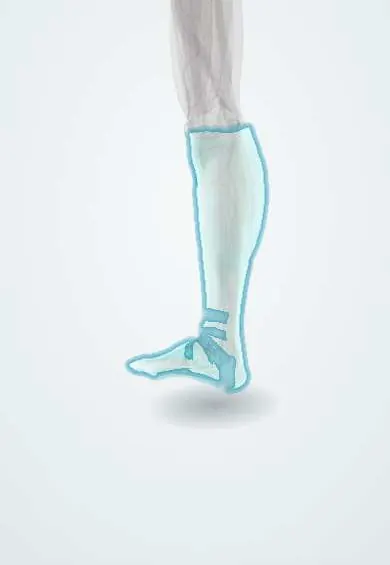
Acute compartment syndrome !
Acute compartment syndrome is a surgical emergency: pressure builds inside a closed muscle compartment, most often in the leg, and cuts off blood flow.
Updated 2026-10-29
Structures involved
Tap one to see what it is and open it in 3D.
- Crural fascia
- Muscle dividers
- Tibialis anterior
- Interosseous membrane
- Deep fibular nerve
- Anterior tibial artery
- Extensor digitorum longus
- Tibialis posterior
- Soleus
- Fibularis longus
In biochemistry
In histology
In the clinical exam
In physiology
Why it happens
- Hypoxia, ischemia and reperfusion injury
- Mechanical and electrical injury: abrasion, contusion, laceration, wounds
- Starling forces at the capillary
What it is
A surgical emergency in which pressure rises inside a closed muscle compartment until blood flow to its muscles and nerves fails. The leg is the most common site.
Who gets it
Most cases follow fractures, above all tibial shaft fractures, and crush injuries; young men are affected most. It also follows reperfusion after vascular repair.
Causes
- Fractures, especially of the tibia
- Crush injuries and prolonged limb compression
- Reperfusion after arterial injury or repair
- Tight casts or dressings
- Burns, bleeding into the compartment, intense exercise
Risk factors
- Young male patients with large muscle mass
- High-energy trauma
- Anticoagulation or bleeding disorders
- Reduced level of consciousness (pain cannot be reported)
Pathophysiology
Fascia does not stretch, so swelling or bleeding raises compartment pressure. When this pressure approaches the perfusion pressure, capillary flow stops and muscle and nerve become ischaemic. Ischaemia causes more swelling, a vicious circle that within hours can lead to irreversible necrosis.
Classification
- Acute (emergency) or chronic exertional (recurrent, exercise-related)
- Leg compartments: anterior, lateral, superficial posterior, deep posterior
Symptoms and signs
- Pain out of proportion to the injury, early and the most important sign
- Pain on passive stretch of the compartment's muscles
- Tense, tight swelling of the compartment
- Paraesthesia or numbness (e.g. first web space in the anterior compartment)
- Weakness and paralysis (late)
- Pulses are often present until very late
Diagnosis
- Clinical
- Mainly a clinical diagnosis: pain out of proportion and pain on passive stretch are the earliest signs. Pallor, pulselessness and paralysis are late.
- Tests
- Intracompartmental pressure measurement when the exam is unreliable (e.g. sedated patients); a small difference between diastolic and compartment pressure supports the diagnosis (thresholds vary). Creatine kinase, potassium and kidney function for muscle damage.
- Imaging
- Imaging does not diagnose it; X-rays show the underlying fracture.
Differential diagnosis
- Pain from the fracture itself
- Deep vein thrombosis
- Arterial injury or acute limb ischaemia
- Peripheral nerve injury
- Cellulitis or necrotising soft-tissue infection
Goal of treatment
Restore muscle and nerve blood flow as fast as possible, within hours, to prevent permanent necrosis, contracture and nerve damage.
Treatment
- Acute
- Immediate first steps: remove or split casts and dressings, keep the limb at heart level (not elevated), give oxygen and correct low blood pressure.
- Surgical
- Urgent fasciotomy releasing all affected compartments (in the leg, usually all four) through one or two incisions.
- Surgical
- Wounds are left open and closed later or covered with skin grafts; dead muscle is debrided.
- Follow-up
- Close monitoring for kidney injury from rhabdomyolysis and high potassium.
Complications
- Muscle necrosis and Volkmann-type contracture
- Permanent nerve damage (e.g. foot drop)
- Rhabdomyolysis and acute kidney injury
- Infection of fasciotomy wounds
- Amputation
Prognosis
Early fasciotomy usually preserves function. Delays of several hours greatly increase permanent damage and complications.
Prevention
- Regular neurovascular checks after fractures and casting
- Avoiding tight casts and splitting them when swelling is expected
Test yourself
Think of the answer, then tap the question to see it.
What are the earliest and most reliable signs of acute compartment syndrome?
Pain out of proportion to the injury and pain on passive stretch of the compartment's muscles.
Does a palpable distal pulse exclude compartment syndrome?
No. Compartment pressure kills muscle before it closes major arteries; pulses are often present until very late.
What is the definitive treatment of acute compartment syndrome?
Urgent fasciotomy of all affected compartments; it is a surgical emergency.
Which fracture most commonly causes compartment syndrome?
Tibial shaft fracture.
Why should the limb not be elevated above heart level?
Elevation lowers arterial inflow pressure and can worsen ischaemia; the limb is kept at heart level.
Related conditions
- Tibial shaft fracture
- Tibial Plateau Fracture
- Popliteal Artery Injury
- Deep vein thrombosis
- Cellulitis of the leg
- Femoral shaft fracture
- Acute limb ischaemia
- Metatarsal fractures (including stress fractures)
Educational information, not medical advice. For any symptom, see a health professional.
Sources: Acute Compartment Syndrome (StatPearls (NCBI Bookshelf), 2023).
Spotted a mistake?We are always improving for the community. Tell us what is wrong and our team will review it.Report a mistake
Representative model, for educational purposes only.