Conditions · Hematology and oncology
Hodgkin lymphoma !
Hodgkin lymphoma is a cancer of the lymph nodes that usually starts as a painless lump in the neck. Most people are cured with treatment.
Updated 2026-11-01
Structures involved
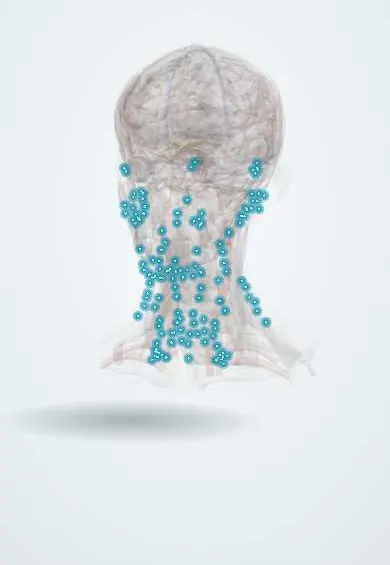
Tap one to see what it is and open it in 3D.
- Neck lymph nodes
- Mediastinal lymph nodes
- Spleen
- Thymus
- Parasternal lymph nodes
- Para-aortic lymph nodes
- Liver
In the clinical exam
Why it happens
- Oncogenic viruses and H. pylori: the table to know
- Systemic effects of inflammation: fever, acute-phase proteins, leukocytosis, sepsis
- How tumours evade the immune system
- Immunohistochemistry: the principle and the markers to know
- Naming tumours: -oma, carcinoma, sarcoma, and the misleading names
- Biopsy: excisional, incisional, core needle, punch and fine-needle aspiration
What it is
A B-cell lymphoma defined by a small number of large malignant Reed-Sternberg cells within a background of reactive inflammatory cells. It typically spreads in an orderly way from one lymph node group to the next.
Who gets it
Shows two age peaks, in young adults (15 to 35 years) and after 55. In low- and middle-income countries, including Latin America, childhood cases and the mixed cellularity subtype linked to Epstein-Barr virus are relatively more frequent than in high-income countries.
Causes
- Malignant transformation of a germinal-centre B cell (Reed-Sternberg cell)
- Epstein-Barr virus infection in a share of cases
- Immunodeficiency, including HIV infection
Risk factors
- Previous infectious mononucleosis (EBV)
- HIV infection and other immunosuppression
- Family history of Hodgkin lymphoma
- Young adult or older adult age
Pathophysiology
Reed-Sternberg cells (CD15 and CD30 positive, CD20 usually negative in the classical form) secrete cytokines that recruit lymphocytes, eosinophils and fibroblasts, so the tumour is mostly reactive cells. Cytokines cause fever, night sweats and itching. Disease spreads contiguously through lymph node chains and later to spleen, liver, lung and marrow.
Classification
- Classical: nodular sclerosis (most common, young women, mediastinal mass), mixed cellularity (EBV, HIV), lymphocyte-rich, lymphocyte-depleted (worst prognosis)
- Nodular lymphocyte-predominant: CD20-positive 'popcorn' cells, indolent course
- Staging (Lugano, based on Ann Arbor): I to IV, with A (no B symptoms) or B (fever, night sweats, weight loss)
Symptoms and signs
- Painless, rubbery enlarged lymph node, most often in the neck or above the clavicle
- Mediastinal mass with cough, chest discomfort or breathlessness
- B symptoms: fever, drenching night sweats, weight loss over 10% in 6 months
- Generalised itching and fatigue
- Pain in involved nodes after drinking alcohol (uncommon but classic)
- Enlarged spleen or liver in advanced disease
Diagnosis
- Clinical
- Full examination of all lymph node regions, liver and spleen, and a history of B symptoms.
- Tests
- Excisional lymph node biopsy (fine-needle aspiration is not enough) with immunohistochemistry showing CD15 and CD30. Complete blood count, ESR, liver and kidney function, albumin, LDH, and HIV and hepatitis B and C testing. Pregnancy test and fertility counselling before treatment.
- Imaging
- PET-CT for staging and to assess response; chest X-ray may show a mediastinal mass. Echocardiography and pulmonary function tests before anthracyclines and bleomycin.
Differential diagnosis
- Non-Hodgkin lymphoma
- Tuberculous lymphadenitis, a common cause of neck nodes in Colombia
- Infectious mononucleosis and other reactive lymphadenopathy
- Sarcoidosis
- Metastatic carcinoma to lymph nodes
- Thymoma or germ cell tumour in the mediastinum
Goal of treatment
Cure the lymphoma while limiting long-term toxicity, adjusting treatment intensity to stage, risk factors and response on PET.
Treatment
- Medical
- Combination chemotherapy, classically ABVD (doxorubicin, bleomycin, vinblastine, dacarbazine) or newer regimens, sometimes with the anti-CD30 antibody-drug conjugate brentuximab vedotin.
- Procedure
- Involved-site radiotherapy, mainly for early-stage or bulky disease, often after a short course of chemotherapy.
- Medical
- For relapse: salvage chemotherapy followed by autologous stem cell transplantation, and immune checkpoint inhibitors.
- Follow-up
- Long-term survivorship follow-up for late effects: thyroid function, cardiac and lung function, and breast and other cancer screening after chest radiotherapy.
Complications
- Superior vena cava syndrome and airway compression
- Infections from the disease and its treatment
- Bleomycin lung toxicity and anthracycline cardiotoxicity
- Second cancers (breast, lung, thyroid, leukaemia) and hypothyroidism after radiotherapy
- Infertility
Prognosis
One of the most curable cancers: most patients, including many with advanced stage, are cured. Over time, late effects of treatment become a major cause of illness in survivors.
Test yourself
Think of the answer, then tap the question to see it.
Which cell defines Hodgkin lymphoma, and which markers does it carry?
The Reed-Sternberg cell, positive for CD15 and CD30 in classical Hodgkin lymphoma.
What is the most common subtype of classical Hodgkin lymphoma?
Nodular sclerosis, typically in young adults with a mediastinal mass.
What are B symptoms?
Fever, drenching night sweats and unexplained loss of more than 10% of body weight within 6 months.
Which biopsy is needed to diagnose lymphoma?
An excisional (whole node) biopsy, because fine-needle aspiration does not show the node architecture.
How does Hodgkin lymphoma typically spread compared with non-Hodgkin lymphoma?
Hodgkin spreads contiguously to neighbouring node groups; non-Hodgkin is more often non-contiguous and extranodal.
Related conditions
Educational information, not medical advice. For any symptom, see a health professional.
Sources: Hodgkin lymphoma (MedlinePlus (U.S. National Library of Medicine), 2025).
Spotted a mistake?We are always improving for the community. Tell us what is wrong and our team will review it.Report a mistake
Representative model, for educational purposes only.