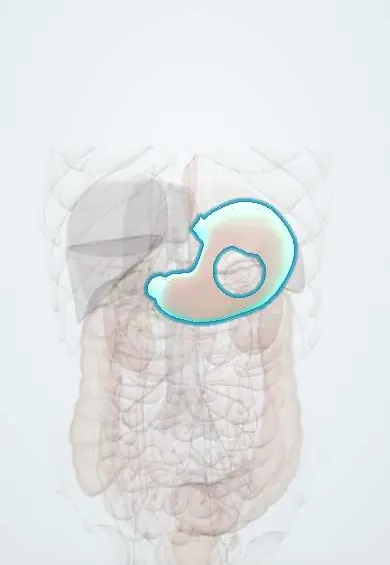
Infantile hypertrophic pyloric stenosis !
Pyloric stenosis is thickening of the stomach outlet muscle in young babies, usually at 2 to 8 weeks; it causes forceful, projectile vomiting.
Updated 2026-10-29
Structures involved
Tap one to see what it is and open it in 3D.
In embryology
In physiology
Why it happens
What it is
Thickening of the pyloric muscle in young infants that narrows the stomach outlet and causes progressive projectile vomiting, usually between 2 and 8 weeks of age.
Who gets it
One of the most common surgical causes of vomiting in infancy. Boys are affected several times more often than girls, especially firstborn sons, and it runs in families.
Causes
- Multifactorial: genetic and environmental factors
- Exposure to macrolide antibiotics in the first weeks of life
Risk factors
- Male sex, especially firstborn
- Family history, particularly in the mother
- Macrolide exposure in early infancy
- Maternal smoking in pregnancy
- Bottle feeding (association reported in some studies)
Pathophysiology
Hypertrophy and hyperplasia of the circular muscle of the pylorus lengthen and narrow the pyloric canal. Milk cannot pass, so the stomach empties by forceful vomiting without bile. Loss of gastric acid causes hypochloraemic, hypokalaemic metabolic alkalosis; the kidney keeps sodium at the expense of potassium and hydrogen ions (paradoxical aciduria).
Symptoms and signs
- Non-bilious projectile vomiting after feeds, worsening over days
- A hungry baby who wants to feed again right after vomiting
- Weight loss or poor weight gain
- Dehydration: fewer wet nappies, lethargy, sunken fontanelle
- Visible gastric peristalsis moving left to right after feeds
- Palpable olive-shaped mass in the epigastrium or right upper quadrant
- Jaundice in a few infants
Diagnosis
- Clinical
- Typical history in an infant of 2 to 8 weeks. The olive is best felt during a test feed, with the stomach empty and the baby calm. Weight and hydration are assessed.
- Tests
- Blood gas and electrolytes: hypochloraemic, hypokalaemic metabolic alkalosis; urea and creatinine for dehydration; bilirubin if jaundiced.
- Imaging
- Ultrasound is the test of choice: a thickened, elongated pyloric muscle that does not open (cut-offs for wall thickness and channel length vary between texts). An upper GI contrast study (string sign) if ultrasound is unavailable or unclear.
Differential diagnosis
- Gastro-oesophageal reflux
- Overfeeding
- Gastroenteritis
- Malrotation with midgut volvulus (bilious vomiting)
- Infection: urinary tract infection, sepsis, meningitis
- Salt-wasting congenital adrenal hyperplasia
Goal of treatment
Correct dehydration and the alkalosis first, then relieve the obstruction surgically; it is urgent but not an operative emergency.
Treatment
- Acute
- Feeds are stopped and intravenous fluids with saline and glucose are given, adding potassium once the baby passes urine, until chloride and bicarbonate return to normal; nasogastric tube if needed.
- Surgical
- Pyloromyotomy (Ramstedt), open or laparoscopic: the thickened muscle is split down to the mucosa, which is left intact.
- Follow-up
- Feeding is restarted within hours of surgery; some early vomiting is common and settles.
Complications
- Dehydration and electrolyte imbalance
- Apnoea and anaesthetic risk if the alkalosis is not corrected first
- Mucosal perforation during pyloromyotomy
- Incomplete pyloromyotomy with persistent vomiting
- Wound infection
Prognosis
Excellent: pyloromyotomy is curative, with a rapid return to normal feeding and growth.
Test yourself
Think of the answer, then tap the question to see it.
At what age does hypertrophic pyloric stenosis typically present?
Between 2 and 8 weeks of life.
Which acid–base disorder is classic in pyloric stenosis?
Hypochloraemic, hypokalaemic metabolic alkalosis, from loss of gastric acid in vomit.
What mass may be felt in pyloric stenosis?
An olive-shaped mass in the epigastrium or right upper quadrant, best felt during a test feed.
Why is the vomiting non-bilious?
The obstruction is at the pylorus, above the ampulla of Vater where bile enters the duodenum.
What is the definitive treatment?
Pyloromyotomy (Ramstedt), after fluids and electrolytes are corrected.
Related conditions
Educational information, not medical advice. For any symptom, see a health professional.
Sources: Pyloric Stenosis (StatPearls (NCBI Bookshelf), 2023).
Spotted a mistake?We are always improving for the community. Tell us what is wrong and our team will review it.Report a mistake
Representative model, for educational purposes only.