Conditions · Metabolism (biochemistry)
Lynch syndrome (hereditary non-polyposis colorectal cancer) !
An inherited tendency to colon, endometrial and other cancers caused by faults in the genes that fix copying errors in DNA.
Updated 2026-11-01
Structures involved
Tap one to see what it is and open it in 3D.
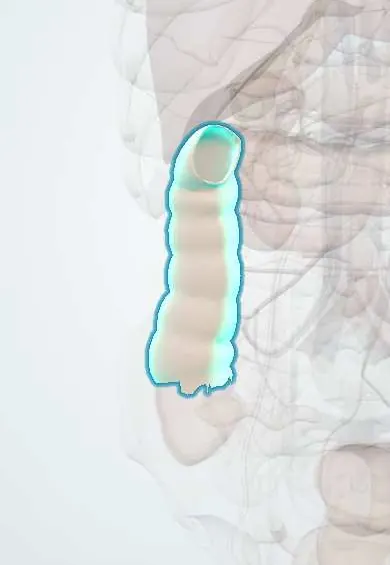
- Ascending colon
- Cecum
- Endometrium
- Transverse colon
- Descending colon
- Sigmoid colon
- Stomach
- Ovaries
- Rectum
- Urinary bladder
In biochemistry
In the clinical exam
Why it happens
- Genomic instability: mismatch repair, BRCA and xeroderma pigmentosum
- Hereditary cancer syndromes: the table to know
- Multistep carcinogenesis: the adenoma–carcinoma sequence
- How tumours evade the immune system
- Molecular pathology: PCR, FISH, sequencing and liquid biopsy
- The hallmarks of cancer
Show 2 more
What it is
An autosomal dominant syndrome caused by a germline variant in a mismatch repair gene (MLH1, MSH2, MSH6, PMS2) or an EPCAM deletion that silences MSH2.
Who gets it
It is the most common hereditary colorectal cancer syndrome: in the United States about 1 in 279 people is estimated to carry an associated variant. It explains about 3% of colorectal cancers. Families have been described in Colombia in hereditary cancer studies, but there is no population figure.
Causes
- Inherited pathogenic variant in MLH1, MSH2, MSH6 or PMS2
- 3' EPCAM deletion that methylates and silences MSH2
- The second copy is lost in the tissue (two-hit model)
Risk factors
- Relatives with early colorectal or endometrial cancer
- Several associated cancers in one person or family
- Amsterdam II or Bethesda criteria
Pathophysiology
The carrier's cells have one working MMR gene copy; once they lose it (second hit), DNA polymerase errors are no longer corrected. Microsatellites change length (microsatellite instability) and frameshift mutations build up in repeat-containing genes such as TGFBR2 and BAX. This speeds up the adenoma–carcinoma sequence: an adenoma can turn into cancer in 2–3 years. The tumours are hypermutated, highly immunogenic and full of lymphocytes.
Classification
- By gene: MLH1 and MSH2 (highest risk), MSH6 (more endometrial risk), PMS2 (lower risk)
- Muir-Torre syndrome: Lynch with sebaceous tumours
- Turcot syndrome (variant): with brain tumours
Symptoms and signs
- Often no symptoms until a cancer appears
- Rectal bleeding, iron-deficiency anaemia or change in bowel habit
- Abnormal or postmenopausal uterine bleeding
- Abdominal pain or weight loss
Diagnosis
- Clinical
- Suspected from family history (Amsterdam II or Bethesda criteria) or from colorectal or endometrial cancer before age 50.
- Tests
- In every colorectal and endometrial cancer: immunohistochemistry for MLH1, MSH2, MSH6 and PMS2 or microsatellite instability testing; if MLH1 is lost, look for a BRAF mutation or promoter methylation (sporadic cause); confirm with germline genetic testing.
- Imaging
- Colonoscopy finds and removes polyps; CT stages the cancer.
Treatment
- Follow-up
- Regular colonoscopy from early adulthood, at short intervals set by the affected gene.
- Surgical
- Colectomy (sometimes extended) when cancer appears; risk-reducing hysterectomy and salpingo-oophorectomy once childbearing is complete, depending on the gene.
- Medical
- Long-term aspirin lowers colorectal cancer risk in carriers (an individual decision with the specialist).
- Medical
- MMR-deficient tumours often respond to immune checkpoint inhibitors.
- Follow-up
- Cascade testing of first-degree relatives and genetic counselling.
Complications
- Colorectal cancer (mainly right colon)
- Endometrial and ovarian cancer
- Cancers of the stomach, small bowel, urinary tract, bile ducts and pancreas
- Sebaceous skin tumours
Prognosis
Colonoscopic surveillance markedly lowers colorectal cancer deaths; MMR-deficient cancers have, stage for stage, a better outlook than sporadic ones.
Prevention
- Surveillance colonoscopy in carriers
- Risk-reducing gynaecological surgery in selected carriers
- Genetic counselling and testing of relatives
Test yourself
Think of the answer, then tap the question to see it.
Which DNA repair system fails in Lynch syndrome?
Mismatch repair (MMR): the MLH1, MSH2, MSH6 and PMS2 genes.
Which tumour finding points to Lynch syndrome?
Microsatellite instability or loss of an MMR protein on immunohistochemistry.
If a tumour has lost MLH1 and its promoter is methylated, what does that suggest?
A sporadic cancer from epigenetic silencing of MLH1, not inherited Lynch syndrome.
What is the second most common cancer in women with Lynch syndrome?
Endometrial cancer, whose risk can match or exceed that of colorectal cancer.
Related conditions
Educational information, not medical advice. For any symptom, see a health professional.
Sources: Lynch syndrome: MedlinePlus Genetics (MedlinePlus, US National Library of Medicine, 2026); MLH1 gene: MedlinePlus Genetics (MedlinePlus, US National Library of Medicine, 2026); MSH2 gene: MedlinePlus Genetics (MedlinePlus, US National Library of Medicine, 2026); Textbook of Biochemistry for Medical Students, 6th ed. (Jaypee Brothers Medical Publishers (Vasudevan DM, Sreekumari S, Vaidyanathan K), 2011).
Spotted a mistake?We are always improving for the community. Tell us what is wrong and our team will review it.Report a mistake
Representative model, for educational purposes only.