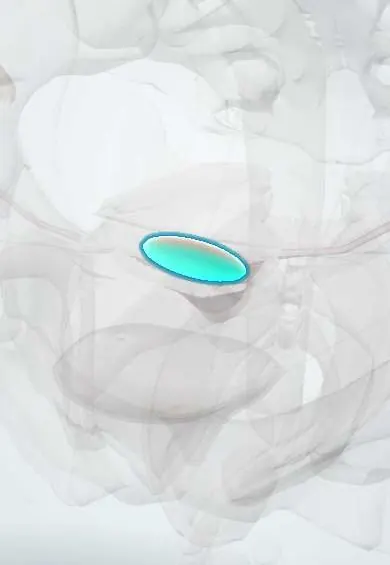
Reproductive system · Pelvis · Female
Endometrium !
The endometrium is the inner lining of the uterus; it thickens each menstrual cycle and is shed as the period if no pregnancy implants.
Opens in the Durgical app, no sign-up needed.
What it is
The inner lining of the uterus.
What it does
Thickens each cycle under oestrogen and progesterone and is shed as the period if no pregnancy implants.
Key facts
- Where
- Mucosa lining the uterine cavity: functional layer (shed) over a basal layer
- Blood supply
- Radial then spiral arteries (functional layer) and straight arteries (basal layer), from the uterine artery
- Nerve
- Uterovaginal plexus (from inferior hypogastric plexus): sympathetic T10–L1, parasympathetic S2–S4
- Function
- Proliferates (oestrogen) and becomes secretory (progesterone) each cycle; shed at menstruation; site of implantation
Relations
- Deep
- Myometrium, with no submucosa between them; the irregular border is part of the junctional zone
- Superficial
- The uterine cavity; continuous with the lining of the uterine tubes at the tubal openings and with the endocervical canal at the internal os
How to find it
Not palpable. Seen directly at hysteroscopy, where its colour, thickness, polyps and focal lesions guide a targeted biopsy, and sampled blindly with a thin suction cannula passed through the cervix.
On imaging
Transvaginal ultrasound measures the double-layer thickness in the sagittal plane: a thin bright line after menstruation, a triple-line pattern in the proliferative phase and a thick, evenly bright lining in the secretory phase. Saline infusion sonohysterography outlines polyps and submucous fibroids.
Common problems
- Endometriosis: tissue like it grows outside the uterus.
- Polyps and thickening; endometrial cancer (warning sign: bleeding after menopause).
How it is diagnosed
Pelvic examination and ultrasound (often transvaginal); hysteroscopy or a sample of the lining (biopsy) when needed; MRI for some cases.
Treatment
- Medicines or a hormonal intrauterine device for heavy bleeding.
- Removal of fibroids (myomectomy) or blocking their blood supply (embolisation).
- Hysterectomy (removal of the uterus) when other treatments are not enough or for cancer.
- Caesarean section to deliver a baby through the abdomen.
Clinical notes
- Sampled by office aspiration biopsy, dilatation and curettage or hysteroscopy; its histology changes predictably through the proliferative and secretory phases
- Asherman syndrome: scant or absent periods and infertility from adhesions after damage to the basal layer
- Endometriosis: endometrial-type tissue outside the uterus, most often on the ovaries, the uterosacral ligament and the rectouterine pouch; retrograde menstruation through the tubes is the leading theory
- In pregnancy it becomes the decidua; where the decidua is thin or missing (over a scar) the placenta can invade too deeply (placenta accreta spectrum)
Related conditions
- Lynch syndrome (hereditary non-polyposis colorectal cancer)
- Miscarriage (early pregnancy loss)
- Uterine fibroids (leiomyomas)
- Endometriosis
- Polycystic ovary syndrome
- Pelvic inflammatory disease
- Endometrial cancer
- Adenomyosis
- Abnormal uterine bleeding
- Dysmenorrhoea
- Molar pregnancy (hydatidiform mole)
- Puerperal infection (postpartum endometritis and maternal sepsis)
- Septic and unsafe abortion
- Endometrial hyperplasia
- Menopause and climacteric syndrome
- Female infertility
- Gestational trophoblastic neoplasia (choriocarcinoma)
- Asherman syndrome (intrauterine adhesions)
Test yourself
Think of the answer, then tap the question to see it.
Which layer of the endometrium survives each period, and what results if it is damaged?
The basal layer, which regrows the functional layer; damage (vigorous curettage, infection) causes intrauterine adhesions: Asherman syndrome.
What causes the functional layer of the endometrium to be shed at the end of the cycle?
Falling progesterone makes the spiral arteries constrict; the functional layer becomes ischaemic and is shed.
What drives endometrial hyperplasia and endometrioid cancer?
Unopposed oestrogen: obesity, anovulation (as in polycystic ovary syndrome) or oestrogen-only therapy.
In postmenopausal bleeding, what does a thin endometrium on transvaginal ultrasound suggest?
Cancer is unlikely when it is about 4 mm or less in many guidelines; a thicker endometrium leads to sampling.
Educational information, not medical advice. For any symptom, see a health professional.
Its names
- Official Latin (TA2)
- endometrium TA2 3521
- Official Spanish (DeCS)
- Endometrio DeCS D004717
- English (TA2)
- Endometrium
- Also called
- mucous membrane of uterus
Related
Sources: Terminologia Anatomica (TA2); DeCS; Anatomy, Abdomen and Pelvis: Uterus.
Spotted a mistake?We are always improving for the community. Tell us what is wrong and our team will review it.Report a mistake
Representative model, for educational purposes only.