Conditions · Surgery and trauma
Malignant hyperthermia !
An inherited muscle reaction to some anaesthetic gases and succinylcholine: muscles stiffen and overheat. It is fatal without fast treatment.
Updated 2026-11-01
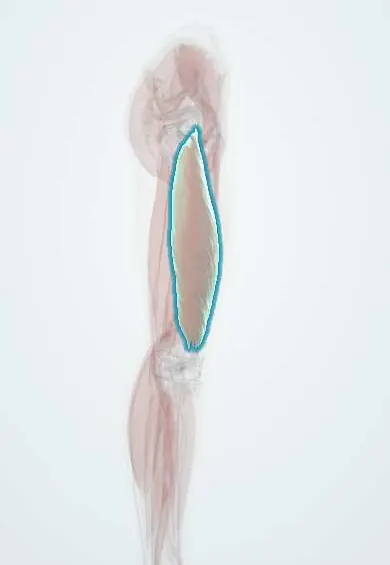
Structures involved
Tap one to see what it is and open it in 3D.
Why it happens
- Mendelian inheritance: autosomal dominant, recessive and X-linked
- Thermal injury: burns, hyperthermia and hypothermia
- Mechanisms of cell injury: ATP, mitochondria, calcium, membranes and DNA
- Skeletal muscle excitation–contraction coupling
- Skeletal muscle: sarcomere and contraction
What it is
A pharmacogenetic disorder of skeletal muscle in which exposure to volatile inhaled anaesthetics or succinylcholine causes uncontrolled calcium release inside muscle cells, leading to a life-threatening hypermetabolic crisis. Between exposures, susceptible people are usually well.
Who gets it
Crises are rare, reported in about 1 in tens of thousands of general anaesthetics, more often in children and young men, but the genetic susceptibility is more common. Every operating room where triggering agents are used, including in Colombia, needs a crisis protocol and access to the specific antidote.
Causes
- Autosomal dominant mutations, most often in the ryanodine receptor gene (RYR1)
- Less often in CACNA1S (dihydropyridine receptor) or STAC3
- Triggers: volatile inhaled anaesthetics (such as sevoflurane, desflurane, isoflurane) and succinylcholine
Risk factors
- Personal or family history of malignant hyperthermia or unexplained anaesthetic death
- Central core disease and other RYR1-related myopathies
- King-Denborough syndrome
- Young age and male sex
Pathophysiology
The abnormal ryanodine receptor lets calcium leak uncontrolled from the sarcoplasmic reticulum when triggered. Sustained contraction and the energy spent pumping calcium back drive extreme oxygen use and CO2 and heat production. The result is hypercarbia, lactic acidosis, rigidity, muscle breakdown with hyperkalaemia and myoglobinuria, and, late, very high temperature.
Symptoms and signs
- Unexplained rise in end-tidal CO2 despite increased ventilation (often the earliest sign)
- Sinus tachycardia and arrhythmias
- Masseter muscle rigidity after succinylcholine, or generalised rigidity
- Tachypnoea in a spontaneously breathing patient
- Rising temperature, often a late sign
- Dark (cola-coloured) urine from myoglobin
- Hot, sweaty or mottled skin
Diagnosis
- Clinical
- Recognised during or shortly after anaesthesia from the combination of rising end-tidal CO2, tachycardia, rigidity and later hyperthermia in a patient exposed to a triggering agent. Treatment starts on clinical suspicion, without waiting for tests.
- Tests
- Arterial blood gas (mixed respiratory and metabolic acidosis), potassium, creatine kinase, urine myoglobin, coagulation studies and kidney function. Susceptibility is confirmed later by the caffeine-halothane contracture test on a thigh muscle biopsy or by genetic testing.
- Imaging
- No imaging is needed for diagnosis.
Differential diagnosis
- Inadequate anaesthesia or ventilation problems (hypercarbia)
- Sepsis
- Thyroid storm
- Pheochromocytoma crisis
- Neuroleptic malignant syndrome and serotonin syndrome
- Iatrogenic overheating
Goal of treatment
Stop the trigger at once, reverse the muscle calcium release with the specific antidote, correct the metabolic and cardiac effects, and prevent kidney injury.
Treatment
- Acute
- Call for help, stop volatile agents and succinylcholine, hyperventilate with 100% oxygen at high gas flows, change to non-triggering intravenous anaesthesia and finish or abort surgery as soon as possible.
- Medical
- Dantrolene, a ryanodine receptor antagonist, is the specific treatment and is given intravenously as early as possible, repeated until signs resolve; hyperkalaemia, acidosis and arrhythmias are treated with standard measures (calcium channel blockers are avoided with dantrolene).
- Conservative
- Active cooling with cold intravenous fluids, ice packs and surface cooling until the temperature falls, and fluids to keep a good urine output.
- Follow-up
- Intensive care monitoring for at least 24 hours because of the risk of recurrence: temperature, end-tidal CO2, ECG, potassium, creatine kinase, urine output and colour, and coagulation.
Complications
- Cardiac arrest from hyperkalaemia and arrhythmias
- Rhabdomyolysis and acute kidney injury
- Disseminated intravascular coagulation
- Compartment syndrome
- Recurrence within 24 hours
- Brain injury and death
Prognosis
Mortality fell from very high levels to a few percent once dantrolene became available and monitoring of end-tidal CO2 became routine; delay in treatment greatly increases complications.
Prevention
- Asking every surgical patient about personal and family history of anaesthetic problems
- Trigger-free anaesthesia (regional or intravenous) in susceptible patients, with a flushed machine
- Dantrolene immediately available wherever triggering agents are used
- Genetic counselling and testing of relatives
Test yourself
Think of the answer, then tap the question to see it.
What is usually the earliest sign of malignant hyperthermia during anaesthesia?
An unexplained rise in end-tidal CO2, often with tachycardia.
Which gene is most often mutated in malignant hyperthermia?
RYR1, the gene for the skeletal muscle ryanodine receptor.
Which drugs trigger malignant hyperthermia?
Volatile inhaled anaesthetics and succinylcholine.
What is the specific treatment for a malignant hyperthermia crisis?
Dantrolene, after stopping the trigger, plus cooling and correction of hyperkalaemia and acidosis.
Which test confirms susceptibility after a suspected episode?
The caffeine-halothane contracture test on a muscle biopsy, or genetic testing.
Related conditions
- Rhabdomyolysis
- Neuroleptic malignant syndrome
- Serotonin syndrome
- Heat stroke and heat exhaustion
- Thyroid storm
- Sepsis and septic shock
- Acute compartment syndrome
- Acute kidney injury
- Disseminated intravascular coagulation
Educational information, not medical advice. For any symptom, see a health professional.
Sources: Malignant hyperthermia: MedlinePlus Medical Encyclopedia (MedlinePlus (U.S. National Library of Medicine), 2024); Malignant hyperthermia: a review (Orphanet Journal of Rare Diseases, 2015).
Spotted a mistake?We are always improving for the community. Tell us what is wrong and our team will review it.Report a mistake
Representative model, for educational purposes only.