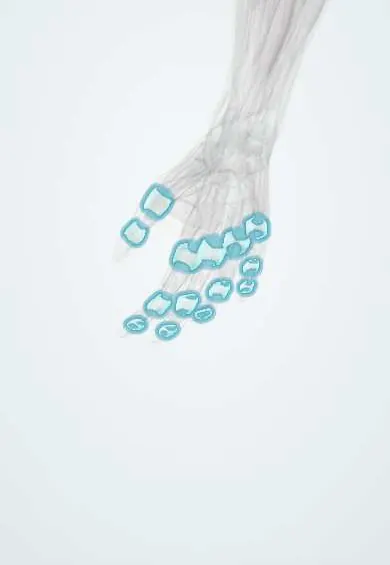
Mixed connective tissue disease !
An overlap autoimmune disease with features of lupus, scleroderma and myositis, marked by Raynaud, puffy hands and anti-U1-RNP antibodies.
Updated 2026-11-01
Structures involved
Tap one to see what it is and open it in 3D.
Why it happens
- Skin blood flow
- The pulmonary circulation and hypoxic vasoconstriction
- Blood vessels: artery, vein and capillary layers
What it is
An overlap syndrome that combines features of systemic lupus erythematosus, systemic sclerosis and polymyositis, defined by high titres of anti-U1 ribonucleoprotein (U1-RNP) antibodies. Raynaud phenomenon and puffy, swollen hands are typical early signs; pulmonary hypertension is the leading cause of death.
Who gets it
Uncommon, with a few cases per 100,000 adults. About three quarters of patients are women, with onset usually in the 30s. It is diagnosed in Colombia and Latin America in the same way as elsewhere, and some patients later evolve into a defined disease such as lupus or systemic sclerosis.
Causes
- Autoimmune disease with antibodies against U1-RNP
- Genetic susceptibility (HLA-DR4 and HLA-DR2)
- Environmental triggers are suspected but not proven
Risk factors
- Female sex
- Age 20 to 40 years
- Family history of autoimmune disease
Pathophysiology
Anti-U1-RNP antibodies and autoreactive T cells drive inflammation and an obliterative vasculopathy with intimal proliferation of small arteries. This explains Raynaud phenomenon, pulmonary arterial hypertension and digital ischaemia, while inflammatory features resemble lupus (arthritis, serositis) and myositis, and fibrotic features resemble scleroderma (sclerodactyly, oesophageal dysmotility, interstitial lung disease).
Symptoms and signs
- Raynaud phenomenon, often the first symptom
- Puffy, swollen fingers and hands («sausage» fingers) and later sclerodactyly
- Polyarthritis resembling rheumatoid arthritis
- Proximal muscle weakness and pain (myositis)
- Heartburn and difficulty swallowing from oesophageal dysmotility
- Breathlessness on exertion from interstitial lung disease or pulmonary hypertension
Diagnosis
- Clinical
- Suspected in a patient with Raynaud phenomenon and swollen hands plus overlapping features of lupus, scleroderma and myositis. Several classification criteria (Alarcón-Segovia, Kasukawa, Sharp) require high-titre anti-U1-RNP plus a set of clinical features.
- Tests
- ANA with a speckled pattern at high titre and high-titre anti-U1-RNP; usually negative anti-dsDNA and anti-Sm; creatine kinase for myositis; blood count, ESR and CRP; pulmonary function tests with DLCO; NT-proBNP.
- Imaging
- High-resolution chest CT for interstitial lung disease; echocardiography to screen for pulmonary hypertension, confirmed by right heart catheterisation; barium swallow or manometry for oesophageal dysmotility; nailfold capillaroscopy.
Differential diagnosis
- Systemic lupus erythematosus
- Systemic sclerosis
- Polymyositis and dermatomyositis
- Rheumatoid arthritis
- Undifferentiated connective tissue disease
- Primary Raynaud phenomenon
Goal of treatment
Treat each organ involved, protect the lungs and pulmonary circulation, and keep the hands warm and functional.
Treatment
- Medical
- Mild disease (arthritis, Raynaud, serositis): NSAIDs, hydroxychloroquine and low-dose corticosteroids; calcium channel blockers for Raynaud plus cold avoidance.
- Medical
- Myositis and active inflammatory disease: systemic corticosteroids with steroid-sparing agents such as methotrexate, azathioprine or mycophenolate.
- Medical
- Interstitial lung disease and pulmonary arterial hypertension: immunosuppression (mycophenolate, cyclophosphamide) and pulmonary vasodilators (endothelin receptor antagonists, phosphodiesterase-5 inhibitors); proton pump inhibitors for reflux.
- Follow-up
- Yearly echocardiography and pulmonary function testing to detect pulmonary hypertension and lung disease early; nursing care for skin and digital ulcers, swallowing safety and hand protection.
Complications
- Pulmonary arterial hypertension (main cause of death)
- Interstitial lung disease
- Digital ulcers and gangrene
- Gastro-oesophageal reflux, oesophageal stricture and aspiration
- Evolution into lupus or systemic sclerosis
Prognosis
Many patients have a relatively mild course that responds to treatment, and some remit; however, pulmonary hypertension and lung fibrosis determine long-term survival, so regular screening is essential.
Test yourself
Think of the answer, then tap the question to see it.
Which antibody defines mixed connective tissue disease?
High-titre anti-U1 ribonucleoprotein (anti-U1-RNP).
What are the typical early signs?
Raynaud phenomenon and puffy, swollen hands.
What is the leading cause of death in MCTD?
Pulmonary arterial hypertension.
Which three diseases overlap in MCTD?
Systemic lupus erythematosus, systemic sclerosis and polymyositis.
Related conditions
- Raynaud phenomenon
- Systemic lupus erythematosus
- Systemic sclerosis (scleroderma, including CREST)
- Inflammatory myopathies (dermatomyositis, polymyositis)
- Rheumatoid arthritis
- Pulmonary hypertension and cor pulmonale
- Interstitial lung disease
- Gastro-oesophageal reflux disease (GERD)
- Acute pericarditis
- Sjögren disease
- Trigeminal neuralgia
Educational information, not medical advice. For any symptom, see a health professional.
Sources: Mixed Connective Tissue Disease - Symptoms, Causes, Treatment | NORD (National Organization for Rare Disorders (NORD), 2026).
Spotted a mistake?We are always improving for the community. Tell us what is wrong and our team will review it.Report a mistake
Representative model, for educational purposes only.