Conditions · Systemic conditions
Rheumatoid arthritis !
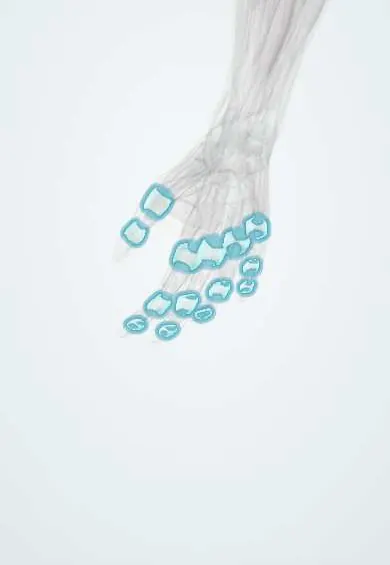
Rheumatoid arthritis is a chronic autoimmune disease that inflames the joint lining, usually the small joints of both hands and feet, and can erode bone.
Updated 2026-10-30
Structures involved
Tap one to see what it is and open it in 3D.
- Finger joint capsules
- Wrist capsule
- Transverse ligament of the atlas
- Toe joint capsules
- Knuckle collateral ligaments
- Volar plates (knuckles)
- Extensor tendons
- Atlas–axis joints
- Axis (C2)
- MTP ligaments and plantar plate
In biochemistry
- C-reactive protein (CRP) as a lab test
- JAK–STAT pathway
- Dihydroorotate dehydrogenase (DHODH)
- Drugs acting on nucleotide metabolism
- Cyclooxygenase (COX-1 and COX-2)
- Dihydrofolate reductase (DHFR)
In immunology
- Type III hypersensitivity (immune complexes)
- Autoantibodies: the table to know
- HLA associations with disease
- Monoclonal antibodies and biologics: naming and targets
- MHC/HLA class I and II
- Cytokines: the table to know
- Interleukin-6
- TNF-α
- Immunofluorescence and the ANA test
In histology
In embryology
In the clinical exam
- Joint examination: inspection, palpation and range of motion
- Hand deformities: Heberden, Bouchard, swan neck, boutonnière
In physiology
Why it happens
- Chronic inflammation: causes, cells and features
- When leukocytes injure tissue: proteases, oxidants and NETs
- Mediators of inflammation: the table to know
- Inflammation: the cardinal signs and its five steps
- Systemic effects of inflammation: fever, acute-phase proteins, leukocytosis, sepsis
- Arachidonic acid metabolites in inflammation, and the drugs that block them
Show 1 more
What it is
A chronic autoimmune inflammatory arthritis that attacks the synovial lining of joints, usually small joints of the hands and feet on both sides. Untreated, it erodes cartilage and bone and can affect other organs.
Who gets it
About two to three times more common in women, with onset most often in middle age. It is one of the most common inflammatory arthritides seen by rheumatologists in Colombia and Latin America. Population surveys found a prevalence of 1.6% in five Mexican regions (0.7% in Nuevo León to 2.8% in Yucatán) and 0.94% in Luján, Argentina.
Causes
- Genetic susceptibility, notably HLA-DRB1 shared-epitope alleles
- Smoking (promotes citrullination and anti-CCP antibodies)
- Possible links with periodontal disease and gut microbiota
- Female hormones
Risk factors
- Female sex
- Middle age
- Family history
- Smoking
- Obesity
Pathophysiology
Loss of tolerance to citrullinated proteins produces anti-CCP antibodies and rheumatoid factor. T cells, B cells and macrophages infiltrate the synovium and release cytokines such as TNF and IL-6. The synovium thickens into an invasive pannus that erodes cartilage and bone at the joint margins and stretches ligaments, causing deformities.
Classification
- 2010 ACR/EULAR classification criteria: joint count, serology (RF, anti-CCP), acute-phase reactants and symptom duration of six weeks or more
- Seropositive or seronegative
- Early or established disease
Symptoms and signs
- Symmetric pain and swelling of MCP, PIP, wrist and MTP joints, usually sparing the DIP joints
- Morning stiffness lasting more than an hour that improves with use
- Fatigue, low-grade fever and weight loss
- Boggy (soft) synovial swelling and a positive squeeze test
- Late deformities: ulnar deviation of the fingers, swan-neck and boutonnière deformities, Z-thumb
- Rheumatoid nodules over pressure areas such as the elbow
Diagnosis
- Clinical
- Inflammatory symptoms in several small joints for weeks, with synovitis on examination. Early referral matters because treatment in the first months gives better results.
- Tests
- Rheumatoid factor and anti-CCP (the most specific), ESR and CRP, blood count, kidney and liver function before treatment; screening for hepatitis B and C and latent tuberculosis before biologics.
- Imaging
- Hand and foot X-rays show periarticular osteopenia, joint-space narrowing and marginal erosions; ultrasound and MRI detect early synovitis. Cervical spine X-rays with flexion views before surgery or when symptomatic.
Differential diagnosis
- Osteoarthritis (DIP involvement, bony nodes, short stiffness)
- Psoriatic arthritis
- Systemic lupus erythematosus
- Gout or calcium pyrophosphate arthritis (polyarticular forms)
- Viral arthritis (chikungunya, parvovirus, hepatitis)
- Polymyalgia rheumatica
Goal of treatment
Reach remission or low disease activity quickly (treat to target), prevent erosions and deformities, preserve function and reduce cardiovascular and other long-term risks.
Treatment
- Medical
- Disease-modifying antirheumatic drugs (DMARDs) started early: a conventional synthetic DMARD first, adjusted every few months to reach the target.
- Medical
- Biologic DMARDs (for example TNF, IL-6 or B-cell inhibitors) or targeted synthetic DMARDs (JAK inhibitors) when targets are not reached.
- Medical
- Short courses of glucocorticoids and NSAIDs to control symptoms while DMARDs take effect.
- Rehabilitation
- Physiotherapy and occupational therapy: exercise, joint protection and splints.
- Surgical
- Synovectomy, tendon repair, joint fusion or replacement for damaged joints.
- Follow-up
- Regular disease activity scores and lab checks for drug toxicity.
Drugs for this condition
- Ibuprofen
- Celecoxib
- Indometacin
- Diclofenac
- Naproxen
- Meloxicam
- Piroxicam
- Dexamethasone
- Prednisone
- Prednisolone
- Triamcinolone
- Sulfasalazine
- Methotrexate
- Ciclosporin
- Azathioprine
- Hydroxychloroquine
- Leflunomide
- Adalimumab
- Infliximab
- Etanercept
- Certolizumab pegol
- Golimumab
- Anakinra
- Tocilizumab
- Tofacitinib
- Baricitinib
- Abatacept
Complications
- Joint destruction and deformities with disability
- Atlantoaxial subluxation and cervical myelopathy
- Interstitial lung disease and pleural effusions
- Cardiovascular disease (higher risk)
- Osteoporosis
- Infections related to immunosuppression
- Anaemia of chronic disease, Felty syndrome, secondary amyloidosis
Prognosis
Early treat-to-target therapy allows many patients to reach remission and avoid deformities. Seropositivity (especially anti-CCP), early erosions and high inflammation predict more aggressive disease.
Prevention
- Not smoking
- Early recognition of inflammatory arthritis and prompt referral
- Vaccination and bone and heart risk control in those already affected
Test yourself
Think of the answer, then tap the question to see it.
Which joints are typically involved in rheumatoid arthritis, and which are spared?
Symmetric MCP, PIP, wrist and MTP joints; the DIP joints are usually spared (unlike osteoarthritis and psoriatic arthritis).
Which antibody is the most specific for rheumatoid arthritis?
Anti-CCP (anti-citrullinated protein antibody); rheumatoid factor is less specific and also appears in other diseases and in older people.
What are swan-neck and boutonnière deformities?
Swan neck: PIP hyperextension with DIP flexion. Boutonnière: PIP flexion with DIP hyperextension, from a damaged central slip of the extensor.
Why do patients with RA need cervical spine assessment before intubation?
Synovitis can loosen the transverse ligament of the atlas, causing atlantoaxial instability; neck extension may compress the spinal cord.
What is the treatment strategy called that adjusts DMARDs until remission is reached?
Treat to target: early DMARDs, frequent measurement of disease activity and escalation until remission or low activity is achieved.
Related conditions
- Systemic lupus erythematosus
- Osteoporosis
- Gout
- Temporomandibular disorder
- Hallux valgus (bunion)
- Tarsal tunnel syndrome
- Flatfoot (pes planus)
- Ankylosing spondylitis
Educational information, not medical advice. For any symptom, see a health professional.
Sources: Rheumatoid Arthritis (StatPearls (NCBI Bookshelf), 2023); Burden of illness of rheumatoid arthritis in Latin America: a regional perspective (Clinical rheumatology, 2015) · adapted, CC BY 4.0.
Spotted a mistake?We are always improving for the community. Tell us what is wrong and our team will review it.Report a mistake
Representative model, for educational purposes only.