Conditions · Metabolism (biochemistry)
Sandhoff disease !
Sandhoff disease is an inherited GM2 gangliosidosis: both hexosaminidases fail, and stored GM2 slowly destroys neurons in the brain and spinal cord.
Updated 2026-11-01
Structures involved
Tap one to see what it is and open it in 3D.
In biochemistry
- Lysosomal storage diseases
- Hexosaminidase A (β-hexosaminidase A)
- Hexosaminidase B (β-hexosaminidase B)
What it is
An autosomal recessive lysosomal storage disease caused by HEXB variants that remove the shared β subunit of β-hexosaminidase A and B; GM2 ganglioside builds up in neurons.
Who gets it
Rare everywhere. It appears more often in the Creole population of northern Argentina, among the Métis of Saskatchewan (Canada) and in Lebanon. No Colombian frequency has been published in the sources consulted.
Causes
- Variants in both copies of the HEXB gene (chromosome 5)
Risk factors
- Both parents carriers of a HEXB variant
- Consanguinity
- Belonging to a community with a founder variant, such as the Creole population of northern Argentina
Pathophysiology
The β subunit coded by HEXB is part of hexosaminidase A (αβ) and hexosaminidase B (ββ). Without it, hexosaminidase A cannot remove N-acetylgalactosamine from GM2 ganglioside, which fills neuronal lysosomes and kills the cells; the loss of hexosaminidase B also leaves globoside and oligosaccharides stored in organs. Residual activity sets the age of onset.
Classification
- Infantile (most common and severe): onset at 3–6 months
- Juvenile: onset between 2 and 10 years
- Adult: movement and psychiatric problems
Symptoms and signs
- Normal development until 3–6 months, then slowing and weakness
- Loss of rolling over, sitting and crawling
- Exaggerated startle to loud noise
- Seizures, vision and hearing loss
- Cherry-red spot on eye examination
- Sometimes enlarged liver and spleen or bone changes
- Juvenile form: speech difficulty, ataxia, dementia
Diagnosis
- Clinical
- Infant with regression, exaggerated startle and a cherry-red spot; enlarged organs favour Sandhoff over Tay–Sachs.
- Tests
- Total hexosaminidase and hexosaminidase B both low in serum or leukocytes (in Tay–Sachs only A is low); oligosaccharides in urine; HEXB gene testing; carrier testing of parents.
- Imaging
- Brain MRI with signal changes in the thalami and white matter and, later, atrophy; ultrasound may show an enlarged liver and spleen.
Treatment
- Medical
- No approved disease-specific therapy; seizures, spasticity and secretions are treated symptomatically.
- Procedure
- Feeding by gastrostomy when swallowing becomes unsafe.
- Rehabilitation
- Physiotherapy and positioning to prevent contractures and aid comfort.
- Conservative
- Palliative care and family support; gene therapy and substrate reduction are being studied in trials.
Complications
- Aspiration pneumonia
- Drug-resistant seizures
- Blindness and deafness
- Loss of all voluntary movement
Prognosis
In the infantile form children usually live only into early childhood. Juvenile and adult forms progress more slowly.
Prevention
- Genetic counselling for families with an affected child (25% recurrence risk per pregnancy)
- Carrier testing in relatives and prenatal or preimplantation diagnosis
Test yourself
Think of the answer, then tap the question to see it.
Which gene is altered in Sandhoff disease, and which enzymes fail?
HEXB; it codes the β subunit shared by hexosaminidase A and B, so both enzymes fail.
How do Sandhoff and Tay–Sachs differ in the enzyme assay?
In Tay–Sachs only hexosaminidase A is low; in Sandhoff both A and B are low.
What eye finding is typical of infantile Sandhoff disease?
A cherry-red spot: the pale, lipid-laden retina around the fovea makes the normal red centre stand out.
Why can Sandhoff disease, unlike Tay–Sachs, enlarge the liver and spleen?
Losing hexosaminidase B also leaves globoside and oligosaccharides stored in organs, not only GM2 in neurons.
Related conditions
- GM2 activator deficiency (GM2 gangliosidosis, AB variant)
- Tay–Sachs disease
- GM1 gangliosidosis
- Epilepsy and seizures
Educational information, not medical advice. For any symptom, see a health professional.
Sources: Sandhoff disease: MedlinePlus Genetics (MedlinePlus, US National Library of Medicine, 2026); HEXB gene: MedlinePlus Genetics (MedlinePlus, US National Library of Medicine, 2026); Textbook of Biochemistry for Medical Students, 6th ed. (Jaypee Brothers Medical Publishers (Vasudevan DM, Sreekumari S, Vaidyanathan K), 2011).
Spotted a mistake?We are always improving for the community. Tell us what is wrong and our team will review it.Report a mistake
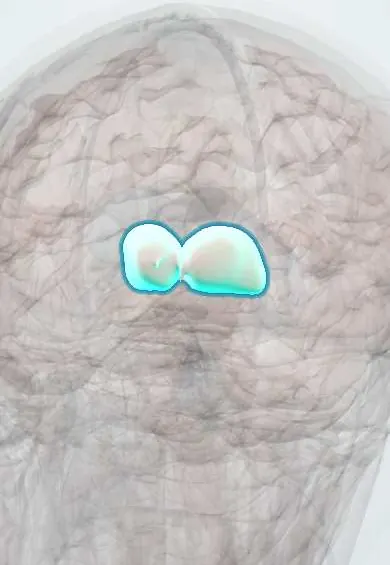
Representative model, for educational purposes only.