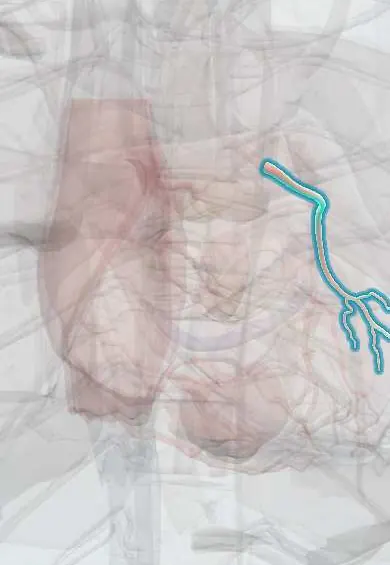
Circumflex artery !
The circumflex artery is a branch of the left coronary artery that curves around the left side of the heart to feed its side and back walls.
Official name: Circumflex artery of heart
Opens in the Durgical app, no sign-up needed.
What it is
The branch of the left coronary artery that curves around the left side of the heart in the groove between atrium and ventricle.
What it does
Feeds the side and back of the left ventricle through its marginal branches.
Key facts
- Origin
- Left main coronary artery; runs in left coronary (atrioventricular) groove
- Branches
- Obtuse marginal (left marginal) branches; atrial branches; SA nodal artery in ~40%; PDA in left-dominant hearts (~10%)
- Supplies
- Lateral and posterior LV wall; left atrium
Relations
- Course
- From the left main coronary artery it turns left under the left auricle and runs in the left coronary (atrioventricular) groove round the obtuse margin toward the crux
- Above
- Left atrium and left auricle
- Below
- Base of the left ventricle, onto which its obtuse marginal branches descend
- Superficial
- Great cardiac vein, and then the coronary sinus, which run with it in the groove
- Deep
- Mitral valve annulus, which lies close to it inside the atrioventricular groove
How to find it
Hard to see at surgery: it runs in the left part of the coronary (atrioventricular) groove, under the left auricle and then around the back of the heart, covered by fat and by the great cardiac vein. Its obtuse marginal branches are reached on the lateral wall by lifting the heart up and to the right.
On imaging
On coronary angiography it is best seen in the right and left anterior oblique caudal views, with the obtuse marginal branches spreading over the lateral wall. CT coronary angiography shows its relation to the mitral annulus and the coronary sinus.
Common problems
- Coronary artery disease: fatty plaque narrows them, causing chest pain on exertion (angina).
- Heart attack: a plaque breaks open and a clot suddenly blocks the artery.
How it is diagnosed
ECG and troponin for a heart attack; stress test, CT coronary angiography or a catheter angiogram to see narrowings.
Treatment
- Medicines (aspirin, statins, blood-pressure control) and stopping smoking.
- Angioplasty and stent through a catheter.
- Bypass surgery (CABG) for several or complex blockages.
Clinical notes
- Mitral valve surgery and ablation near the mitral annulus can injure it, because it runs in the groove right next to the annulus
- Obtuse marginal branches are frequent targets for bypass grafts and stents
Anatomical variants
- Anomalous origin from the right aortic sinus or the right coronary artery, passing behind the aorta: the commonest coronary anomaly and usually harmless
- In left-dominant hearts it is large and reaches the crux; in right-dominant hearts it may end short, at the obtuse margin
Related conditions
Test yourself
Think of the answer, then tap the question to see it.
Why is circumflex artery occlusion called an «electrically silent» infarct?
The standard 12 leads see the posterolateral wall it supplies poorly.
How does a posterior myocardial infarction show on the standard ECG?
As a mirror image in V1–V3: ST depression with tall R waves; posterior leads V7–V9 confirm it.
In a left-dominant heart, why can circumflex occlusion cause an inferior infarct with AV block?
The circumflex then gives the posterior descending artery and the AV nodal artery.
Why can mitral valve surgery injure the circumflex artery?
It runs in the left atrioventricular groove right next to the mitral annulus.
Educational information, not medical advice. For any symptom, see a health professional.
Its names
- Official Latin (TA2)
- arteria circumflexa cordis TA2 4148
- Official Spanish (DeCS)
- Arteria circunfleja del corazón DeCS D003331
- English (TA2)
- Circumflex artery of heart
- Also called
- circumflex branch of left coronary artery · LCx
Related
Sources: Terminologia Anatomica (TA2); DeCS; Anatomy, Thorax, Heart; Anatomy, Thorax, Sinoatrial Nodal Artery; 19.1 Heart Anatomy (OpenStax (Rice University), 2022) · adapted, CC BY 4.0.
Spotted a mistake?We are always improving for the community. Tell us what is wrong and our team will review it.Report a mistake
Representative model, for educational purposes only.