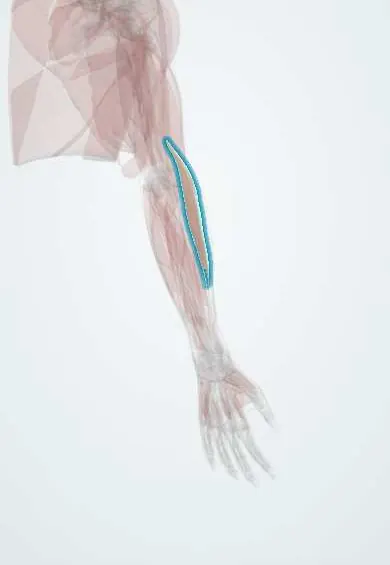
ECRL !
The extensor carpi radialis longus runs along the thumb side of the back of the forearm; it lifts the wrist and tilts it toward the thumb.
Official name: Extensor carpi radialis longus
Opens in the Durgical app, no sign-up needed.
What it is
A wrist extensor on the thumb side, to the base of the index metacarpal.
What it does
Lifts the wrist and tilts it toward the thumb.
Key facts
- Origin
- Lateral supracondylar ridge
- Insertion
- Dorsal base of the 2nd metacarpal
- Action
- Extends and radially deviates the wrist
- Nerve
- Radial nerve (C6–C7)
- Blood supply
- Radial artery, radial recurrent artery
Relations
- In front
- Brachioradialis, which overlaps it in the upper forearm
- Deep
- Extensor carpi radialis brevis (ECRB), then supinator and the radius
- Superficial
- In the distal forearm the abductor pollicis longus (APL) and extensor pollicis brevis (EPB) cross obliquely over its tendon
- Course
- Its tendon passes under the extensor retinaculum in the second compartment, radial to Lister's tubercle, is crossed by the extensor pollicis longus (EPL) and inserts on the dorsal base of the index metacarpal
How to find it
Clenching a fist with the wrist extended makes the two radial extensor tendons stand out on the back of the wrist; ECRL is the more radial, heading to the base of the index metacarpal.
Examination
- Resisted wrist extension with radial deviation: weakness means a radial nerve lesion above the elbow; in PIN palsy it stays strong
On imaging
Ultrasound shows ECRL and ECRB side by side in the second extensor compartment, radial to Lister's tubercle. Intersection syndrome shows as fluid and oedema where the APL and EPB bellies cross them, a few centimetres above the wrist; MRI shows the same oedema. Radiographs are normal. Its origin on the supracondylar ridge lies just above the common extensor origin.
Clinical notes
- Intersection syndrome: pain, swelling and sometimes squeaking crepitus where APL and EPB cross the radial wrist extensors, seen in rowers and weightlifters
- Carpal boss: a bony bump at the bases of the 2nd and 3rd metacarpals near the ECRL and ECRB insertions, easily mistaken for a ganglion
- Used as a donor in some transfers for tetraplegia and intrinsic reconstruction
Anatomical variants
- Accessory bellies or doubled tendons, and cross-slips with ECRB, are common in dissection
Related conditions
Test yourself
Think of the answer, then tap the question to see it.
Where does the ECRL (extensor carpi radialis longus) insert, and in which compartment does it run?
On the dorsal base of the 2nd (index) metacarpal; in the second compartment with ECRB, radial to Lister's tubercle.
Why does the wrist still extend, but drift toward the thumb, in posterior interosseous nerve palsy?
The ECRL is supplied by the radial nerve above its division, so it keeps working while the extensors supplied by the posterior interosseous nerve are lost.
What is intersection syndrome?
Pain, swelling and sometimes crepitus a few centimetres above the wrist, where APL and EPB cross over the ECRL and ECRB; seen in rowers and weightlifters.
Educational information, not medical advice. For any symptom, see a health professional.
Its names
- Official Latin (TA2)
- extensor radialis longus carpi TA2 2497
- Official Spanish (DeCS)
- Músculo extensor radial largo del carpo
- English (TA2)
- Extensor carpi radialis longus
Related
Sources: Terminologia Anatomica (TA2); Anatomy, Shoulder and Upper Limb, Wrist Extensor Muscles.
Spotted a mistake?We are always improving for the community. Tell us what is wrong and our team will review it.Report a mistake
Representative model, for educational purposes only.