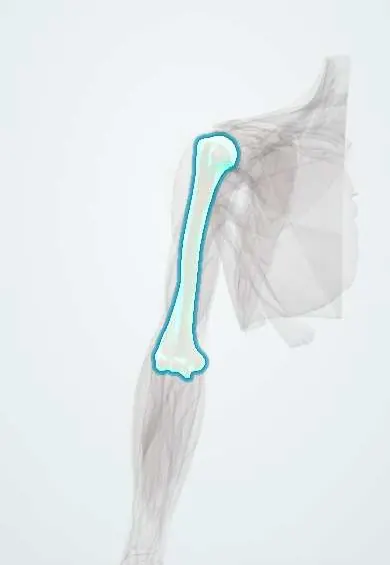
Humeral shaft fracture !
A humeral shaft fracture is a break of the middle part of the upper arm bone; it can injure the radial nerve and cause wrist drop.
Updated 2026-10-29
Structures involved
Tap one to see what it is and open it in 3D.
- Humerus
- Radial nerve
- Deep brachial artery
- Brachial artery
- Triceps (lateral head)
- Brachialis
- ECRL
- Extensor digitorum
In histology
Why it happens
What it is
A fracture of the shaft (diaphysis) of the humerus, between the surgical neck and the area just above the elbow. It is known for its association with radial nerve palsy.
Who gets it
Has two peaks: young adults after high-energy trauma, and older adults after simple falls. Traffic accidents, including motorcycle crashes common in Colombia, are a frequent cause in the young.
Causes
- Direct blow to the arm or traffic accident
- Fall onto an outstretched hand or the elbow in older people
- Twisting force (for example arm wrestling or throwing) causing a spiral fracture
- Pathological fracture through a tumour or metastasis
Risk factors
- Motorcycle and road traffic accidents
- Osteoporosis and falls in older age
- Bone metastases or primary bone lesions
- Contact sports
Pathophysiology
The radial nerve runs in the spiral (radial) groove on the back of the mid-humerus and pierces the lateral intermuscular septum in the distal third, where it is held close to bone. Fractures here can stretch or trap it. Most of these palsies are neurapraxia and recover. Muscle pull by the deltoid and pectoralis major determines fragment displacement.
Classification
- By site: proximal, middle or distal third
- By pattern: transverse, oblique, spiral, comminuted
- Holstein-Lewis fracture: spiral fracture of the distal third, classically linked to radial nerve palsy
- Open or closed; AO/OTA classification
Symptoms and signs
- Pain, swelling and deformity of the arm
- Abnormal movement or crepitus in the mid-arm
- Wrist drop and inability to extend the fingers at the knuckles if the radial nerve is injured
- Numbness over the back of the hand between the thumb and index finger
Diagnosis
- Clinical
- Deformity and abnormal mobility of the arm. Clinicians document radial nerve function before and after any manoeuvre: wrist and finger extension at the knuckles, thumb extension, and sensation on the dorsal first web space.
- Tests
- Nerve conduction studies and electromyography if a radial nerve palsy does not recover over the expected weeks to months.
- Imaging
- X-rays of the whole humerus in two planes, including the shoulder and elbow. CT if the fracture extends into a joint; ultrasound can assess the radial nerve.
Differential diagnosis
- Proximal humerus fracture
- Supracondylar or distal humerus fracture
- Pathological fracture
- Elbow dislocation
Goal of treatment
Achieve union with acceptable alignment, preserve shoulder and elbow movement, and protect or recover radial nerve function.
Treatment
- Conservative
- Most closed fractures heal in a coaptation splint followed by a functional brace, because the humerus tolerates some angulation and shortening.
- Surgical
- Surgery (plate fixation or intramedullary nail) for open fractures, vascular injury, polytrauma, unacceptable alignment, floating elbow, failed bracing or some pathological fractures.
- Follow-up
- Radial nerve palsy present at injury is usually observed with a wrist splint; exploration is considered when there is no recovery, in open fractures, or if it appears after reduction (practices vary).
- Rehabilitation
- Early shoulder and elbow exercises in the brace; later strengthening.
Complications
- Radial nerve palsy
- Non-union
- Malunion (usually well tolerated)
- Shoulder or elbow stiffness
- Brachial artery injury (uncommon)
Prognosis
Most shaft fractures unite with good function. Most radial nerve palsies linked to closed fractures recover spontaneously over several months.
Prevention
- Road safety and protective gear on motorcycles
- Fall prevention and osteoporosis treatment in older adults
Test yourself
Think of the answer, then tap the question to see it.
Which nerve is classically injured in a humeral shaft fracture, and what deficit does it cause?
The radial nerve in the spiral groove; it causes wrist drop, loss of finger extension at the knuckles and numbness on the dorsal first web space.
What is a Holstein-Lewis fracture?
A spiral fracture of the distal third of the humeral shaft, classically associated with radial nerve palsy.
What is the usual initial treatment of a closed humeral shaft fracture?
A coaptation splint followed by a functional brace; most heal without surgery.
Do most radial nerve palsies with closed humeral shaft fractures recover?
Yes. Most are neurapraxia and recover over months, so they are usually observed first.
Related conditions
- Proximal humerus fracture
- Supracondylar humerus fracture
- Acute compartment syndrome
- Osteoporosis
- Volkmann ischaemic contracture
- Elbow dislocation
Educational information, not medical advice. For any symptom, see a health professional.
Sources: Humeral Shaft Fractures (StatPearls (NCBI Bookshelf), 2023).
Spotted a mistake?We are always improving for the community. Tell us what is wrong and our team will review it.Report a mistake
Representative model, for educational purposes only.