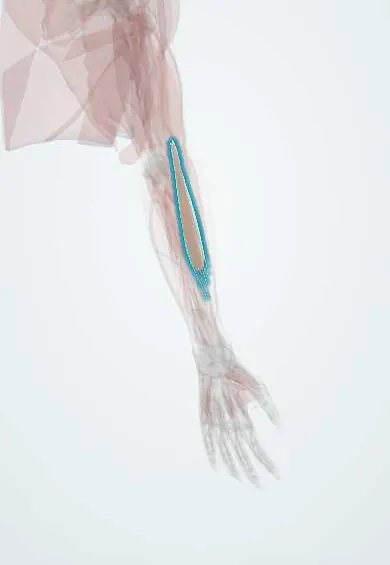
Lateral epicondylitis (tennis elbow) !
Tennis elbow (lateral epicondylitis) is wear of the tendon that anchors the wrist extensors to the outer elbow; it causes pain when gripping or lifting.
Updated 2026-10-29
Structures involved
Tap one to see what it is and open it in 3D.
Why it happens
What it is
A painful tendinopathy of the common extensor origin at the lateral epicondyle of the humerus, mainly the extensor carpi radialis brevis. Despite the name, it is a degenerative rather than an inflammatory process.
Who gets it
Most common between about 35 and 55 years. Far more cases are linked to manual work and repetitive gripping than to tennis.
Causes
- Repetitive wrist extension and forearm supination, especially with gripping
- Overuse in racquet sports with poor technique
- Occasionally a direct blow
Risk factors
- Manual and repetitive work (tools, keyboards, construction)
- Racquet sports
- Smoking
- Obesity
- Age 35 to 55
Pathophysiology
Repeated microtears at the origin of the extensor carpi radialis brevis fail to heal properly. The tendon shows angiofibroblastic degeneration: disorganised collagen, new vessels and few inflammatory cells, which is why it is called a tendinosis.
Symptoms and signs
- Pain over the lateral elbow, spreading into the forearm
- Pain with gripping, lifting with the palm down or turning handles
- Tenderness just distal and anterior to the lateral epicondyle
- Weak grip because of pain
Diagnosis
- Clinical
- Point tenderness at the extensor origin. Cozen test (pain at the lateral epicondyle on resisted wrist extension with the forearm pronated and the fist closed), Mill test and pain on resisted middle-finger extension.
- Tests
- Not usually needed.
- Imaging
- Diagnosis is clinical. Ultrasound or MRI can show tendon degeneration or tears in persistent cases; X-ray to exclude other causes.
Differential diagnosis
- Radial tunnel syndrome (posterior interosseous nerve)
- Cervical radiculopathy (C6–C7)
- Radiocapitellar osteoarthritis or osteochondritis
- Posterolateral rotatory instability
- Synovial plica of the elbow
Goal of treatment
Reduce pain and restore grip and function while the tendon remodels; most cases settle without surgery.
Treatment
- Conservative
- Activity modification, rest from provoking tasks and a counterforce brace or wrist splint.
- Medical
- Topical or oral NSAIDs for short-term relief. Corticosteroid injection eases pain in the short term but is linked to more recurrence; platelet-rich plasma is used in some centres with mixed evidence.
- Rehabilitation
- Physiotherapy with progressive eccentric and isometric loading of the wrist extensors.
- Surgical
- Debridement or release of the extensor carpi radialis brevis origin (open or arthroscopic) for symptoms persisting despite many months of conservative care.
Complications
- Chronic pain
- Recurrence
- Skin and fat atrophy after repeated steroid injections
- Rarely, lateral ligament injury from surgery or repeated injections
Prognosis
Self-limiting in most patients, usually improving over about a year with conservative care. A small proportion needs surgery.
Prevention
- Ergonomic tools and grips
- Proper racquet technique and equipment
- Forearm strengthening
Test yourself
Think of the answer, then tap the question to see it.
Which tendon origin is mainly involved in lateral epicondylitis?
The extensor carpi radialis brevis at the common extensor origin on the lateral epicondyle.
What is the Cozen test?
With the elbow extended, forearm pronated and fist closed, the patient extends the wrist against resistance; pain at the lateral epicondyle is positive.
Is lateral epicondylitis mainly an inflammatory condition?
No; histology shows degenerative tendinosis with disorganised collagen and few inflammatory cells.
Which nerve entrapment is an important differential diagnosis of tennis elbow?
Radial tunnel syndrome, compression of the posterior interosseous nerve near the supinator.
Related conditions
Educational information, not medical advice. For any symptom, see a health professional.
Sources: Lateral Epicondylitis (Tennis Elbow) (StatPearls (NCBI Bookshelf), 2023).
Spotted a mistake?We are always improving for the community. Tell us what is wrong and our team will review it.Report a mistake
Representative model, for educational purposes only.