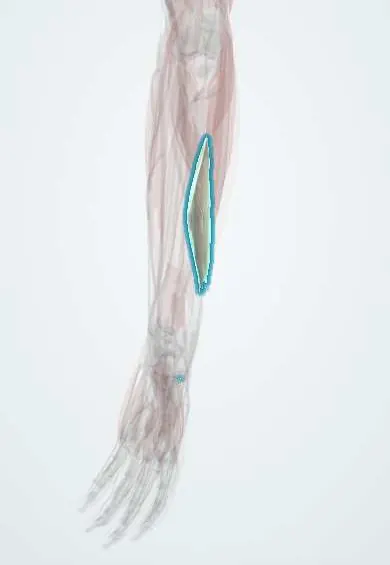
APL !
The abductor pollicis longus is a deep forearm muscle whose tendon reaches the thumb base; it moves the thumb away from the palm and steadies its base.
Official name: Abductor pollicis longus
Opens in the Durgical app, no sign-up needed.
What it is
A deep forearm muscle whose tendon goes to the base of the thumb.
What it does
Moves the thumb away from the palm and steadies its base.
Key facts
- Origin
- Posterior ulna, radius and interosseous membrane
- Insertion
- Base of the 1st metacarpal
- Action
- Abducts and extends the thumb at the CMC joint
- Nerve
- Posterior interosseous nerve (C7–C8)
- Blood supply
- Posterior interosseous artery
Relations
- Course
- Emerges from the deep extensor layer below the supinator, crosses obliquely over the radial wrist extensors and the brachioradialis tendon, passes over the radial styloid in the first compartment and reaches the base of the 1st metacarpal
- Deep
- ECRL and ECRB in the distal forearm, then the radial styloid; at the base of the thumb, the radial artery
- Superficial
- Branches of the superficial radial nerve, which cross the first compartment and are at risk when it is released
- Behind
- Extensor pollicis brevis (EPB), which runs alongside on its dorsal side
How to find it
With the thumb pulled out to the side and up, it is the most palmar tendon at the base of the thumb, felt over the radial styloid and forming the front edge of the anatomical snuffbox together with EPB.
Examination
- Finkelstein test (in practice usually Eichhoff's version: thumb tucked in the fist, wrist tilted toward the little finger): sharp pain over the radial styloid supports De Quervain tenosynovitis
- Resisted thumb abduction and extension reproducing pain over the first compartment supports the same diagnosis
On imaging
Ultrasound first for de Quervain tenosynovitis: the APL and EPB tendons in the first extensor compartment over the radial styloid look thick, with sheath fluid. It often shows several APL slips and sometimes a septum splitting the compartment, which matters for injection and surgery. Radiographs exclude thumb-base causes such as trapeziometacarpal arthritis.
Clinical notes
- De Quervain release opens the first compartment; missed APL slips or a separate EPB subcompartment are causes of persisting pain
- Intersection syndrome: crepitus and swelling where APL and EPB cross the radial wrist extensors, a few centimetres above Lister's tubercle
- A slip of APL is used in suspension arthroplasty for thumb CMC arthritis
Anatomical variants
- Multiple tendon slips are the rule rather than the exception; extra slips may insert on the trapezium, the thenar muscles or the joint capsule
Related conditions
Test yourself
Think of the answer, then tap the question to see it.
Which tendons share the first extensor compartment, and what condition affects it?
The APL (abductor pollicis longus) and EPB; de Quervain tenosynovitis.
Which border of the anatomical snuffbox does the APL form?
The palmar (radial) border, with the EPB; the radial artery passes deep to both tendons into the snuffbox.
How does the APL displace a Bennett fracture?
It pulls the thumb metacarpal shaft proximally and radially, while a small palmar-ulnar fragment stays attached by ligament.
Educational information, not medical advice. For any symptom, see a health professional.
Its names
- Official Latin (TA2)
- abductor longus pollicis TA2 2517
- Official Spanish (DeCS)
- Músculo abductor largo del pulgar
- English (TA2)
- Abductor pollicis longus
Related
Sources: Terminologia Anatomica (TA2); Anatomy, Shoulder and Upper Limb: Hand Anatomical Snuff Box; Anatomy, Shoulder and Upper Limb, Wrist Extensor Muscles.
Spotted a mistake?We are always improving for the community. Tell us what is wrong and our team will review it.Report a mistake
Representative model, for educational purposes only.