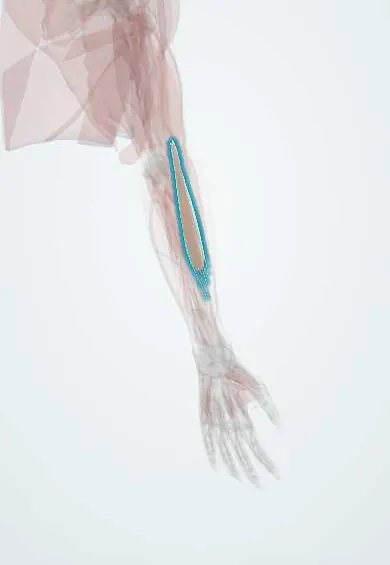
ECRB !
The extensor carpi radialis brevis lifts the wrist; it starts at the outer elbow, and its origin is where tennis elbow usually begins.
Official name: Extensor carpi radialis brevis
Opens in the Durgical app, no sign-up needed.
What it is
A wrist extensor from the outer elbow to the base of the middle-finger metacarpal; the usual site of tennis elbow.
What it does
Lifts the wrist; its origin is where tennis elbow usually starts.
Key facts
- Origin
- Lateral epicondyle (common extensor tendon)
- Insertion
- Dorsal base of the 3rd metacarpal
- Action
- Extends and radially deviates the wrist
- Nerve
- Deep branch of the radial nerve (C7–C8)
- Blood supply
- Radial artery
Relations
- Superficial
- Extensor carpi radialis longus (ECRL) and brachioradialis
- Medial
- Extensor digitorum, which shares the common extensor tendon
- Deep
- Supinator, with the posterior interosseous nerve entering it; at the elbow, the radial head, annular ligament and radial collateral ligament
- Course
- Its tendon runs in the second extensor compartment on the ulnar side of ECRL, close to Lister's tubercle, to the dorsal base of the 3rd metacarpal
How to find it
On the back of the wrist it is the more ulnar of the two radial extensor tendons, heading to the base of the middle-finger metacarpal; at the elbow its origin lies just in front of and below the lateral epicondyle.
Examination
- Cozen test: resisted wrist extension with the elbow straight and forearm pronated; pain at the lateral epicondyle supports lateral epicondylitis
- Mill test: passive wrist flexion with the elbow straight and forearm pronated stretches the origin; pain there is a positive result
- Maudsley test: resisted extension of the middle finger reproducing lateral epicondyle pain
On imaging
Its origin forms most of the deep common extensor tendon at the lateral epicondyle, the site of tennis elbow (lateral epicondylitis). Ultrasound shows a thick, hypoechoic origin, at times with tears, calcification or Doppler flow. MRI shows high tendon signal and is used for suspected tears or cases that fail to improve. Radiographs are usually normal.
Common problems
- Tennis elbow (lateral epicondylitis): wear of the tendon, mostly the ECRB part, from repeated gripping and wrist lifting.
- Pain on the outer elbow when gripping, lifting a cup or shaking hands; common in people aged 35-55, not only tennis players.
How it is diagnosed
Tenderness on the outer elbow bump and pain when lifting the wrist or middle finger against resistance. Ultrasound or MRI if unclear.
Treatment
- Activity changes, a forearm strap, and stretching and strengthening exercises; most cases settle within a year.
- Injections are sometimes used; steroid injections give short-term relief only.
- Surgery to clean out the damaged tendon when months of treatment fail.
Clinical notes
- Surgery for resistant tennis elbow removes the degenerate ECRB origin; going too far back risks the lateral ulnar collateral ligament and posterolateral instability
- Radial tunnel syndrome: pain a few finger-widths below the epicondyle over the supinator, without weakness; it can coexist with or mimic tennis elbow
- Pronator teres to ECRB transfer restores wrist extension in permanent radial nerve palsy
Related conditions
Test yourself
Think of the answer, then tap the question to see it.
Which muscle origin is the usual site of tennis elbow, and why is it hidden at surgery?
The ECRB (extensor carpi radialis brevis); its origin lies under the ECRL on the deep surface of the common extensor tendon.
What are the Cozen and Mill tests?
Elbow straight, forearm pronated: Cozen is resisted wrist extension, Mill is passive wrist flexion; pain at the lateral epicondyle supports lateral epicondylitis.
What is the risk of going too far back when the ECRB origin is debrided for tennis elbow?
Injury to the lateral ulnar collateral ligament and posterolateral instability.
Educational information, not medical advice. For any symptom, see a health professional.
Its names
- Official Latin (TA2)
- extensor radialis brevis carpi TA2 2499
- Official Spanish (DeCS)
- Músculo extensor radial corto del carpo
- English (TA2)
- Extensor carpi radialis brevis
Related
Sources: Terminologia Anatomica (TA2); Anatomy, Shoulder and Upper Limb, Forearm Extensor Carpi Radialis Brevis Muscle; Anatomy, Shoulder and Upper Limb, Wrist Extensor Muscles.
Spotted a mistake?We are always improving for the community. Tell us what is wrong and our team will review it.Report a mistake
Representative model, for educational purposes only.