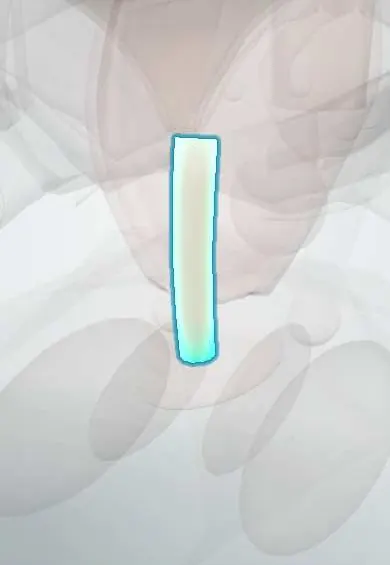
Urinary system · Pelvis · Female
Urethra (female) !
The female urethra is the short tube, about 4 cm, that carries urine from the bladder to the outside; its shortness makes bladder infections common in women.
Official name: Female urethra
Opens in the Durgical app, no sign-up needed.
What it is
A short tube, about 4 cm long, from the bladder to the vestibule, embedded in the front wall of the vagina.
What it does
Carries urine out; its sphincters keep it closed between voids.
Key facts
- Where
- About 4 cm from the bladder neck down and forward, embedded in the anterior vaginal wall, to the external orifice in the vestibule
- Blood supply
- Internal pudendal and vaginal arteries; inferior vesical branches
- Nerve
- Vesical plexus (autonomic); pudendal nerve (external sphincter, sensation)
- Function
- Conveys urine; continence by the internal (smooth) and external (striated) sphincters and the support of the anterior vaginal wall
Relations
- Behind
- The anterior wall of the vagina, to which it is fused along most of its length
- In front
- The pubic symphysis, the pubourethral ligaments and the venous plexus behind the pubis
- Lateral
- The external urethral sphincter and compressor urethrae around its middle third; the medial edges of levator ani beside it
- Course
- From the internal urethral orifice at the bladder neck it runs down and forward through the pelvic floor and the perineal membrane, opening in the vestibule in front of the vaginal orifice
How to find it
The external orifice is seen in the vestibule, between the glans of the clitoris in front and the vaginal orifice behind. After menopause it may sit higher, just inside the vaginal opening, which can make catheterisation harder.
Examination
- Cotton-swab test: a swab in the urethra swings through a large angle on straining, indicating urethral hypermobility
- Pressing along the anterior vaginal wall: pus or fluid from the meatus suggests a urethral diverticulum or infected paraurethral glands
On imaging
Transperineal ultrasound and MRI show the urethra, its sphincter and any diverticulum; MRI is the best test for a diverticulum. Voiding cystourethrography shows it filling during voiding.
Common problems
- Its short length makes bladder infections more common than in men.
- Stress urinary incontinence when its support weakens.
How it is diagnosed
Urine tests; examination with a cough test; urodynamics in some cases.
Treatment
- Pelvic floor training; a mid-urethral sling for stress incontinence.
Clinical notes
- Catheterisation is easier than in the male because it is short and straight, though the meatus can be mistaken for the vaginal orifice
- Urethral injury from trauma is much rarer than in men; when it happens it usually comes with a pelvic fracture and often a vaginal tear
Development
Comes from the urogenital sinus. The paraurethral (Skene) glands that open beside the meatus are the homologue of the prostate.
Related conditions
- Urinary tract infection (acute cystitis)
- Trichomoniasis
- Stress urinary incontinence
- Gonorrhoea
- Chlamydia infection
- Catheter-associated urinary tract infection
- Genitourinary syndrome of menopause (atrophic vaginitis)
Test yourself
Think of the answer, then tap the question to see it.
Why are urinary tract infections more common in women than in men?
The female urethra is short (about 4 cm); sexual activity and falling oestrogen after menopause also raise the risk.
What does a positive cotton-swab test show?
Urethral hypermobility: a swab in the urethra swings through a large angle on straining.
What causes stress incontinence through the female urethra?
Weakening of the support beneath it (the anterior vaginal wall hammock) or of its sphincter, so it leaks as abdominal pressure rises.
Why can catheterisation of the female urethra be harder after menopause?
The meatus may sit higher, just inside the vaginal opening, and can be mistaken for the vaginal orifice.
Educational information, not medical advice. For any symptom, see a health professional.
Its names
- Official Latin (TA2)
- urethra feminina TA2 3426
- Official Spanish (DeCS)
- Uretra femenina DeCS D014521
- English (TA2)
- Female urethra
- Also called
- urethra muliebris
Related
Sources: Terminologia Anatomica (TA2); DeCS; Anatomy, Abdomen and Pelvis, Sphincter Urethrae; Anatomy, Abdomen and Pelvis: Bladder.
Spotted a mistake?We are always improving for the community. Tell us what is wrong and our team will review it.Report a mistake
Representative model, for educational purposes only.