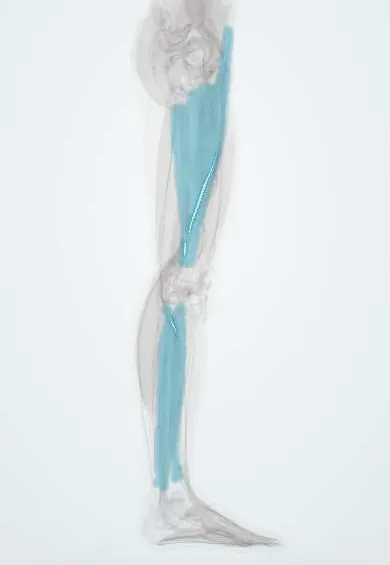
Muscle dividers !
The intermuscular septa are tough sheets that divide the thigh and leg muscles into separate groups, or compartments.
Official name: Lateral femoral intermuscular septum
Opens in the Durgical app, no sign-up needed.
What it is
Sheets separating the muscle groups of the thigh and leg.
What it does
Divide the muscles into compartments.
Key facts
- Where
- Thigh: lateral, medial and posterior septa from fascia lata to linea aspera; leg: anterior and posterior septa to fibula
- Function
- Divide thigh into anterior, medial and posterior compartments, and leg into anterior, lateral and posterior
Relations
- Superficial
- Arise from the deep surface of the fascia lata and the crural fascia
- Deep
- Attach to the linea aspera of the femur in the thigh and to the anterior and posterior borders of the fibula in the leg
- Contents
- Thigh: anterior (quadriceps, sartorius, femoral vessels and nerve), medial (adductors, gracilis, obturator nerve), posterior (hamstrings, sciatic nerve). Leg: anterior (dorsiflexors, deep fibular nerve), lateral (fibularis longus and brevis, superficial fibular nerve), posterior (calf muscles, tibial nerve)
How to find it
Not palpable. The lateral thigh septum lies under the shallow groove between the iliotibial tract and the hamstrings; in the leg, the anterior septum lies under the line between the tibialis anterior and fibularis longus bellies.
On imaging
On axial MRI or CT the septa are thin dark lines from the deep fascia to the femur or fibula. Oedema, haematoma or infection confined between two septa shows which compartment is involved.
Clinical notes
- Lateral approach to the femur: vastus lateralis is lifted off the lateral septum; the perforating branches of the profunda femoris artery pierce it close to the bone and bleed if cut
- Thigh fasciotomy: a lateral incision opens the anterior compartment, then the lateral septum is divided to release the posterior compartment
- Haematoma, infection and tumours tend to stay within the compartment the septa bound, which guides surgical planning
Related conditions
Test yourself
Think of the answer, then tap the question to see it.
Which is the strongest intermuscular septum of the thigh, and which muscles does it separate?
The lateral intermuscular septum: it separates the vastus lateralis from the short head of the biceps femoris.
In a leg fasciotomy, why is the anterior intermuscular septum a key landmark?
It lies between the anterior and lateral compartments; the fascia is opened in front of it and behind it to confirm both compartments are released.
Which vessels pierce the lateral intermuscular septum close to the femur and bleed in a lateral approach?
The perforating branches of the deep femoral (profunda femoris) artery.
Educational information, not medical advice. For any symptom, see a health professional.
Its names
- Official Latin (TA2)
- septum intermusculare laterale femoris; septum intermusculare mediale femoris; septum intermusculare anterius cruris TA2 2691
- Official Spanish (DeCS)
- Tabiques intermusculares del muslo y de la pierna DeCS D005205
- English (TA2)
- Lateral femoral intermuscular septum
- Also called
- anterior crural intermusclar septum
Related
Sources: Terminologia Anatomica (TA2); DeCS; Anatomy, Bony Pelvis and Lower Limb: Fascia Lata.
Spotted a mistake?We are always improving for the community. Tell us what is wrong and our team will review it.Report a mistake
Representative model, for educational purposes only.