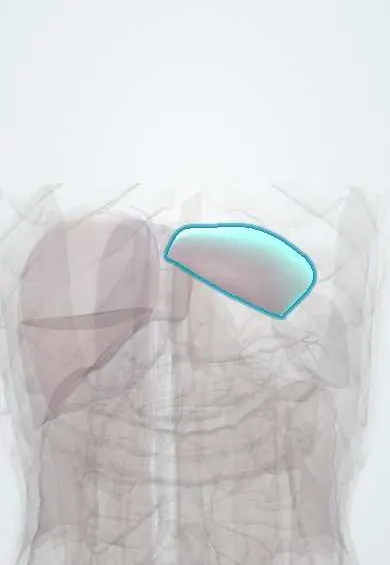
Liver segment II !
Liver segment II is the upper back part of the left liver, under the left dome of the diaphragm; with segment III it is used in child liver transplants.
Official name: Left posterior lateral segment of liver
Opens in the Durgical app, no sign-up needed.
What it is
Liver segment II: the upper part of the left lateral lobe.
What it does
Because each segment has its own supply, surgeons can remove one or more segments and leave the rest working.
Key facts
- Where
- Left lateral section, superior (posterior) part, left of falciform ligament
- Blood supply
- Branch of left portal vein and left hepatic artery; drains into left hepatic vein
- Nerve
- Hepatic plexus (celiac sympathetic and vagal fibres) along its portal pedicle, shared with the whole liver
- Function
- Independent surgical unit; bile to left hepatic duct; with III it is the left lateral section (used in pediatric living-donor grafts)
Relations
- Above
- Left dome of the diaphragm, with the heart and the base of the left lung above it
- Behind
- Abdominal esophagus and the cardia of the stomach; the left triangular ligament anchors its tip to the diaphragm
- Below
- Liver segment III; on the visceral surface the lesser omentum attaches along the fissure for the ligamentum venosum, next to the caudate lobe
How to find it
High under the left costal margin and the left dome of the diaphragm, behind segment III; in open surgery it comes into view when the left triangular ligament is divided and the left lateral section is folded down.
On imaging
On axial CT or MRI it is the part of the liver left of the left hepatic vein on the upper slices, above the plane of the left portal vein; segment III takes its place on the lower slices.
Common problems
- Fatty liver disease, very common with obesity and diabetes.
- Hepatitis (viral, alcohol).
- Cirrhosis: scarring that can lead to liver failure and portal hypertension.
- Liver cancer and metastases.
How it is diagnosed
Blood tests (liver enzymes), ultrasound, elastography, CT or MRI, biopsy.
Treatment
- Treat the cause (weight loss, antiviral medicines, stopping alcohol); surgery to remove segments; liver transplant for failure.
Clinical notes
- Freeing it means dividing the left triangular ligament, close to where the left hepatic vein enters the inferior vena cava
- A left-lobe amoebic abscess is less common than a right-lobe one but can rupture into the pericardium or the left pleura
- The left lateral section is held up by a retractor in hiatal hernia repair, fundoplication and gastrectomy; firm or prolonged retraction can bruise or tear it and raise liver enzymes after surgery
Anatomical variants
- A long left lateral section ("beaver tail" liver) can wrap around the spleen and on CT may be mistaken for a splenic collection or haematoma
Test yourself
Think of the answer, then tap the question to see it.
Which segments form the left lateral section of the liver?
Liver segments II and III, left of the falciform ligament; segment II is the upper (posterior) part.
Which hepatic vein drains liver segment II?
The left hepatic vein; freeing the segment means dividing the left triangular ligament, close to where that vein enters the IVC.
How is liver segment II used in split-liver transplantation?
With segment III, as the left lateral graft for a child; the extended right graft goes to an adult.
Educational information, not medical advice. For any symptom, see a health professional.
Its names
- Official Latin (TA2)
- segmentum posterius laterale sinistrum hepatis TA2 3068
- Official Spanish (DeCS)
- Segmento II del hígado DeCS D008099
- English (TA2)
- Left posterior lateral segment of liver
- Also called
- segment II of liver
Sources: Terminologia Anatomica (TA2); DeCS; Diagnostic Imaging of the Liver; Anatomy, Abdomen and Pelvis: Liver; 23.6 Accessory Organs in Digestion: The Liver, Pancreas, and Gallbladder (OpenStax (Rice University), 2022) · adapted, CC BY 4.0.
Spotted a mistake?We are always improving for the community. Tell us what is wrong and our team will review it.Report a mistake
Representative model, for educational purposes only.