Conditions · Gastroenterology and hepatology
Distal oesophageal spasm and hypercontractile oesophagus !
Disorders in which the oesophagus squeezes too early or too hard. They cause chest pain that can mimic a heart attack and trouble swallowing.
Updated 2026-11-01
Structures involved
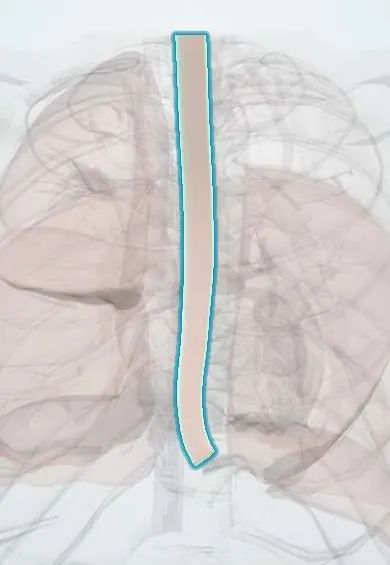
Tap one to see what it is and open it in 3D.
Why it happens
- Swallowing and esophageal motility
- The enteric nervous system, slow waves and GI control
- Smooth muscle contraction
- Nitric oxide (NO)
What it is
Primary motility disorders of the oesophageal smooth muscle. In distal oesophageal spasm, contractions are premature and uncoordinated; in hypercontractile (jackhammer) oesophagus, contractions are extremely strong. Both cause chest pain and dysphagia.
Who gets it
Uncommon, found in a small share of people studied with manometry for dysphagia or non-cardiac chest pain; more often in women and in middle-aged and older adults. In Colombia, Chagas disease must be considered in people from endemic areas with an oesophageal motility disorder.
Causes
- Usually idiopathic
- Impaired inhibitory nerve function (nitric oxide) in the myenteric plexus in distal spasm
- Excess cholinergic drive in hypercontractile oesophagus
- Gastro-oesophageal reflux may trigger or coexist with it
- Opioid use can produce a similar pattern
Risk factors
- Female sex and age over 50
- Gastro-oesophageal reflux
- Chronic opioid use
- Anxiety and visceral hypersensitivity (affect symptom perception)
Pathophysiology
Normal peristalsis spreads down the oesophagus in sequence because inhibitory nerves delay contraction in the distal segment. In distal oesophageal spasm, loss of this inhibition makes the distal oesophagus contract prematurely or simultaneously, which blocks the bolus and causes pain. In hypercontractile oesophagus, contractions are of excessive vigour. In both, the lower oesophageal sphincter usually relaxes normally, unlike achalasia, although the disorders overlap and may progress to it.
Classification
- Distal oesophageal spasm: premature contractions in at least 20% of swallows, with normal sphincter relaxation (Chicago classification)
- Hypercontractile (jackhammer) oesophagus: very high contraction vigour in at least 20% of swallows
- Both are major disorders of peristalsis on high-resolution manometry
Symptoms and signs
- Retrosternal chest pain, squeezing, that may spread to the back, neck or arms
- Intermittent dysphagia to both solids and liquids
- Symptoms triggered by very hot or cold drinks or by stress
- Regurgitation and heartburn in some
- A feeling of food sticking in the chest
Diagnosis
- Clinical
- Suspected in a person with intermittent dysphagia and chest pain after a cardiac cause has been excluded.
- Tests
- ECG and troponin first in any acute chest pain. High-resolution oesophageal manometry confirms the diagnosis and distinguishes it from achalasia. Upper endoscopy excludes structural disease, eosinophilic oesophagitis and reflux injury. Chagas serology in people from endemic areas.
- Imaging
- Barium swallow may show a «corkscrew» or «rosary bead» oesophagus in distal spasm, but it can be normal. Cardiac testing (stress test or coronary imaging) when angina is possible.
Differential diagnosis
- Angina or acute coronary syndrome
- Achalasia, including type III (spastic) achalasia
- GERD and reflux-related chest pain
- Eosinophilic oesophagitis
- Chagasic oesophageal disease
- Oesophageal cancer or stricture
Goal of treatment
Reduce chest pain and dysphagia after excluding cardiac disease, treating any reflux and avoiding unnecessary invasive procedures.
Treatment
- Conservative
- Reassurance and explanation, avoiding very hot or cold drinks and stopping opioids when possible.
- Medical
- Proton pump inhibitors when reflux contributes. Smooth muscle relaxants (calcium channel blockers, nitrates, phosphodiesterase-5 inhibitors) and tricyclic antidepressants or other neuromodulators to reduce pain perception.
- Procedure
- Botulinum toxin injection into the distal oesophagus, pneumatic dilation, or peroral endoscopic myotomy (POEM) for severe, refractory cases.
- Follow-up
- Nursing focus: treat every chest pain as cardiac until proven otherwise, monitor blood pressure and headache with smooth muscle relaxants, and watch for food impaction.
Complications
- Food bolus impaction
- Weight loss when dysphagia is severe
- Progression to achalasia in a minority
- Anxiety and repeated emergency visits for chest pain
Prognosis
Benign and usually chronic with fluctuating symptoms. It does not shorten life; many people improve with reassurance and medicines, and a few need endoscopic treatment.
Test yourself
Think of the answer, then tap the question to see it.
What must be excluded first in a patient with chest pain suspected of oesophageal spasm?
Cardiac ischaemia (acute coronary syndrome or angina) with ECG, troponin and cardiac testing.
Which test confirms distal oesophageal spasm?
High-resolution oesophageal manometry showing premature contractions with normal sphincter relaxation.
What is the classic barium swallow appearance of distal oesophageal spasm?
A «corkscrew» or «rosary bead» oesophagus.
How does distal oesophageal spasm differ from achalasia on manometry?
In spasm the lower oesophageal sphincter relaxes normally; in achalasia it fails to relax.
What is jackhammer oesophagus?
A hypercontractile oesophagus with extremely vigorous contractions on manometry.
Related conditions
- Achalasia
- Gastro-oesophageal reflux disease (GERD)
- Eosinophilic oesophagitis
- Stable angina
- Myocardial Infarction (Heart Attack)
- Vasospastic (Prinzmetal) angina
- Oesophageal cancer
- Chagasic megaoesophagus and megacolon
- Generalized anxiety disorder
Educational information, not medical advice. For any symptom, see a health professional.
Sources: Esophageal Motility Disorders - Gastroenterology - MSD Manual Professional Edition (MSD Manual Professional Edition, 2025).
Spotted a mistake?We are always improving for the community. Tell us what is wrong and our team will review it.Report a mistake
Representative model, for educational purposes only.