Vasospastic (Prinzmetal) angina !
Chest pain from a sudden spasm of a heart artery, usually at rest in the early morning, often with normal-looking arteries.
Updated 2026-11-01
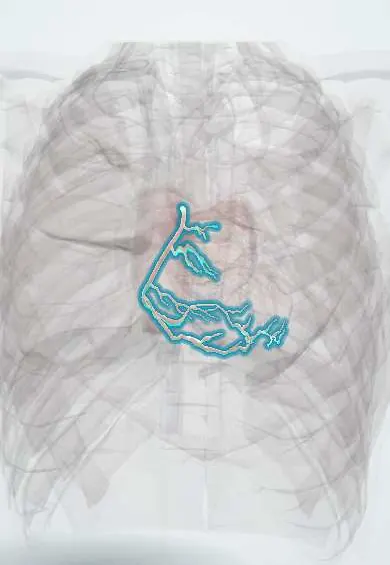
Structures involved
Tap one to see what it is and open it in 3D.
- Right coronary artery
- LAD (anterior descending artery)
- Left main coronary artery
- Circumflex artery
- Left ventricle
- Atrioventricular (AV) node
- Sinoatrial (SA) node
Why it happens
- Coronary circulation and myocardial ischemia
- Smooth muscle contraction
- The ECG in ischemia and infarction
- Nitric oxide (NO)
What it is
Vasospastic angina, also called variant or Prinzmetal angina, is myocardial ischaemia caused by a transient, intense spasm of an epicardial coronary artery that narrows or closes it. Attacks typically come at rest, often between midnight and early morning, and produce transient ST-segment elevation on the ECG that resolves when the spasm ends. Spasm can occur in normal arteries or at the site of a non-obstructive plaque.
Who gets it
Less common than exertional angina in Western series and more frequent in East Asian populations. It tends to affect younger patients than atherosclerotic angina, and smoking is the strongest modifiable link. In Colombia and Latin America, cocaine and other stimulant use are important triggers to ask about in young adults with chest pain at rest.
Causes
- Hyperreactivity of coronary smooth muscle with endothelial dysfunction (reduced nitric oxide)
- Triggers: smoking, cocaine, amphetamines and other stimulants, cold exposure, emotional stress, hyperventilation
- Drugs: triptans, ergot alkaloids, some chemotherapies (fluoropyrimidines), non-selective beta-blockers that leave alpha tone unopposed
- Magnesium deficiency and alcohol withdrawal (reported associations)
Risk factors
- Cigarette smoking (the main modifiable risk factor)
- Cocaine or amphetamine use
- Younger to middle age; East Asian ancestry
- Other vasospastic disorders such as migraine and Raynaud phenomenon
- Insulin resistance and inflammation (associations)
Pathophysiology
An abnormally reactive segment of an epicardial coronary artery constricts in response to stimuli that normally cause little effect, such as acetylcholine released with vagal tone at night. Dysfunctional endothelium produces less nitric oxide, so constriction is not balanced by dilation. Total or near-total occlusion causes transmural ischaemia with ST elevation in the leads facing the territory; partial spasm can cause ST depression. Prolonged spasm can cause myocardial infarction, and ischaemia or reperfusion can trigger ventricular arrhythmias or AV block (especially with right coronary spasm).
Classification
- Spasm in angiographically normal coronary arteries
- Spasm superimposed on non-obstructive or obstructive atherosclerosis
- Focal (one segment) versus diffuse (multivessel) spasm
- Part of the wider group of ischaemia with non-obstructive coronary arteries (INOCA), alongside microvascular angina
Symptoms and signs
- Episodes of chest pain or pressure at rest, often between midnight and early morning, lasting minutes
- Pain that may wake the patient from sleep and recur in clusters
- Usually good exercise tolerance during the day
- Rapid relief with short-acting nitrates
- Palpitations, dizziness or fainting when spasm causes arrhythmia or block
Diagnosis
- Clinical
- Suspect it when angina occurs at rest, especially at night or early morning, responds promptly to nitrates and the patient has preserved exercise tolerance. Documenting transient ST changes during a spontaneous attack is the key step. Every episode of rest pain with ST elevation is first treated as an acute coronary syndrome until infarction is excluded.
- Tests
- 12-lead ECG during pain (transient ST elevation that resolves with nitrates) and ambulatory ECG (Holter) monitoring to catch nocturnal episodes. Serial troponin to rule out infarction. Toxicology screen when stimulant use is possible. Magnesium and lipid profile as part of the work-up.
- Imaging
- Coronary angiography to exclude fixed obstructive disease; provocation with intracoronary acetylcholine or ergonovine, done only during cardiac catheterisation, confirms inducible spasm. Echocardiography assesses wall motion and function.
Differential diagnosis
- Acute coronary syndrome due to plaque rupture
- Stable exertional angina
- Takotsubo cardiomyopathy
- Microvascular angina
- Oesophageal spasm and gastro-oesophageal reflux
- Pericarditis (diffuse ST elevation, positional pain)
Goal of treatment
Relieve and prevent spasm, remove triggers and prevent infarction, arrhythmia and sudden death.
Treatment
- Acute
- During an attack: short-acting sublingual nitrate, ECG and troponin, and management as acute coronary syndrome until infarction is ruled out.
- Medical
- First-line prevention: calcium channel blockers (dihydropyridine or non-dihydropyridine), often taken at night; long-acting nitrates are added when control is incomplete.
- Medical
- Avoid non-selective beta-blockers, triptans and ergot drugs, which can worsen spasm; statins and antiplatelet therapy are used when atherosclerosis coexists.
- Lifestyle
- Complete smoking cessation and avoidance of cocaine and other stimulants, the most effective measures; limit cold exposure and manage stress.
- Procedure
- An implantable cardioverter-defibrillator is considered for survivors of cardiac arrest from spasm-related ventricular arrhythmia.
- Follow-up
- Nursing: continuous ECG monitoring during episodes, recording of pain timing and nitrate response, blood pressure check after nitrates, and counselling on tobacco and substance avoidance.
Complications
- Acute myocardial infarction
- Ventricular tachycardia or fibrillation and sudden cardiac death
- High-degree AV block (especially with right coronary spasm)
- Recurrent hospital visits and reduced quality of life
Prognosis
With calcium channel blockers and stopping smoking, most patients have a good long-term outlook and symptoms often lessen over time. Risk is higher with multivessel spasm, coexisting obstructive disease or a history of arrhythmia or arrest.
Prevention
- Stopping smoking and avoiding cocaine and stimulants
- Taking preventive medication regularly and not stopping it abruptly
- Avoiding drugs that provoke spasm when the diagnosis is known
Test yourself
Think of the answer, then tap the question to see it.
What is the classic presentation of Prinzmetal angina?
Chest pain at rest, often between midnight and early morning, with transient ST elevation that resolves with nitrates.
Which drug class is first-line to prevent vasospastic angina?
Calcium channel blockers.
Which drug class should be avoided because it can worsen spasm?
Non-selective beta-blockers (also triptans and ergot alkaloids).
Which test confirms inducible coronary spasm?
Provocative testing with intracoronary acetylcholine or ergonovine during coronary angiography.
What is the main modifiable risk factor?
Cigarette smoking (also cocaine and stimulant use).
Related conditions
- Stable angina
- Myocardial Infarction (Heart Attack)
- Cocaine and sympathomimetic toxicity
- Stimulant use disorder (cocaine, amphetamines)
- Raynaud phenomenon
- Migraine
- Ventricular tachycardia
- Atrioventricular (heart) block
- Cardiac arrest (VF, pulseless VT, asystole, PEA)
- Takotsubo (stress) cardiomyopathy
- Distal oesophageal spasm and hypercontractile oesophagus
- Gastro-oesophageal reflux disease (GERD)
Educational information, not medical advice. For any symptom, see a health professional.
Sources: Angina (Chest Pain) - Types | NHLBI, NIH (National Heart, Lung, and Blood Institute (NHLBI), NIH, 2026).
Spotted a mistake?We are always improving for the community. Tell us what is wrong and our team will review it.Report a mistake
Representative model, for educational purposes only.