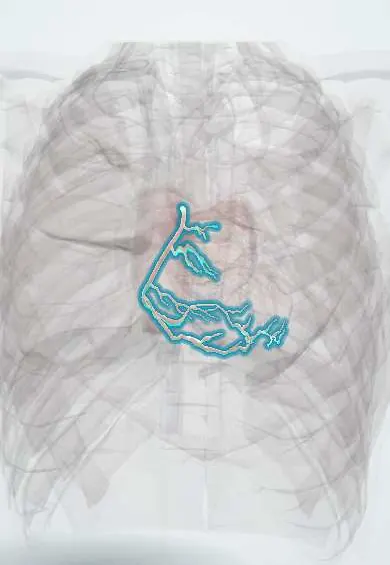
Conditions · Pediatrics and neonatology
Kawasaki disease !
A childhood vasculitis with prolonged fever, red eyes, lips and rash. Without early treatment it can damage the coronary arteries.
Updated 2026-11-01
Structures involved
Tap one to see what it is and open it in 3D.
- Right coronary artery
- Left main coronary artery
- Neck lymph nodes
- LAD (anterior descending artery)
- Circumflex artery
- Pericardium
- Mitral anterior leaflet
- Tongue
Why it happens
- Thrombosis and Virchow's triad
- Coronary circulation and myocardial ischemia
- Blood vessels: artery, vein and capillary layers
What it is
An acute, self-limited inflammation of medium-sized arteries in young children, recognised by five or more days of fever plus typical mucocutaneous signs. Its main danger is coronary artery aneurysms.
Who gets it
Mostly affects children under five, more boys than girls, with the highest rates in Japan and East Asia. It is the leading cause of acquired heart disease in children in high-income countries; in Latin America, where rheumatic heart disease still competes for that place, it is probably under-diagnosed because it mimics common infectious exanthems.
Causes
- Cause unknown
- Probably an abnormal immune response to an infectious or environmental trigger in genetically susceptible children
Risk factors
- Age under 5 years (peak in toddlers)
- Male sex
- East Asian ancestry
- Sibling or parent with a history of the disease
- Higher risk of aneurysm: age under 6 months, delayed treatment, resistance to immunoglobulin
Pathophysiology
Activated immune cells infiltrate the wall of medium-sized muscular arteries, above all the coronaries. Necrotising arteritis destroys the internal elastic lamina and media, so the vessel dilates into aneurysms; later scarring, thrombosis or stenosis can cause myocardial ischaemia years afterwards. Myocarditis, pericarditis and valve regurgitation can appear in the acute phase.
Classification
- Complete (classic): fever ≥5 days plus at least 4 of the 5 principal features
- Incomplete: fever ≥5 days with 2 or 3 features, supported by laboratory or echocardiographic findings
- Phases: acute febrile, subacute (desquamation, thrombocytosis, highest aneurysm risk) and convalescent
Symptoms and signs
- High fever for 5 days or more, poorly responsive to antipyretics, with marked irritability
- Bilateral non-exudative conjunctival injection sparing the limbus
- Red, cracked lips, strawberry tongue and diffuse redness of the mouth and pharynx
- Polymorphous rash on trunk and limbs, often accentuated in the groin
- Red, swollen hands and feet, followed by peeling of fingers and toes in the second or third week
- Cervical lymphadenopathy, usually one-sided and at least 1.5 cm
- Redness or crusting at a BCG vaccination scar in some infants
Diagnosis
- Clinical
- Clinical diagnosis based on the duration of fever and the five principal features (eyes, mouth, rash, extremities, neck node). Incomplete forms are common in infants, who are the group with the highest aneurysm risk.
- Tests
- No specific test. Supportive findings: high CRP and ESR, leucocytosis with neutrophilia, normocytic anaemia, low albumin, raised transaminases, sterile pyuria and, after the first week, thrombocytosis. ECG may show arrhythmia or ischaemia.
- Imaging
- Echocardiography at diagnosis and again at about 2 and 6 weeks measures coronary diameters (z-scores) and checks ventricular function, valves and pericardium. CT or MR angiography or catheter angiography for large or complex aneurysms.
Differential diagnosis
- Measles and other viral exanthems (adenovirus, enterovirus)
- Scarlet fever and streptococcal or staphylococcal toxic shock syndrome
- Multisystem inflammatory syndrome in children (MIS-C) after SARS-CoV-2
- Drug reactions, including Stevens–Johnson syndrome
- Systemic juvenile idiopathic arthritis
- Dengue and other tropical febrile illnesses
Goal of treatment
Switch off the vascular inflammation early, ideally within the first 10 days of fever, to prevent coronary aneurysms, and prevent thrombosis in children who already have coronary damage.
Treatment
- Medical
- Intravenous immunoglobulin (IVIG) as a single infusion in hospital, the key treatment that lowers aneurysm risk.
- Medical
- Aspirin, at anti-inflammatory then low antiplatelet levels, continued until follow-up echocardiography is normal or longer when there are aneurysms (with attention to influenza and varicella because of Reye syndrome).
- Medical
- IVIG-resistant or high-risk disease: a second IVIG infusion, corticosteroids, or other immunomodulators such as infliximab or anakinra.
- Follow-up
- Serial echocardiography and long-term cardiology follow-up according to coronary risk; anticoagulants or dual antiplatelet therapy for large aneurysms. Nursing: fever curve, vital signs and infusion reactions during IVIG, fluid balance, skin and mouth care, and teaching to postpone live vaccines after IVIG.
- Procedure
- Coronary revascularisation (percutaneous intervention or bypass) in rare children with severe stenosis or ischaemia.
Complications
- Coronary artery aneurysms, thrombosis and stenosis
- Myocardial infarction and sudden death
- Myocarditis, pericardial effusion and valvular regurgitation (mainly mitral)
- Aneurysms in other medium-sized arteries
- Macrophage activation syndrome (rare)
Prognosis
With timely IVIG most children recover completely and the risk of coronary aneurysm falls to a few percent; without treatment about a quarter develop aneurysms. Small aneurysms often regress, whereas giant aneurysms carry lifelong risk of thrombosis and infarction.
Test yourself
Think of the answer, then tap the question to see it.
Which fever duration and how many principal features define complete Kawasaki disease?
Fever for at least 5 days plus at least 4 of the 5 principal features (conjunctivitis, oral changes, rash, extremity changes, cervical node).
What is the most important complication of Kawasaki disease?
Coronary artery aneurysm, which can lead to thrombosis, myocardial infarction and sudden death.
Which two drugs form standard initial treatment?
Intravenous immunoglobulin plus aspirin.
Which imaging test is done at diagnosis and during follow-up?
Echocardiography, to measure the coronary arteries and check heart function.
Why are live vaccines such as measles postponed after IVIG?
The passive antibodies in immunoglobulin can neutralise the vaccine virus and reduce the response.
Related conditions
- Myocardial Infarction (Heart Attack)
- Acute pericarditis
- Heart failure
- Measles
- Streptococcal pharyngitis
- Conjunctivitis
Educational information, not medical advice. For any symptom, see a health professional.
Sources: About Kawasaki Disease | Kawasaki Disease | CDC (Centers for Disease Control and Prevention, 2024); Kawasaki disease: MedlinePlus Medical Encyclopedia (MedlinePlus (U.S. National Library of Medicine), 2024).
Spotted a mistake?We are always improving for the community. Tell us what is wrong and our team will review it.Report a mistake
Representative model, for educational purposes only.