Legg-Calvé-Perthes disease !
Legg-Calvé-Perthes disease is loss of blood supply to the ball of the hip in a growing child; the bone softens, then slowly regrows, sometimes flattened.
Updated 2026-10-29
Structures involved
Tap one to see what it is and open it in 3D.
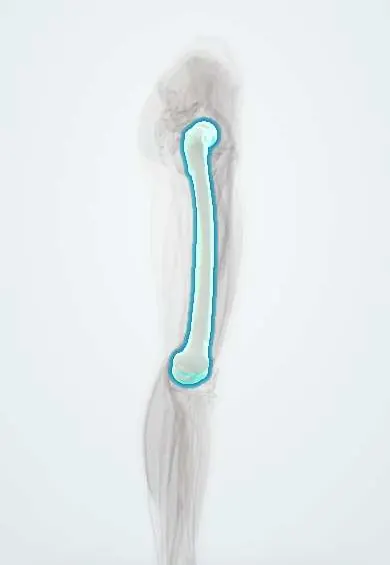
- Femur
- Femoral head cartilage
- Circumflex femoral arteries
- Hip bone
- Acetabular cartilage
- Hip capsule
- Ligament of the femoral head
In the clinical exam
Why it happens
What it is
Idiopathic avascular necrosis of the femoral head in a growing child, followed by fragmentation and slow regrowth of the bone, which can leave the head flattened.
Who gets it
Mainly affects boys, typically between about 4 and 8 years old; most cases are unilateral. It is less common than transient synovitis, the usual cause of a limp in this age group.
Causes
- Interruption of blood supply to the femoral head epiphysis; the exact cause is unknown
- Proposed factors include clotting abnormalities, repeated microtrauma and passive smoke exposure
Risk factors
- Male sex
- Age about 4 to 8 years
- Delayed bone age and short stature
- Low birth weight
- Family history
- Exposure to second-hand smoke
Pathophysiology
In young children the femoral head depends heavily on the lateral epiphyseal branches of the medial circumflex femoral artery. After an ischaemic episode the bone dies, then is resorbed and replaced. While soft, the head can deform and extrude from the acetabulum; the final shape decides the long-term outcome.
Classification
- Waldenström stages: initial (sclerosis), fragmentation, reossification and healed
- Lateral pillar (Herring) classification during fragmentation, which predicts outcome
- Stulberg classification of the final shape at skeletal maturity
Symptoms and signs
- Painless or mildly painful limp of gradual onset
- Pain in the groin, thigh or knee, worse with activity
- Limited internal rotation and abduction of the hip
- Thigh muscle wasting and, later, a slight leg-length difference
Diagnosis
- Clinical
- A child with a limp and loss of internal rotation and abduction of the hip, without systemic illness.
- Tests
- Usually normal; inflammatory markers help exclude infection.
- Imaging
- Anteroposterior and frog-leg radiographs show sclerosis, a crescent sign, fragmentation and flattening of the head. MRI shows early changes before radiographs.
Differential diagnosis
- Transient synovitis of the hip
- Septic arthritis of the hip
- Slipped capital femoral epiphysis
- Multiple epiphyseal dysplasia
- Sickle cell disease or steroid-related avascular necrosis
- Juvenile idiopathic arthritis
Goal of treatment
Keep the femoral head round and well contained in the acetabulum while it heals, and maintain hip motion.
Treatment
- Conservative
- Observation, activity modification and pain relief with anti-inflammatory drugs, especially in younger children.
- Rehabilitation
- Physiotherapy to keep range of motion, mainly abduction and internal rotation.
- Surgical
- Containment surgery (femoral or pelvic osteotomy) in older children or with marked involvement; indications vary between centres.
- Follow-up
- Serial radiographs through the stages of the disease until healing.
Complications
- Flattened, enlarged femoral head (coxa plana, coxa magna)
- Hip joint incongruity and impingement
- Leg-length difference
- Early osteoarthritis of the hip in adulthood
Prognosis
Most important is age at onset: children under about 6 usually do well. Older age, greater involvement of the lateral pillar and a non-spherical head at maturity predict early arthritis.
Test yourself
Think of the answer, then tap the question to see it.
What is Legg-Calvé-Perthes disease?
Idiopathic avascular necrosis of the femoral head epiphysis in a growing child.
Which patient typically has Legg-Calvé-Perthes disease?
A boy of about 4 to 8 years with a gradual, often painless limp and delayed bone age.
Which hip movements are lost first in Legg-Calvé-Perthes disease?
Internal rotation and abduction.
What is the strongest predictor of outcome in Legg-Calvé-Perthes disease?
Age at onset: younger children (under about 6) have a better prognosis.
What is the principle of treatment in Legg-Calvé-Perthes disease?
Containment: keep the femoral head inside the acetabulum while it heals so it remodels round.
Related conditions
- Slipped capital femoral epiphysis
- Avascular necrosis of the femoral head
- Developmental dysplasia of the hip
- Hip Osteoarthritis
Educational information, not medical advice. For any symptom, see a health professional.
Sources: Legg-Calve-Perthes Disease (StatPearls (NCBI Bookshelf), 2026).
Spotted a mistake?We are always improving for the community. Tell us what is wrong and our team will review it.Report a mistake
Representative model, for educational purposes only.