Slipped capital femoral epiphysis !
Slipped capital femoral epiphysis is a teenage hip problem in which the ball of the femur slips off its neck through the growth plate.
Updated 2026-10-29
Structures involved
Tap one to see what it is and open it in 3D.
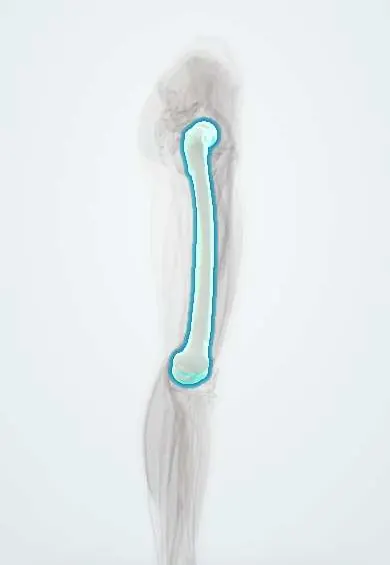
- Femur
- Femoral head cartilage
- Hip capsule
- Hip bone
- Circumflex femoral arteries
- Ligament of the femoral head
- Acetabular cartilage
In the clinical exam
Why it happens
What it is
A hip disorder of adolescence in which the femoral head (the capital epiphysis) slips off the femoral neck through the weakened growth plate, usually backwards and downwards.
Who gets it
The most common hip disorder of adolescents, typically around the growth spurt; more frequent in boys and in children with obesity. It is bilateral in a substantial share of cases, sometimes in sequence.
Causes
- Shear forces across a weakened proximal femoral growth plate during the adolescent growth spurt
- Mechanical overload from excess body weight
- Endocrine disorders in atypical cases (hypothyroidism, growth hormone deficiency or treatment, renal osteodystrophy)
Risk factors
- Obesity
- Adolescent age around puberty
- Male sex
- Endocrine or metabolic disease, especially when the child is young or of low weight
- Prior radiotherapy to the pelvis
Pathophysiology
During the growth spurt the physis widens and tilts, so shear from body weight can exceed its strength. The metaphysis moves forwards and up while the epiphysis stays in the acetabulum. An unstable slip can tear the retinacular vessels from the circumflex femoral arteries that supply the head, causing avascular necrosis.
Classification
- Stable (the child can walk, with or without crutches) or unstable (cannot bear weight); unstable slips carry a much higher risk of avascular necrosis
- Acute, chronic or acute-on-chronic by duration of symptoms
- Severity by the slip angle or the percentage of displacement on imaging (mild, moderate, severe)
Symptoms and signs
- Pain in the hip, groin, thigh or only the knee (referred pain via the obturator nerve)
- Limp, often with an out-toeing gait
- Loss of internal rotation of the hip
- Obligatory external rotation when the hip is flexed
- Inability to bear weight in unstable slips
Diagnosis
- Clinical
- Limp and limited internal rotation; flexing the hip forces it into external rotation (Drehmann sign). Both hips are examined.
- Tests
- Endocrine tests (thyroid function and others) in atypical cases: young, thin or with signs of a hormonal disorder.
- Imaging
- Anteroposterior and frog-leg lateral radiographs of both hips. Klein line (along the superior femoral neck) fails to cross the epiphysis. MRI can show an early pre-slip.
Differential diagnosis
- Legg-Calvé-Perthes disease
- Septic arthritis of the hip
- Transient synovitis
- Femoral neck stress fracture
- Knee pathology (when pain is referred)
Goal of treatment
Stop further slipping and close the growth plate early, while protecting the blood supply of the femoral head and preventing early arthritis.
Treatment
- Acute
- Non-weight-bearing and urgent orthopaedic referral as soon as the diagnosis is suspected.
- Surgical
- In-situ pinning with a single cannulated screw across the physis, without forcing the slip back into place.
- Surgical
- Prophylactic pinning of the other hip in selected patients (young age, endocrine cause); practice varies.
- Surgical
- Corrective osteotomy or surgical dislocation in severe slips or later deformity, in specialist centres.
- Follow-up
- Radiographic follow-up of both hips until the growth plates close.
- Lifestyle
- Weight management as part of long-term care.
Complications
- Avascular necrosis of the femoral head (mainly after unstable slips)
- Chondrolysis (loss of hip cartilage)
- Slip of the opposite hip
- Femoroacetabular impingement from the residual deformity
- Early hip osteoarthritis
Prognosis
Stable slips pinned in situ usually do well. Outcomes are worse after unstable slips, mostly because of avascular necrosis, and residual deformity raises the risk of arthritis in adulthood.
Prevention
- Early recognition in adolescents with hip or knee pain and a limp
- Prevention of childhood obesity
Test yourself
Think of the answer, then tap the question to see it.
What is the typical patient with a slipped capital femoral epiphysis?
An obese adolescent, more often a boy, around the growth spurt, with a limp and hip, thigh or knee pain.
Why can a slipped capital femoral epiphysis present with knee pain only?
Hip pain is referred to the knee along the obturator nerve, so the hip must be examined in any adolescent with knee pain.
What does Klein line show in a slipped capital femoral epiphysis?
A line along the superior femoral neck that normally crosses part of the epiphysis; in a slip it misses it or crosses less of it.
What is the standard treatment for a slipped capital femoral epiphysis?
In-situ pinning with a screw across the growth plate, without manipulation to reduce the slip.
Which type of slip carries the highest risk of avascular necrosis?
The unstable slip, in which the child cannot bear weight even with crutches.
Related conditions
- Legg-Calvé-Perthes disease
- Avascular necrosis of the femoral head
- Developmental dysplasia of the hip
- Hip Osteoarthritis
- Obesity
Educational information, not medical advice. For any symptom, see a health professional.
Sources: Slipped Capital Femoral Epiphysis (StatPearls (NCBI Bookshelf), 2023).
Spotted a mistake?We are always improving for the community. Tell us what is wrong and our team will review it.Report a mistake
Representative model, for educational purposes only.