Multiple endocrine neoplasia (MEN 1, 2A, 2B) !
Inherited syndromes in which tumours grow in several hormone glands. Gene testing of the family allows early surgery that prevents cancer.
Updated 2026-11-01
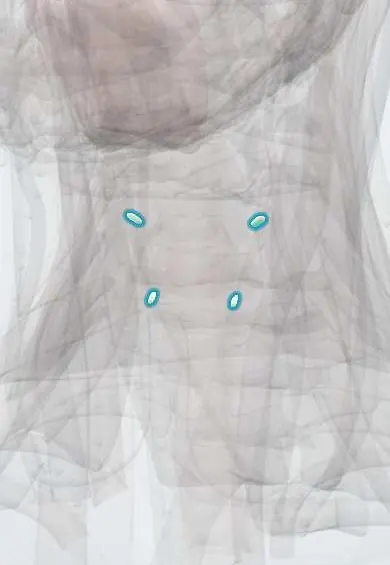
Structures involved
Tap one to see what it is and open it in 3D.
In embryology
Why it happens
- Tumour suppressor genes: RB, TP53, APC, BRCA and the two-hit hypothesis
- Oncogenes: RAS, MYC, HER2, BCR-ABL and the table to know
- Hereditary cancer syndromes: the table to know
- Receptor tyrosine kinases
- Thyroid follicles, C cells and parathyroid
- Adrenal cortex zones and medulla
What it is
A group of autosomal dominant syndromes in which tumours develop in two or more endocrine glands. MEN 1 (MEN1 gene, menin) involves the parathyroids, pancreas and duodenum, and pituitary; MEN 2A and 2B (RET proto-oncogene) involve medullary thyroid carcinoma and pheochromocytoma, with hyperparathyroidism in 2A and mucosal neuromas in 2B.
Who gets it
Rare, but important in practice because carriers in a family can be identified by genetic testing. Medullary thyroid carcinoma develops in almost all RET carriers; primary hyperparathyroidism is the most frequent and earliest feature of MEN 1.
Causes
- MEN 1: inactivating mutation of the MEN1 tumour-suppressor gene (menin) on chromosome 11
- MEN 2A and 2B: activating mutations of the RET proto-oncogene on chromosome 10
- Autosomal dominant inheritance with high penetrance; some cases are new mutations
Risk factors
- A first-degree relative with MEN or with a known MEN1 or RET mutation
- Hyperparathyroidism at a young age or with multigland disease
- Medullary thyroid carcinoma or bilateral pheochromocytoma at any age
Pathophysiology
In MEN 1, loss of the second normal copy of a tumour-suppressor gene allows multiple tumours to grow in the target glands. In MEN 2, a constantly active RET receptor drives hyperplasia of thyroid C cells and adrenal medullary cells, which progresses to medullary carcinoma and pheochromocytoma. Symptoms come from excess hormones (calcium, gastrin, insulin, prolactin, catecholamines, calcitonin) and from local tumour growth.
Classification
- MEN 1 (the three Ps): parathyroid hyperplasia or adenomas, pancreatic and duodenal neuroendocrine tumours (gastrinoma, insulinoma), pituitary adenomas (often prolactinoma)
- MEN 2A: medullary thyroid carcinoma, pheochromocytoma and parathyroid hyperplasia
- MEN 2B: medullary thyroid carcinoma, pheochromocytoma, mucosal neuromas and a marfanoid habitus
Symptoms and signs
- Hypercalcaemia: kidney stones, bone pain, abdominal pain, polyuria and fatigue
- Gastrinoma: recurrent or multiple peptic ulcers and chronic diarrhoea (Zollinger-Ellison syndrome)
- Insulinoma: fasting hypoglycaemia with confusion or sweating
- Pituitary tumour: amenorrhoea, galactorrhoea, acromegaly or visual field defects
- Pheochromocytoma: episodic headache, sweating, palpitations and hypertension
- Medullary thyroid carcinoma: thyroid nodule or neck lymph nodes; diarrhoea in advanced disease
Diagnosis
- Clinical
- Suspected when two of the characteristic tumours occur in one person, or one occurs in a relative of a known case. A careful family history is essential.
- Tests
- Genetic testing for MEN1 or RET mutations in index cases and relatives. Calcium and PTH; gastrin, fasting glucose with insulin, prolactin and IGF-1 in MEN 1; calcitonin and CEA for medullary carcinoma; plasma or urine metanephrines for pheochromocytoma.
- Imaging
- Pituitary MRI; pancreatic CT, MRI, endoscopic ultrasound or somatostatin receptor PET; neck ultrasound; adrenal CT or MRI.
Differential diagnosis
- Sporadic primary hyperparathyroidism
- Sporadic pituitary adenoma or neuroendocrine tumour
- Von Hippel-Lindau disease and neurofibromatosis type 1 (other syndromes with pheochromocytoma)
- Familial hypocalciuric hypercalcaemia
Goal of treatment
Detect tumours early in carriers, remove or control them before they spread or cause hormonal emergencies, and screen relatives.
Treatment
- Surgical
- Prophylactic total thyroidectomy in RET carriers, timed by the risk level of the specific mutation (in early childhood for MEN 2B).
- Surgical
- Pheochromocytoma is removed before any thyroid or other surgery, after alpha-blockade. Subtotal or total parathyroidectomy for hyperparathyroidism; resection of selected pancreatic tumours.
- Medical
- Proton pump inhibitors for gastrinoma, dopamine agonists for prolactinoma, and somatostatin analogues for some neuroendocrine tumours.
- Follow-up
- Lifelong biochemical and imaging surveillance of carriers, and genetic counselling and testing of first-degree relatives.
Complications
- Metastatic medullary thyroid carcinoma
- Malignant pancreatic neuroendocrine tumours, a leading cause of death in MEN 1
- Hypertensive crisis from pheochromocytoma
- Recurrent hyperparathyroidism and kidney stones
- Hypoparathyroidism after parathyroid surgery
Prognosis
Depends on which tumours develop and when they are found. Early genetic diagnosis with prophylactic thyroidectomy has greatly improved survival in MEN 2; in MEN 1, malignant neuroendocrine tumours largely determine outcome.
Prevention
- Genetic testing of relatives of affected individuals
- Prophylactic thyroidectomy in RET mutation carriers
Test yourself
Think of the answer, then tap the question to see it.
Which three glands are classically affected in MEN 1?
Parathyroid, pancreas (and duodenum) and pituitary: the three Ps.
Which gene is mutated in MEN 2A and 2B?
The RET proto-oncogene, with an activating (gain-of-function) mutation.
In MEN 2, which tumour must be excluded and treated before thyroid surgery?
Pheochromocytoma, to avoid a hypertensive crisis during anaesthesia.
Which features distinguish MEN 2B from MEN 2A?
Mucosal neuromas and a marfanoid habitus, with no hyperparathyroidism.
What is the most common feature of MEN 1?
Primary hyperparathyroidism from multigland parathyroid hyperplasia.
Related conditions
- Primary hyperparathyroidism
- Pituitary adenoma
- Prolactinoma (hyperprolactinaemia)
- Zollinger-Ellison syndrome (gastrinoma)
- Insulinoma
- Medullary thyroid carcinoma
- Phaeochromocytoma
- Thyroid cancer (papillary)
- Marfan syndrome
Educational information, not medical advice. For any symptom, see a health professional.
Sources: Multiple endocrine neoplasia (MEN) I (MedlinePlus Medical Encyclopedia (U.S. National Library of Medicine), 2025); Multiple endocrine neoplasia (MEN) II (MedlinePlus Medical Encyclopedia (U.S. National Library of Medicine), 2025).
Spotted a mistake?We are always improving for the community. Tell us what is wrong and our team will review it.Report a mistake
Representative model, for educational purposes only.