Periodic paralyses (hypokalaemic, hyperkalaemic, thyrotoxic) !
Rare muscle-channel disorders that cause sudden attacks of weakness or paralysis lasting hours, often linked to changes in blood potassium.
Updated 2026-11-01
Structures involved
Tap one to see what it is and open it in 3D.
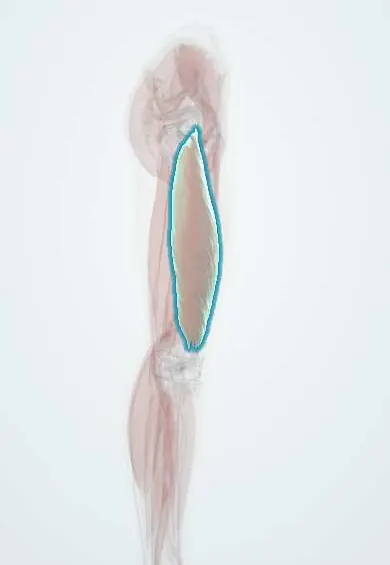
- Vastus lateralis
- Middle deltoid
- Rectus femoris
- Vastus medialis
- Gluteus maximus
- Biceps (long head)
- Thyroid gland
Why it happens
What it is
A group of skeletal-muscle channelopathies in which the muscle membrane transiently becomes inexcitable, causing episodes of flaccid weakness with preserved consciousness and sensation. The primary forms are inherited (hypokalaemic, hyperkalaemic and Andersen-Tawil syndrome); thyrotoxic periodic paralysis is an acquired form that appears during hyperthyroidism. Strength returns between attacks, although fixed weakness may develop later.
Who gets it
Hypokalaemic periodic paralysis affects about 1 in 100,000 people and hyperkalaemic about 1 in 200,000. Thyrotoxic periodic paralysis is most common in men of Asian descent but is also well documented in Latin American men, usually aged 20 to 40, and is a frequent cause of acute hypokalaemic paralysis in young adults. In Colombia it should be suspected in young men with hypokalaemic weakness and signs of Graves disease.
Causes
- Hypokalaemic periodic paralysis: CACNA1S (calcium channel) or SCN4A (sodium channel) variants, autosomal dominant
- Hyperkalaemic periodic paralysis: SCN4A variants, autosomal dominant
- Andersen-Tawil syndrome: KCNJ2 (inward-rectifier potassium channel) variants
- Thyrotoxic periodic paralysis: hyperthyroidism (most often Graves disease) plus genetic susceptibility, e.g. KCNJ18 variants
- Secondary hypokalaemic paralysis (not true periodic paralysis): renal tubular acidosis, primary hyperaldosteronism, diuretics, diarrhoea
Risk factors
- Family history (primary forms)
- Hyperthyroidism in young men (thyrotoxic form)
- Carbohydrate-rich meals, alcohol and rest after strenuous exercise (hypokalaemic and thyrotoxic forms)
- Fasting, potassium-rich foods, cold and rest after exercise (hyperkalaemic form)
- Stress, infections and drugs such as glucocorticoids, insulin or beta-agonists
Pathophysiology
Faulty sodium, calcium or potassium channels make the muscle fibre membrane depolarise abnormally. In the hypokalaemic form a leak current (gating pore) makes fibres depolarise paradoxically when extracellular potassium falls, inactivating sodium channels so the fibre cannot fire. Insulin and catecholamines, released after carbohydrate meals or exercise, drive potassium into cells and trigger attacks. In the hyperkalaemic form, sodium channels fail to inactivate, causing persistent depolarisation (with myotonia) when potassium rises. In thyrotoxic paralysis, thyroid hormone increases Na+/K+-ATPase activity, shifting potassium into muscle. Total body potassium is normal: the problem is a shift.
Classification
- Hypokalaemic periodic paralysis (type 1 CACNA1S, type 2 SCN4A)
- Hyperkalaemic periodic paralysis (SCN4A), often with myotonia
- Andersen-Tawil syndrome: periodic paralysis, long QT with ventricular arrhythmias and dysmorphic features
- Thyrotoxic periodic paralysis (acquired, hypokalaemic)
Symptoms and signs
- Attacks of flaccid weakness of the limbs, usually proximal and legs more than arms, often on waking or after rest
- Reduced or absent tendon reflexes during the attack
- Normal consciousness and sensation; facial, swallowing and breathing muscles usually spared
- Hypokalaemic and thyrotoxic attacks: hours to days, infrequent, often after a heavy carbohydrate meal or night after exercise
- Hyperkalaemic attacks: shorter (minutes to hours), more frequent, starting in infancy or childhood, with myotonia (stiffness) between attacks
- Thyrotoxic form: weight loss, tremor, palpitations, heat intolerance or goitre may be present or subtle
Diagnosis
- Clinical
- Suspected in a young person with recurrent, self-limited attacks of flaccid weakness with areflexia, normal sensation and normal consciousness, with typical triggers or a family history. In a young man with a first hypokalaemic attack, always look for hyperthyroidism.
- Tests
- Serum potassium measured during the attack (low, high or normal according to type). ECG in every patient (U waves, QT prolongation, arrhythmias). Thyroid function (TSH, free T4, T3). Urinary potassium, acid-base status and renin-aldosterone to exclude renal or hormonal potassium loss (low urinary potassium supports a shift). Creatine kinase may be mildly raised. Between attacks: the long exercise test on nerve conduction studies (fall in compound muscle action potential amplitude) and genetic testing for CACNA1S, SCN4A and KCNJ2.
- Imaging
- Not required for diagnosis; thyroid ultrasound or scintigraphy in the thyrotoxic form; muscle MRI may show oedema or fatty change in fixed myopathy.
Differential diagnosis
- Guillain-Barré syndrome
- Myasthenia gravis and Lambert-Eaton syndrome
- Secondary hypokalaemia (renal tubular acidosis, hyperaldosteronism, diuretics, diarrhoea)
- Transient ischaemic attack, stroke or spinal cord compression
- Rhabdomyolysis and inflammatory myopathy
- Functional (dissociative) weakness
Goal of treatment
Correct the potassium shift safely during attacks without overshooting, prevent future attacks by avoiding triggers and using preventive drugs, and in the thyrotoxic form cure the hyperthyroidism.
Treatment
- Acute
- Hypokalaemic and thyrotoxic attacks: potassium chloride, preferably oral, given cautiously in small amounts with repeated potassium checks and cardiac monitoring, because potassium shifts back out of cells and rebound hyperkalaemia is common. Avoid glucose-containing intravenous fluids.
- Acute
- Hyperkalaemic attacks: often brief and relieved by mild exercise or carbohydrate intake; inhaled beta-agonists or thiazide diuretics for longer attacks.
- Medical
- Thyrotoxic form: non-selective beta-blockers (propranolol) to prevent and shorten attacks, plus definitive treatment of hyperthyroidism (antithyroid drugs, radioactive iodine or surgery); attacks stop once euthyroid.
- Medical
- Prevention in primary forms: carbonic anhydrase inhibitors (acetazolamide, dichlorphenamide); potassium-sparing diuretics in hypokalaemic forms; thiazides in the hyperkalaemic form.
- Lifestyle
- Trigger avoidance: low-carbohydrate, low-salt meals and avoiding alcohol and strenuous exercise followed by rest (hypokalaemic); regular carbohydrate meals and avoiding potassium-rich foods, fasting and cold (hyperkalaemic).
- Follow-up
- Nursing priorities: continuous cardiac monitoring during attacks, serial potassium, assessment of breathing and swallowing, fall prevention and hourly strength checks.
Complications
- Cardiac arrhythmias from potassium abnormalities (ventricular arrhythmias in Andersen-Tawil syndrome)
- Rebound hyperkalaemia after treatment
- Rarely, respiratory failure or aspiration during severe attacks
- Permanent proximal myopathy in middle age
- Malignant hyperthermia-like reactions with anaesthesia in some channelopathies
Prognosis
Attacks of the primary forms tend to become less frequent after middle age, but many patients develop slowly progressive fixed proximal weakness. Thyrotoxic periodic paralysis disappears once thyroid function is normalised. With correct treatment and arrhythmia prevention, life expectancy is normal.
Prevention
- Identify and avoid individual triggers, take preventive medication when attacks are frequent, keep thyroid function normal in the thyrotoxic form, and warn anaesthetists before surgery.
Test yourself
Think of the answer, then tap the question to see it.
A young man wakes up unable to move his legs after a night of heavy carbohydrate intake; potassium is low. Which test must not be missed?
Thyroid function: thyrotoxic periodic paralysis is a key cause of acute hypokalaemic paralysis in young men.
Why can rebound hyperkalaemia occur after treating a hypokalaemic attack?
The hypokalaemia is caused by a shift into cells, not a deficit; when the attack ends potassium moves back out, adding to the replaced potassium.
Which drug class prevents and shortens thyrotoxic periodic paralysis attacks?
Non-selective beta-blockers, such as propranolol.
Which gene is mutated in hyperkalaemic periodic paralysis, and what extra feature is common?
SCN4A (skeletal muscle sodium channel); myotonia between attacks.
What triad defines Andersen-Tawil syndrome?
Periodic paralysis, long QT with ventricular arrhythmias, and dysmorphic features.
Related conditions
- Hypokalaemia
- Hyperkalaemia
- Graves disease (hyperthyroidism)
- Thyroid storm
- Long QT syndrome and torsades de pointes
- Renal tubular acidosis
- Primary hyperaldosteronism (Conn syndrome)
- Guillain-Barré syndrome
- Myasthenia gravis
- Myotonic dystrophy (types 1 and 2)
Educational information, not medical advice. For any symptom, see a health professional.
Sources: Familial Periodic Paralysis - Pediatrics - MSD Manual Professional Edition (MSD Manual Professional Edition, 2026); Hypokalemic periodic paralysis: MedlinePlus Genetics (MedlinePlus (U.S. National Library of Medicine), 2026); Hyperkalemic periodic paralysis: MedlinePlus Genetics (MedlinePlus (U.S. National Library of Medicine), 2026).
Spotted a mistake?We are always improving for the community. Tell us what is wrong and our team will review it.Report a mistake
Representative model, for educational purposes only.