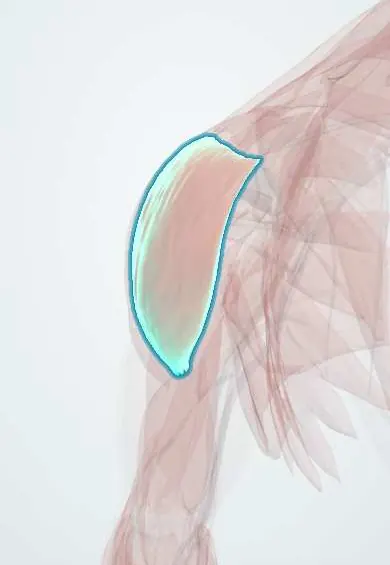
Middle deltoid !
The middle deltoid is the outer part of the shoulder's rounded muscle; it is the main muscle that lifts the arm out to the side.
Official name: Deltoid, middle (acromial) part
Opens in the Durgical app, no sign-up needed.
What it is
The middle part of the rounded shoulder muscle, over the side of the shoulder.
What it does
Lifts the arm out to the side.
Key facts
- Origin
- Acromion
- Insertion
- Deltoid tuberosity of the humerus
- Action
- Abducts the arm (after the first ~15°)
- Nerve
- Axillary nerve (C5–C6)
- Blood supply
- Posterior circumflex humeral artery, thoracoacromial artery (deltoid branch)
Relations
- Above
- Lateral edge of the acromion
- Deep
- The subacromial (subdeltoid) bursa over the supraspinatus tendon and greater tubercle; lower, the axillary nerve and posterior circumflex humeral vessels
- In front
- Front deltoid
- Behind
- Rear deltoid
- Superficial
- Skin of the outer shoulder, supplied by the upper lateral cutaneous nerve of the arm (the 'regimental badge' patch)
How to find it
Abducting the arm to about 90° against resistance hardens the rounded mass below the lateral edge of the acromion, the bony shelf felt at the top of the shoulder.
Examination
- Regimental badge sensation over the lower outer deltoid, checked before and after reducing a dislocated shoulder: numbness suggests axillary nerve injury, but normal feeling does not rule out motor damage
- Resisted abduction at 90°: weakness with a normal start of abduction (first ~15°) points to the axillary nerve or the C5 root rather than the supraspinatus
On imaging
On coronal MRI it is the thick muscle over the greater tuberosity, with the subacromial-subdeltoid bursa beneath it. On ultrasound, when the supraspinatus tendon is torn through and absent, the deltoid lies directly on the humeral head: a classic sign of a full-thickness tear. Axillary nerve injury shows as deltoid atrophy and fatty change on MRI.
Common problems
- Weakness or wasting when the axillary nerve is injured (shoulder dislocation, humerus fracture).
- In a reverse shoulder replacement it becomes the main muscle that lifts the arm.
How it is diagnosed
Exam of shoulder lifting strength and of the skin feeling over the outer shoulder; EMG if a nerve injury is suspected.
Treatment
- Physical therapy to strengthen it.
- Its strength is what makes a reverse shoulder replacement work.
Clinical notes
- Lateral deltoid-splitting approaches to the shoulder and proximal humerus stop or protect the axillary nerve (texts quote about 5 cm below the acromion, with wide variation)
- Supraspinatus and middle deltoid work as a force couple: without the cuff, the deltoid pulls the humeral head up against the acromion instead of rotating it
- Deltoid contracture after repeated childhood injections is a recognised cause of a fixed abducted shoulder with a dimple over the muscle
Development
It forms in place from the mesoderm of the arm bud and belongs to the dorsal muscle mass, which is why its nerve, the axillary nerve, comes from the posterior cord of the brachial plexus.
Related conditions
- Lambert-Eaton myasthenic syndrome
- Periodic paralyses (hypokalaemic, hyperkalaemic, thyrotoxic)
- Inflammatory myopathies (dermatomyositis, polymyositis)
- Axillary nerve injury
Test yourself
Think of the answer, then tap the question to see it.
Why is the middle deltoid the strongest abductor of the three deltoid parts?
It is multipennate: many short fibres give the strongest pull for abduction.
How far below the acromion does the axillary nerve run deep to the middle deltoid?
Roughly 5 cm, winding round the surgical neck; the distance varies, so deltoid splits are kept above it.
What does the regimental badge test check after a shoulder dislocation, and what is its limitation?
Sensation over the lower outer deltoid (axillary nerve); numbness suggests injury, but normal feeling does not rule out motor damage.
Why does the humeral head ride up against the acromion when the rotator cuff fails?
The supraspinatus and middle deltoid form a force couple; without the cuff the deltoid pulls the head upward instead of rotating it.
Educational information, not medical advice. For any symptom, see a health professional.
Its names
- Official Latin (TA2)
- pars acromialis musculi deltoidei TA2 2454
- Official Spanish (DeCS)
- Porción acromial del músculo deltoides
- English (TA2)
- Deltoid, middle (acromial) part
Related
Sources: Terminologia Anatomica (TA2); Anatomy, Shoulder and Upper Limb, Deltoid Muscle; Anatomy of the Human Body (20th ed.): Development of the Muscles (Lea & Febiger (Gray's Anatomy, 1918), 1918) · adapted, Public domain.
Spotted a mistake?We are always improving for the community. Tell us what is wrong and our team will review it.Report a mistake
Representative model, for educational purposes only.