Conditions · Gastroenterology and hepatology
Primary sclerosing cholangitis !
A chronic disease that inflames and scars the bile ducts inside and outside the liver. It is strongly linked to ulcerative colitis and raises cancer risk.
Updated 2026-11-01
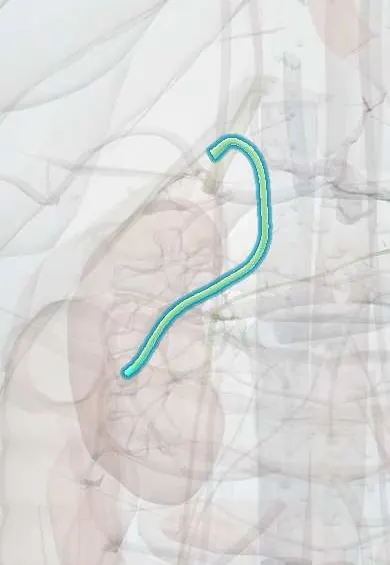
Structures involved
Tap one to see what it is and open it in 3D.
Why it happens
- Fibrosis in organs: TGF-β and the myofibroblast
- Chronic inflammation: causes, cells and features
- Precancerous conditions: when chronic inflammation, metaplasia or hyperplasia raise the risk
- Bile and the enterohepatic circulation
- Alkaline phosphatase (ALP) as a lab test
- Gallbladder and bile ducts
What it is
A chronic, progressive disease in which inflammation and fibrosis narrow the bile ducts inside and outside the liver, producing a beaded pattern of strictures. It leads to cholestasis, recurrent cholangitis, biliary cirrhosis and a high risk of bile duct cancer.
Who gets it
Rare; usually diagnosed in men aged 30 to 40. Most patients also have inflammatory bowel disease, mainly ulcerative colitis, so it is suspected in people with IBD and abnormal liver tests. Latin American series report a similar profile with lower prevalence.
Causes
- Immune-mediated injury of the bile ducts; exact cause unknown
- Genetic susceptibility (HLA associations)
- Gut–liver axis: bacterial products and lymphocytes from an inflamed colon are thought to reach the bile ducts
Risk factors
- Inflammatory bowel disease, especially ulcerative colitis (pancolitis)
- Male sex, young to middle adulthood
- Family history of PSC
- Non-smokers (smoking appears oddly protective, as in ulcerative colitis)
Pathophysiology
Concentric 'onion-skin' fibrosis around bile ducts produces multifocal strictures with dilated segments between them. Bile stasis favours stones, bacterial cholangitis and dominant strictures. Persistent cholestasis causes secondary biliary cirrhosis, and chronic inflammation of the biliary epithelium predisposes to cholangiocarcinoma.
Classification
- Large-duct (classic) PSC, visible on cholangiography
- Small-duct PSC, normal cholangiogram and diagnosis by biopsy
- PSC with features of autoimmune hepatitis (overlap)
- IgG4-related sclerosing cholangitis is a separate, steroid-responsive disease to exclude
Symptoms and signs
- Often asymptomatic, found by a raised alkaline phosphatase in a patient with IBD
- Fatigue and itching
- Intermittent jaundice and right upper quadrant pain
- Episodes of fever with chills (bacterial cholangitis)
- Weight loss; later signs of cirrhosis
Diagnosis
- Clinical
- Suspected in a patient with inflammatory bowel disease and a cholestatic pattern on liver tests; examination may be normal or show jaundice and hepatosplenomegaly.
- Tests
- High alkaline phosphatase and GGT; bilirubin rises with strictures. AMA is negative; p-ANCA is often positive but non-specific. IgG4 is measured to exclude IgG4-related cholangitis. CA 19-9 helps when cholangiocarcinoma is suspected.
- Imaging
- MRCP is the first-choice test and shows multifocal strictures and dilatations ('beaded' ducts). ERCP is kept for therapy and for brushing cytology of dominant strictures. Ultrasound and elastography assess the liver and gallbladder.
Differential diagnosis
- Secondary sclerosing cholangitis (previous surgery, stones, ischaemia, infection)
- IgG4-related sclerosing cholangitis
- Primary biliary cholangitis
- Cholangiocarcinoma
- Choledocholithiasis
Goal of treatment
No drug reliably changes the course; care aims to relieve itching and cholangitis, open dominant strictures, screen for cancers, and refer for transplant when the liver fails.
Treatment
- Medical
- Ursodeoxycholic acid may improve liver tests but has not been shown to improve survival. Antibiotics for episodes of cholangitis; antipruritic therapy and fat-soluble vitamin replacement as in other cholestatic diseases.
- Procedure
- ERCP with balloon dilatation, short-term stents and brush cytology for a dominant stricture causing jaundice or cholangitis.
- Follow-up
- Colonoscopy with surveillance biopsies at diagnosis and every one to two years in those with IBD (high colorectal cancer risk); yearly imaging and CA 19-9 for cholangiocarcinoma and gallbladder polyps; bone density.
- Surgical
- Liver transplantation for end-stage liver disease, recurrent cholangitis or intractable itching; PSC can recur in the graft.
Complications
- Recurrent bacterial cholangitis
- Biliary cirrhosis with portal hypertension and liver failure
- Cholangiocarcinoma (lifetime risk around 10–20%)
- Colorectal cancer in patients with colitis; gallbladder cancer
- Bile duct stones, fat-soluble vitamin deficiency and osteoporosis
Prognosis
Progressive; median time to death or transplant from diagnosis is often quoted at 10 to 20 years. Transplantation gives good results, but cancer remains the main threat and surveillance is lifelong.
Test yourself
Think of the answer, then tap the question to see it.
Which disease is most strongly associated with primary sclerosing cholangitis?
Inflammatory bowel disease, especially ulcerative colitis.
What is the classic imaging finding in PSC?
Multifocal strictures and dilatations of intra- and extrahepatic bile ducts ('beaded' appearance) on MRCP or ERCP.
Which cancer should be suspected when a PSC patient has rapidly worsening jaundice?
Cholangiocarcinoma, often at a dominant stricture.
Why do PSC patients with colitis need regular colonoscopy?
Because PSC with IBD carries a high risk of colorectal cancer, so yearly or two-yearly surveillance is advised.
What is the only treatment that changes the long-term outcome of advanced PSC?
Liver transplantation.
Related conditions
- Ulcerative colitis
- Crohn disease
- Cholangiocarcinoma (bile duct cancer)
- Acute cholangitis
- Cirrhosis
- Portal hypertension
- Colorectal cancer
- Primary biliary cholangitis
Educational information, not medical advice. For any symptom, see a health professional.
Sources: Sclerosing cholangitis: MedlinePlus Medical Encyclopedia (MedlinePlus (U.S. National Library of Medicine), 2024).
Spotted a mistake?We are always improving for the community. Tell us what is wrong and our team will review it.Report a mistake
Representative model, for educational purposes only.