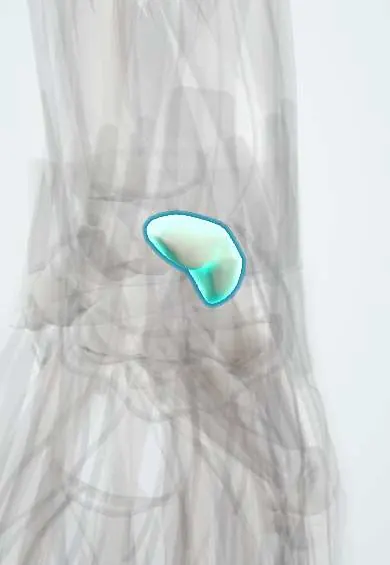
Scaphoid fracture !
A scaphoid fracture is a break of the wrist bone at the base of the thumb, usually from a fall on the hand; first X-rays can miss it and it may heal poorly.
Updated 2026-10-29
Structures involved
Tap one to see what it is and open it in 3D.
Why it happens
What it is
Fracture of the scaphoid, the most commonly fractured carpal bone, usually from a fall on the outstretched hand. It is easily missed because first X-rays can be normal, and its fragile blood supply makes nonunion and avascular necrosis a risk.
Who gets it
Typical of young, active adults, often men, after falls in sport, work or traffic accidents, including motorcycle accidents; less common in children and older adults, who more often break the distal radius.
Causes
- Fall on an outstretched hand with the wrist extended and radially deviated
- Direct blow to the wrist
- Sports and motor vehicle or motorcycle accidents
Risk factors
- Young, active adults
- Contact and high-energy sports
- Motorcycle riding
- Occupations with a risk of falls
Pathophysiology
The scaphoid bridges the proximal and distal carpal rows, so forced wrist extension concentrates stress on its waist. Most of its blood enters distally from branches of the radial artery and flows retrograde to the proximal pole. A fracture can cut off that flow, so proximal fragments are prone to avascular necrosis and delayed or failed union.
Classification
- By location: distal pole (including tubercle), waist (most common) or proximal pole (highest risk)
- Stable (non-displaced) or unstable (displaced, comminuted, angulated)
- Acute or established nonunion
Symptoms and signs
- Pain on the radial side of the wrist after a fall
- Tenderness in the anatomical snuffbox
- Tenderness over the scaphoid tubercle on the palmar side
- Pain on axial compression of the thumb
- Mild swelling and reduced grip strength; deformity is uncommon
Diagnosis
- Clinical
- Snuffbox tenderness, scaphoid tubercle tenderness and pain on thumb axial compression after a fall; together they raise suspicion, but none is specific alone.
- Tests
- No laboratory tests are needed for diagnosis.
- Imaging
- Dedicated scaphoid X-ray views, which may be normal at first. If suspicion persists, the wrist is immobilised and MRI (most sensitive) or CT is done, or X-rays are repeated after 10 to 14 days.
Differential diagnosis
- Distal radius fracture
- Scapholunate ligament injury
- Wrist sprain
- De Quervain tenosynovitis
- Thumb base (first metacarpal) fracture
Goal of treatment
Achieve bony union with good alignment, prevent nonunion and avascular necrosis, and restore pain-free wrist function.
Treatment
- Conservative
- Cast or splint immobilisation including the thumb for non-displaced waist and distal pole fractures, with serial X-rays to confirm healing.
- Surgical
- Internal fixation with a headless compression screw (percutaneous or open) for displaced, unstable or proximal pole fractures, and in some active patients to return to work faster.
- Surgical
- For established nonunion: debridement, bone grafting (sometimes vascularised) and fixation.
- Rehabilitation
- Hand therapy after immobilisation to regain motion and grip strength.
Complications
- Nonunion
- Avascular necrosis of the proximal pole
- Malunion with humpback deformity
- Scaphoid nonunion advanced collapse (SNAC) and wrist osteoarthritis
- Stiffness after prolonged immobilisation
Prognosis
Most non-displaced fractures that are diagnosed and immobilised early heal well. Proximal pole and displaced fractures, and those diagnosed late, have higher rates of nonunion and avascular necrosis.
Prevention
- Wrist guards in sports with frequent falls (skating, snowboarding)
- Protective gear and road safety for motorcycle riders
Test yourself
Think of the answer, then tap the question to see it.
Which clinical sign is classically associated with a scaphoid fracture?
Tenderness in the anatomical snuffbox, on the radial side of the wrist.
Why is the proximal pole of the scaphoid at risk of avascular necrosis?
Blood from radial artery branches enters distally and flows retrograde to the proximal pole, so a fracture can cut off its supply.
How is a suspected scaphoid fracture with normal initial X-rays managed?
Immobilisation and further imaging: MRI or CT, or repeat X-rays after 10 to 14 days.
Which part of the scaphoid is most commonly fractured?
The waist (middle third).
What late wrist problem follows untreated scaphoid nonunion?
Scaphoid nonunion advanced collapse (SNAC) with progressive wrist arthritis.
Related conditions
Educational information, not medical advice. For any symptom, see a health professional.
Sources: Scaphoid Wrist Fracture (StatPearls (NCBI Bookshelf), 2023).
Spotted a mistake?We are always improving for the community. Tell us what is wrong and our team will review it.Report a mistake
Representative model, for educational purposes only.