Tourette syndrome and tic disorders !
A childhood-onset brain condition with sudden, repeated movements (motor tics) and sounds (vocal tics) that come and go over time.
Updated 2026-11-01
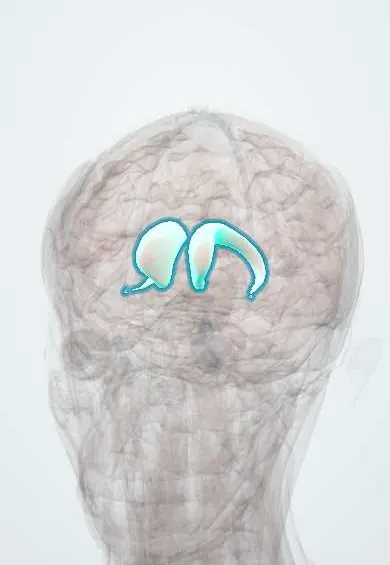
Structures involved
Tap one to see what it is and open it in 3D.
Why it happens
What it is
Tic disorders are neurodevelopmental conditions with tics: sudden, rapid, recurrent, non-rhythmic movements or vocalisations. Tourette syndrome is the most complex form, with multiple motor tics and at least one vocal tic present for more than a year and starting before age 18. Tics are often preceded by an uncomfortable urge and can be suppressed briefly.
Who gets it
Transient tics are common in school-age children; Tourette syndrome affects under 1% of children and is 3 to 4 times more frequent in boys. Tics usually begin around 4 to 6 years of age, peak around 10 to 12 years and improve in adolescence in most patients. In Colombia and Latin America many children are seen first by paediatricians or neurologists, and the coexisting ADHD or OCD is often what brings them to care.
Causes
- Strong genetic contribution with a polygenic pattern; family history is common
- Dysfunction of cortico-striato-thalamo-cortical circuits that select and inhibit movements
- Perinatal factors such as prematurity, low birth weight and maternal smoking in some studies
- Abrupt-onset presentations after streptococcal infection have been proposed (PANDAS) but remain controversial
Risk factors
- Male sex
- Family history of tics, OCD or ADHD
- Coexisting ADHD or obsessive-compulsive disorder
- Stress, excitement, fatigue and anxiety (worsen existing tics)
Pathophysiology
Tics arise from faulty gating of motor programmes in the basal ganglia. Reduced inhibition in the striatum (caudate nucleus and putamen) and altered dopamine signalling allow unwanted motor or vocal programmes to be released through the globus pallidus and thalamus back to the motor and cingulate cortex. Frontal control networks strengthen with age, which helps explain why tics often improve in adolescence.
Classification
- Provisional tic disorder: motor and/or vocal tics for less than 1 year
- Persistent (chronic) motor or vocal tic disorder: only motor or only vocal tics for more than 1 year
- Tourette syndrome: multiple motor tics plus at least one vocal tic, more than 1 year, onset before 18
- Simple tics (blinking, grimacing, sniffing, throat clearing) versus complex tics (gestures, jumping, words or phrases)
Symptoms and signs
- Simple motor tics: eye blinking, facial grimacing, head jerking, shoulder shrugging
- Simple vocal tics: sniffing, throat clearing, grunting, coughing
- Complex tics: touching, jumping, repeating own words (palilalia) or others' words (echolalia)
- Coprolalia (involuntary obscene words) in only a minority of patients
- A premonitory urge before tics, brief voluntary suppression, and waxing and waning over weeks to months
- Associated ADHD, obsessive-compulsive symptoms, anxiety, rage attacks or learning difficulties
Diagnosis
- Clinical
- Diagnosis is clinical, based on history and observation of tics, often helped by a home video. Key features are the premonitory urge, suppressibility, change in location over time, and onset in childhood. Tic severity is graded with scales such as the Yale Global Tic Severity Scale. Screen every child for ADHD, OCD, anxiety and learning problems.
- Tests
- No test confirms the diagnosis. EEG only if seizures are suspected; copper studies if Wilson disease is possible; throat culture or streptococcal antibodies only when an abrupt post-infectious onset is suspected; ECG before some antipsychotics because of QT prolongation.
- Imaging
- Brain MRI is not routine; reserve it for atypical features such as adult onset, focal neurological signs or regression.
Differential diagnosis
- Stereotypies (rhythmic, earlier onset, no premonitory urge, common in autism)
- Sydenham chorea after rheumatic fever
- Myoclonus or epileptic seizures
- Huntington disease and Wilson disease
- Drug-induced or tardive dyskinesia
- Functional (psychogenic) tic-like movements
Goal of treatment
Reduce impairment rather than eliminate all tics: educate, treat the comorbidities that often cause the most disability, and protect safety and schooling.
Treatment
- Conservative
- Education and reassurance for the family, school and patient; many mild tics need no medication.
- Conservative
- First-line behavioural therapy: Comprehensive Behavioural Intervention for Tics (CBIT), based on habit reversal training with a competing response.
- Medical
- First-line drugs for mild-moderate tics: alpha-2 adrenergic agonists (clonidine, guanfacine), which also help coexisting ADHD; monitor blood pressure and sedation.
- Medical
- Severe tics: dopamine-blocking agents such as aripiprazole, risperidone, haloperidol or pimozide, or vesicular monoamine transporter 2 (VMAT2) inhibitors such as tetrabenazine, with monitoring for movement and metabolic effects and QT prolongation.
- Procedure
- Focal disabling tics: botulinum toxin injections; deep brain stimulation is reserved for severe, refractory adult cases.
- Follow-up
- Monitoring of tic severity, school performance, mood and medication side effects over time.
Complications
- Social isolation, bullying and low self-esteem
- Academic difficulties, often driven by ADHD or OCD
- Physical injury from forceful tics (cervical myelopathy, eye injury)
- Depression and anxiety
- Side effects of antipsychotic treatment (weight gain, movement disorders)
Prognosis
Most children improve substantially by late adolescence or early adulthood; a minority keeps significant tics as adults. Long-term outcome depends heavily on coexisting ADHD, OCD and mood disorders.
Test yourself
Think of the answer, then tap the question to see it.
What are the DSM criteria for Tourette syndrome?
Multiple motor tics and at least one vocal tic, present for more than 1 year, with onset before age 18, not due to a substance or another condition.
Which two conditions most often coexist with Tourette syndrome?
ADHD and obsessive-compulsive disorder.
What is the first-line non-drug treatment for disabling tics?
Comprehensive Behavioural Intervention for Tics (CBIT), based on habit reversal training.
Which drug class is often tried first for tics, especially with ADHD?
Alpha-2 adrenergic agonists such as clonidine or guanfacine.
Is coprolalia required for the diagnosis?
No. It occurs in only a minority of patients.
Related conditions
- Attention-deficit/hyperactivity disorder (ADHD)
- Obsessive-compulsive disorder (OCD)
- Autism spectrum disorder (ASD)
- Generalized anxiety disorder
- Antipsychotic-induced movement disorders (dystonia, akathisia, parkinsonism, tardive dyskinesia)
- Huntington disease
- Epilepsy and seizures
- Essential tremor
- Body dysmorphic disorder, hoarding disorder and trichotillomania
Educational information, not medical advice. For any symptom, see a health professional.
Sources: Tourette syndrome (MedlinePlus (U.S. National Library of Medicine), 2025); Tourette syndrome (NHS (National Health Service, UK), 2025).
Spotted a mistake?We are always improving for the community. Tell us what is wrong and our team will review it.Report a mistake
Representative model, for educational purposes only.