Reproductive system · Pelvis · Female
Broad ligament !
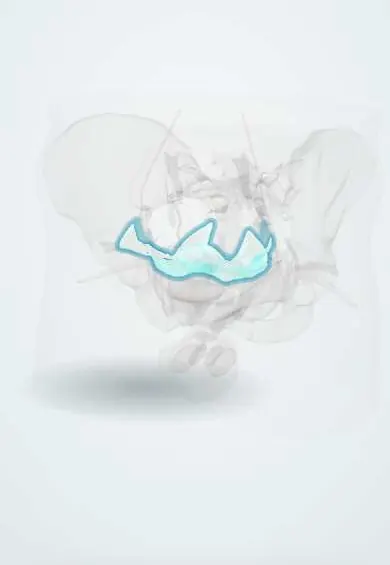
The broad ligament is a wide fold of peritoneum on each side of the uterus; it holds the uterus in the middle of the pelvis and carries its vessels.
Official name: Broad ligament of uterus
Opens in the Durgical app, no sign-up needed.
What it is
A wide double fold of peritoneum draped over the uterus and tubes from side to side, like a sheet over a clothesline.
What it does
Holds the uterus loosely in the middle of the pelvis and carries the uterine vessels; the ureter passes beneath its base.
Key facts
- Where
- Double fold of peritoneum from the sides of the uterus to the lateral pelvic walls and floor
- Attaches
- Parts: mesometrium, mesosalpinx, mesovarium; contains the uterine tube, round and ovarian ligaments, uterine and ovarian vessels; the ureter passes under its base
- Function
- Loose peritoneal support holding the uterus in the midline; little true support
Relations
- Contents
- Uterine tube, round ligament of uterus, ovarian ligament, uterine artery and ovarian artery with their veins, lymphatics, nerves and mesonephric remnants; the ureters pass under its base
- Medial
- Sides of the uterus, along which the uterine artery climbs
- Lateral
- Lateral pelvic walls, with the suspensory ligament of ovary at the outer end of the free edge
- In front
- Vesicouterine pouch and urinary bladder
- Behind
- Rectouterine pouch; the ovaries hang from its posterior layer
- Below
- Parametrium and cardinal ligament, where its two layers part over the pelvic floor
How to find it
At laparoscopy it is the sheet of peritoneum hanging from the uterus and tubes to each side wall; the round ligament ridges its front, and the ovary sits on its back.
On imaging
On ultrasound or MRI a mass between its layers (an intraligamentous fibroid or a paraovarian cyst) lies beside the uterus, separate from the ovary, and can push the uterus to the opposite side.
Common problems
- Weakened supports allow prolapse.
- Endometriosis often grows on the uterosacral ligaments.
How it is diagnosed
Examination and ultrasound; seen directly in laparoscopy.
Treatment
- They are divided step by step in a hysterectomy.
Clinical notes
- To reach the ureter and the uterine vessels at surgery, the round ligament is divided and the two layers are separated, opening the retroperitoneal space
- Intraligamentous fibroids grow between its layers, can push the ureter aside and make hysterectomy harder
- A broad ligament haematoma can follow a caesarean section or a tear at birth and spread through the retroperitoneum
Development
As the two paramesonephric ducts swing toward the midline and fuse to form the uterus, they lift a transverse fold of peritoneum from each side wall of the pelvis; this fold becomes the broad ligament and divides the female pelvis into a front and a back pouch.
Memory aid
"Water under the bridge": the ureter (water) flows under the uterine artery (bridge) at the base of the broad ligament.
Related conditions
Test yourself
Think of the answer, then tap the question to see it.
What passes under the base of the broad ligament, about 2 cm lateral to the cervix?
The ureter, running forward under the uterine artery («water under the bridge»): the danger zone in hysterectomy.
What are the main contents of the broad ligament?
Uterine tube, round and ovarian ligaments, uterine and ovarian arteries and veins, lymphatics, nerves and mesonephric remnants.
Why can intraligamentous fibroids make hysterectomy harder?
They grow between the layers of the broad ligament and can push the ureter aside.
Educational information, not medical advice. For any symptom, see a health professional.
Its names
- Official Latin (TA2)
- ligamentum latum uteri TA2 3800
- Official Spanish (DeCS)
- Ligamento ancho DeCS D001956
- English (TA2)
- Broad ligament of uterus
- Also called
- plica lata uteri
Related
Sources: Terminologia Anatomica (TA2); DeCS; Anatomy, Abdomen and Pelvis: Broad Ligaments.
Spotted a mistake?We are always improving for the community. Tell us what is wrong and our team will review it.Report a mistake
Representative model, for educational purposes only.