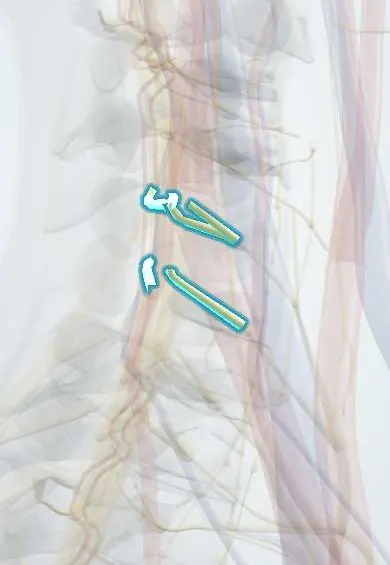
C5 nerve root !
The C5 nerve root leaves the spine at C4-C5; it powers the deltoid and biceps and gives feeling over the outer shoulder.
Official name: C5
Opens in the Durgical app, no sign-up needed.
What it is
The C5 nerve root, leaving the spine at C4-C5.
What it does
Supplies the deltoid and biceps (lifting and bending the arm) and feeling over the outer shoulder.
Key facts
- Roots
- C5 dorsal and ventral roots; exits the C4–C5 intervertebral foramen; compressed by a C4–C5 disc herniation
- Moves
- Deltoid, supraspinatus, infraspinatus, rhomboids; biceps and brachialis (with C6); biceps reflex (C5–C6)
- Feeling from
- C5 dermatome: lateral shoulder and upper arm (regimental badge area)
Relations
- Course
- Leaves the C4–C5 foramen behind the vertebral artery, gives the dorsal scapular nerve and a twig to the phrenic nerve, and joins C6 as the two emerge between the scalenes, forming the upper trunk of the brachial plexus
- In front
- The C4–C5 disc and uncovertebral joint
- Behind
- The C4–C5 facet joint
How to find it
It cannot be felt. It leaves the spine through the C4–C5 foramen, above the C5 pedicle; on ultrasound of the interscalene groove it is usually the highest of the round dark dots between the anterior and middle scalenes.
Examination
- Resisted elbow flexion with the forearm turned up and resisted shoulder abduction: weakness of both suggests C5
- Biceps reflex at the elbow: reduced with C5 (and C6) root lesions
- Pinprick at the lateral antecubital fossa (C5 key point) and over the outer shoulder
On imaging
Leaves through the C4–C5 foramen; axial MRI at that level shows a disc or uncovertebral spur pressing on it. On ultrasound at the interscalene groove, the C5 and C6 roots look like a vertical row of dark round dots between the anterior and middle scalenes, the target of the interscalene block. A C5 palsy after neck surgery is diagnosed clinically; MRI or CT looks for a cause.
Common problems
- Cervical radiculopathy: a disc or bone spur pinches a root, causing pain, numbness or weakness down the arm in that root's pattern.
How it is diagnosed
Exam of strength, reflexes and feeling in the arm (each root has its own pattern); MRI; sometimes nerve tests (EMG).
Treatment
- Most improve with time, physical therapy, medicine and sometimes an injection.
- Lasting pain or weakness: surgery to free the root, such as ACDF or a foraminotomy.
Clinical notes
- C5 palsy after cervical decompression: deltoid and biceps weakness hours to days after surgery, usually recovering over months; the cause is debated (root stretch as the cord drifts back is one idea)
- Differential: rotator cuff tear (painful arc, normal reflexes and sensation), axillary nerve palsy after shoulder dislocation (deltoid only), neuralgic amyotrophy (severe shoulder pain, then patchy weakness)
- Erb palsy (C5–C6 stretch at birth or in a fall onto the shoulder) leaves the arm adducted and internally rotated with the elbow straight
Anatomical variants
- Prefixed brachial plexus: C4 sends a sizeable branch into the plexus, so shoulder muscles may draw part of their supply from C4 as well as C5
Related conditions
Test yourself
Think of the answer, then tap the question to see it.
Through which foramen does the C5 nerve root exit, and which disc herniation compresses it?
The C4–C5 intervertebral foramen; a C4–C5 disc herniation compresses it.
What are the ISNCSCI key muscle and key sensory point for the C5 nerve root?
Key muscle: elbow flexors (biceps, brachialis). Key sensory point: lateral side of the antecubital fossa, just above the elbow crease.
Why does weakness of the deltoid, supraspinatus, infraspinatus and biceps together point to the C5 root rather than one peripheral nerve?
These muscles are supplied by different nerves (axillary, suprascapular, musculocutaneous) that share the C5 root.
Which nerve root is most often weakened after cervical decompression surgery?
C5 (C5 palsy): deltoid and biceps weakness hours to days after surgery, usually recovering over months.
Educational information, not medical advice. For any symptom, see a health professional.
Its names
- Official Latin (TA2)
- radix nervi spinalis C5 TA2 6363
- Official Spanish (DeCS)
- Raíz C5 DeCS D013126
- English (TA2)
- C5
- Also called
- spinal nerves C1-C8
Related
Sources: Terminologia Anatomica (TA2); DeCS; Anatomy, Head and Neck: Cervical Nerves; Anatomy, Skin, Dermatomes.
Spotted a mistake?We are always improving for the community. Tell us what is wrong and our team will review it.Report a mistake
Representative model, for educational purposes only.