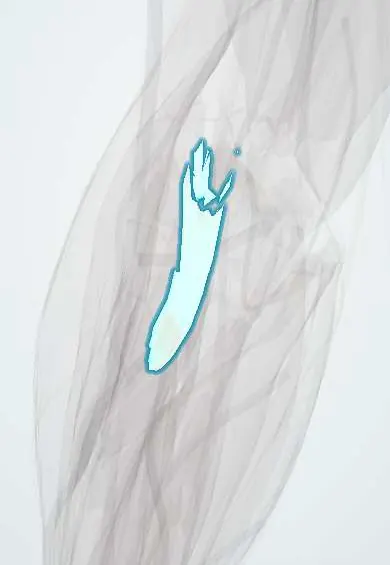
Distal biceps tendon !
The distal biceps tendon attaches the biceps to the radius below the elbow; it bends the elbow and turns the palm up with great strength.
Opens in the Durgical app, no sign-up needed.
What it is
The thick tendon at the front of the elbow that dives to the radius.
What it does
Bends the elbow and is the strongest turner of the palm upward.
Key facts
- Attaches
- Back of the radial tuberosity, turning around the radius; the bicipital aponeurosis fans medially into the forearm fascia
- Function
- Supination and elbow flexion; the brachial artery lies just medial to it in the cubital fossa; ruptures when lifting a heavy load (hook test)
- Tight in
- Elbow extension with the forearm pronated
Relations
- Course
- Forms in the lower arm, passes through the middle of the cubital fossa, then dives deep between the brachioradialis and the pronator teres, winding round the radius to the radial tuberosity
- Medial
- Brachial artery and, further medial, the median nerve
- Lateral
- Radial nerve, between the brachioradialis and the brachialis; the lateral antebrachial cutaneous nerve emerges just lateral to the tendon
- Deep
- Brachialis and the elbow capsule; near the insertion the bicipitoradial bursa cushions it against the radius
- Superficial
- Bicipital aponeurosis, fanning off its medial side, with the median cubital vein lying on it
How to find it
With the elbow bent to 90° and the forearm supinated against resistance, the tendon is a firm cord in the middle of the elbow crease. It is hooked most easily from the lateral side, since the aponeurosis covers its medial edge.
Examination
- Hook test: the examiner's index finger hooks under the lateral edge of the tendon; failure to hook it means a complete rupture
- Biceps squeeze test: squeezing the belly with the forearm resting fails to supinate the forearm in a complete rupture
- Resisted supination with the elbow bent: pain and weakness suggest a partial or complete tear
On imaging
MRI in the FABS position (elbow flexed, shoulder abducted, forearm supinated) shows the tendon along its length, separates partial from complete tears and measures retraction. Ultrasound from the front or medial side is a quick alternative.
Common problems
- Rupture when the bent elbow is forced straight under a heavy load; often a pop, bruising and a bunched-up biceps.
- Weakness turning the palm up (for example using a screwdriver) and bending the elbow.
- Partial tears and tendon wear cause pain at the front of the elbow.
How it is diagnosed
Hook test (the examiner cannot hook a finger under the tendon). MRI or ultrasound confirms the tear.
Treatment
- Early surgical repair back to the radius (with a button, anchors or a screw) for active people, ideally within a few weeks.
- Without surgery in less active people: some loss of turning strength remains.
Clinical notes
- Repair uses one anterior incision or two incisions; the lateral antebrachial cutaneous nerve is the nerve most often irritated, and the posterior interosseous nerve is at risk near the radial neck
- Two-incision repairs carry a risk of heterotopic bone and radioulnar synostosis
- Chronic retracted ruptures may need a tendon graft
- Bicipitoradial bursitis can mimic a mass or a partial tear in front of the elbow and may compress the posterior interosseous nerve
Anatomical variants
- The tendon often has two separable parts, from the short and long heads, so a partial tear may involve one head only
Memory aid
Cubital fossa from lateral to medial: 'Really Need Beer To Be At My Nicest': Radial Nerve, Biceps Tendon, Brachial Artery, Median Nerve.
Test yourself
Think of the answer, then tap the question to see it.
Where does the distal biceps tendon insert, and what is its strongest action?
On the back of the radial tuberosity, turning around the radius; it is the strongest supinator and also flexes the elbow.
What is the hook test for the distal biceps tendon?
With the elbow at 90° and the forearm supinated, a finger hooks under the tendon's lateral edge; no cord to hook means a complete rupture.
Who typically ruptures the distal biceps tendon, and which strength falls most?
Middle-aged men lifting against a load with the elbow bent; supination strength falls more than flexion strength.
Which nerve is most often irritated in distal biceps tendon repair?
The lateral antebrachial cutaneous nerve; the posterior interosseous nerve is also at risk near the radius.
Educational information, not medical advice. For any symptom, see a health professional.
Its names
- Official Latin (TA2)
- tendo musculi bicipitis brachii TA2 2464
- Official Spanish (DeCS)
- Tendón distal del bíceps braquial
- English (TA2)
- Distal biceps tendon
Related
- Bicipitoradial bursa
- Lateral forearm skin nerve
- Posterior interosseous nerve
- Cubital fossa
- Radius
- Biceps (long head)
- Biceps (short head)
Sources: Terminologia Anatomica (TA2); Anatomy, Shoulder and Upper Limb, Biceps Muscle.
Spotted a mistake?We are always improving for the community. Tell us what is wrong and our team will review it.Report a mistake
Representative model, for educational purposes only.