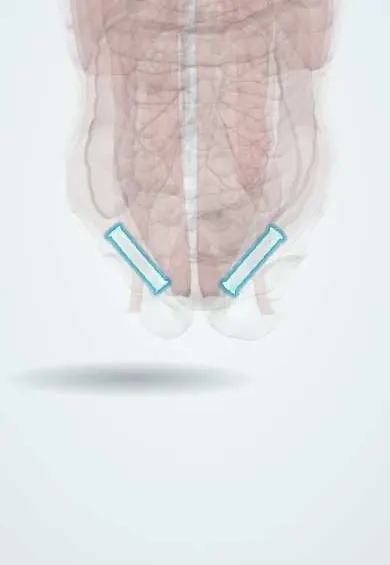
Inguinal canal !
The inguinal canal is a short passage through the lower belly wall in the groin; it carries the spermatic cord or round ligament, and groin hernias occur here.
Opens in the Durgical app, no sign-up needed.
What it is
A short tunnel (about 4 cm) through the lower abdominal wall, above the inguinal ligament, from the deep ring to the superficial ring.
What it does
Carries the spermatic cord in men (the round ligament in women). Because it crosses the wall, it is a weak spot.
Key facts
- Where
- Oblique tunnel about 4 cm long, just above medial half of inguinal ligament; deep ring above its midpoint, superficial ring above pubic tubercle
- Attaches
- Front: external oblique aponeurosis; back: transversalis fascia (+ conjoint tendon medially); roof: internal oblique and transversus; floor: inguinal ligament
- Function
- Transmits spermatic cord (male) or round ligament of uterus (female) and the ilioinguinal nerve; indirect hernias enter at deep ring
Relations
- In front
- External oblique aponeurosis along the whole canal, reinforced in its lateral third by the lowest fibres of the internal oblique
- Behind
- Transversalis fascia along the whole canal, reinforced medially by the conjoint tendon; the inferior epigastric vessels lie just medial to the deep ring
- Above
- Roof: the arching lower fibres of internal oblique and transversus abdominis
- Below
- Floor: the in-rolled inguinal ligament, with the lacunar ligament medially
- Contents
- Spermatic cord (ductus deferens, testicular artery, pampiniform plexus, cremasteric vessels, genital branch of the genitofemoral nerve, lymphatics) or the round ligament of the uterus; plus the ilioinguinal nerve. Deep ring: an opening in transversalis fascia; superficial ring: a split in the external oblique aponeurosis
How to find it
The deep ring lies just above the midpoint of the inguinal ligament (halfway between the anterior superior iliac spine and the pubic tubercle); the superficial ring lies just above and lateral to the pubic tubercle. In a standing man, the examiner's little finger can follow the loose scrotal skin up to the superficial ring and feel for an impulse when the person coughs.
Examination
- Cough impulse: an expansile bulge in the groin swelling on coughing indicates a hernia rather than a lymph node or lipoma
- Deep ring occlusion test: with the hernia reduced and pressure over the deep ring, a hernia held back on coughing suggests indirect; one bulging medial to the finger suggests direct. Not reliable on its own
- Getting above the swelling: a scrotal swelling the examiner can't get above extends from the canal (inguinoscrotal hernia); one the examiner can get above is a scrotal lesion
- Position relative to the pubic tubercle separates inguinal (above and medial) from femoral (below and lateral) hernias
On imaging
Dynamic ultrasound with coughing or straining shows the hernia sac and its relation to the inferior epigastric vessels: lateral means indirect, medial means direct. CT or MRI helps when the examination is unclear.
Common problems
- Indirect inguinal hernia: bowel or fat goes through the deep ring along the cord; the most common type, at any age.
- Direct inguinal hernia: the floor of the canal weakens, usually in older men.
- A hernia that gets stuck (incarcerated) and loses its blood supply (strangulated) is an emergency.
How it is diagnosed
A bulge in the groin that grows when coughing or standing; ultrasound if unclear.
Treatment
- Repair with a mesh, open or laparoscopic.
Clinical notes
- Indirect hernia follows a patent processus vaginalis; it is the most common groin hernia in both sexes and in children, more often on the right
- Direct hernia: a broad bulge through a weak posterior wall in older men; its wide neck makes strangulation less likely
- Femoral hernia passes through the femoral canal below the inguinal ligament; more common in women and, with its narrow neck, prone to strangulation
- Open repair can injure or trap the ilioinguinal, iliohypogastric or genital branch of the genitofemoral nerve, causing chronic groin pain or numbness of the groin and scrotum or labium
- In a woman the canal carries the round ligament; a canal of Nuck cyst or hernia is the female counterpart of a patent processus vaginalis
Development
The gubernaculum guides the testis from the posterior abdominal wall through the canal, which it usually completes by birth, pushing a peritoneal pouch (processus vaginalis) ahead of it. If the pouch fails to close, an indirect hernia or a hydrocele can follow.
Memory aid
English mnemonic MALT, going round the canal from the roof: Muscles (internal oblique, transversus) roof; Aponeuroses (external and internal oblique) front; Ligaments (inguinal, lacunar) floor; Tendon and Transversalis fascia (conjoint tendon) back.
Related conditions
Test yourself
Think of the answer, then tap the question to see it.
What landmark separates direct from indirect inguinal hernias?
The inferior epigastric vessels: indirect hernias enter the deep ring lateral to them; direct hernias push through Hesselbach triangle medial to them.
What are the boundaries of Hesselbach triangle?
Inferior epigastric vessels laterally, the lateral border of the rectus abdominis medially and the inguinal ligament below.
What forms the walls of the inguinal canal?
Front: external oblique aponeurosis; back: transversalis fascia (plus conjoint tendon medially); roof: internal oblique and transversus; floor: inguinal ligament.
Which nerve runs in the inguinal canal outside the spermatic cord?
The ilioinguinal nerve, which leaves through the superficial ring; it can be injured or trapped in open repair, causing chronic groin pain or numbness.
How do inguinal and femoral hernias relate to the pubic tubercle?
Inguinal hernias appear above and medial to the pubic tubercle; femoral hernias below and lateral to it, under the inguinal ligament.
Educational information, not medical advice. For any symptom, see a health professional.
Its names
- Official Latin (TA2)
- canalis inguinalis; anulus inguinalis profundus; anulus inguinalis superficialis TA2 2381
- Official Spanish (DeCS)
- Conducto inguinal DeCS D007264
- English (TA2)
- Inguinal canal
- Also called
- internal inguinal ring · external inguinal ring
Related
Sources: Terminologia Anatomica (TA2); DeCS; Anatomy, Abdomen and Pelvis: Inguinal Region (Inguinal Canal).
Spotted a mistake?We are always improving for the community. Tell us what is wrong and our team will review it.Report a mistake
Representative model, for educational purposes only.