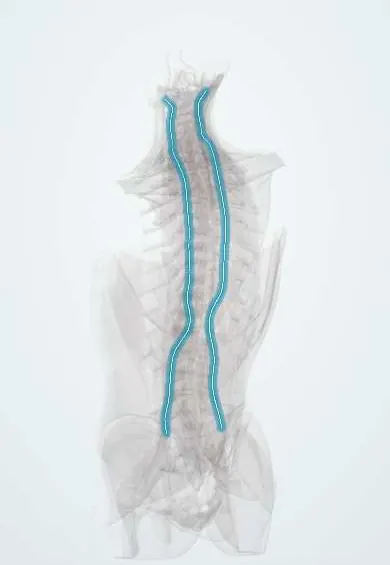
Intertransverse ligaments !
The intertransverse ligaments are thin ligaments between the side wings (transverse processes) of neighbouring vertebrae; they limit side bending.
Opens in the Durgical app, no sign-up needed.
What it is
Thin ligaments between the transverse processes (side wings) of neighbouring vertebrae.
What it does
Limit side bending to the other side.
Key facts
- Attaches
- Between adjacent transverse processes; scattered fibres in neck, cord-like in thoracic, thin membranes in lumbar region
- Function
- Limit lateral flexion to the opposite side
- Tight in
- Lateral flexion to the opposite side
Relations
- In front
- Lumbar region: psoas major and quadratus lumborum, with the ventral rami of the spinal nerves
- Behind
- Erector spinae (longissimus, iliocostalis) and the dorsal rami of the spinal nerves
- Medial
- The outer opening of the intervertebral foramen with the exiting nerve root
How to find it
Found in dissection deep to the erector spinae, stretched between neighbouring transverse processes. It changes by region: a few loose fibres beside the intertransversarii in the neck, rounded cords blended with the deep muscles in the thorax, and a thin sheet in the lumbar region, where the anterior layer of the thoracolumbar fascia attaches to it.
On imaging
Not seen as a separate structure on routine CT or MRI; on axial MRI the plane at the transverse processes, with psoas and quadratus lumborum in front and the erector spinae behind, marks it. After posterolateral fusion, CT looks for solid bone bridging the transverse processes.
Clinical notes
- Far lateral (extraforaminal) disc herniations lie just in front of its medial part; the paraspinal (Wiltse) approach between multifidus and longissimus reaches them by opening it
- In posterolateral fusion the graft bed lies on it, close to the exiting root in front
- Lumbar transverse process fractures, from a direct blow or a violent muscle pull, tear these ligaments; on their own they are stable, but they can signal kidney or other abdominal injury
Test yourself
Think of the answer, then tap the question to see it.
Which movement do the intertransverse ligaments limit?
Lateral flexion to the opposite side; they are the weakest spinal ligaments, with a minor role in stability.
In the lumbar region, which nerve branches run in front of and behind the intertransverse membrane?
The ventral ramus runs in front of it and the dorsal ramus behind it; the membrane separates the front and back muscle groups.
Why do the intertransverse ligaments matter in posterolateral fusion?
The bone graft is laid over the transverse processes and this membrane, close to the exiting root in front.
Educational information, not medical advice. For any symptom, see a health professional.
Its names
- Official Latin (TA2)
- ligamenta intertransversaria TA2 1676
- Official Spanish (DeCS)
- Ligamentos intertransversos
- English (TA2)
- Intertransverse ligaments
Related
Sources: Terminologia Anatomica (TA2); Anatomy, Back, Lumbar Spine; Anatomy of the Human Body (20th ed.): Articulations of the Vertebral Column (Lea & Febiger (Gray's Anatomy, 1918), 1918) · adapted, Public domain; Anatomy of the Human Body (20th ed.): The Deep Muscles of the Back (Lea & Febiger (Gray's Anatomy, 1918), 1918) · adapted, Public domain.
Spotted a mistake?We are always improving for the community. Tell us what is wrong and our team will review it.Report a mistake
Representative model, for educational purposes only.