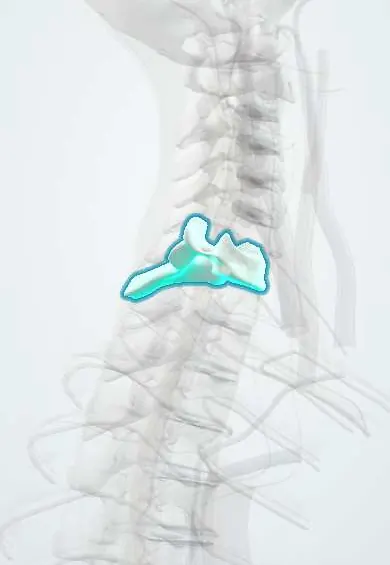
C7 vertebra !
C7 is the lowest neck vertebra; its long spinous process is the bump felt at the base of the neck (vertebra prominens).
Official name: Vertebra prominens
Opens in the Durgical app, no sign-up needed.
What it is
The lowest neck vertebra, with a long spinous process you can feel at the base of the neck (the 'vertebra prominens').
What it does
Stacks with the other neck vertebrae to hold up the head, protect the spinal cord and let the neck bend and turn.
Key facts
- Joints with
- C6 above (disc, facet and uncovertebral joints); T1 below (C7–T1 disc and facet joints)
- Landmarks
- Vertebra prominens: long non-bifid spinous process, easily felt; small transverse foramen, usually only vertebral veins pass; may carry a cervical rib
Relations
- In front
- Esophagus and trachea; on the left the thoracic duct arches forward over the dome of the pleura at about this level to reach the junction of the internal jugular and subclavian veins
- Lateral
- Dome of the pleura and the subclavian artery below and in front; the cervicothoracic (stellate) ganglion of the sympathetic trunk lies in front of the transverse process; the vertebral artery usually passes in front of it to enter at C6
- Behind
- Long, non-bifid spine: attachment of the lower nuchal ligament, trapezius, rhomboids (minor) and splenius
- Contents
- Spinal cord at about the C8 segment, the lowest part of the cervical enlargement (hand muscles)
How to find it
A finger run down the back of the neck meets the first large spine that stays fixed when the head is tilted back: usually C7 (C6 slides forward and fades). To tell C7 from T1, the head is turned from side to side: C7 moves slightly under the finger, T1 stays still.
Examination
- Elevated arm stress test (Roos): both arms held up with the elbows bent at shoulder height while the hands open and close for up to three minutes; early heaviness, numbness or inability to continue on one side supports thoracic outlet syndrome, though false positives are common
- Adson test: with the arm slightly extended, the head is turned toward that side and a deep breath held; loss of the radial pulse with symptoms points to compression of the subclavian artery, but the pulse also drops in many healthy people
On imaging
A lateral cervical film must show the top of T1; the shoulders often hide it, so a swimmer's view (one arm raised) or CT is used. The AP view shows a cervical rib or a long C7 transverse process: C7 transverse processes point downwards, those of T1 upwards.
Common problems
- Wear and bone spurs (cervical spondylosis), most often at C5-C6 and C6-C7.
- Spurs or a disc can narrow the canal (pressing the cord) or a side opening (pinching a nerve root).
- Fractures from falls, car accidents or diving.
How it is diagnosed
X-rays show alignment and spurs. MRI shows discs, nerves and the spinal cord. CT shows bone detail.
Treatment
- Most neck pain settles with time, activity changes, physical therapy and pain medicine.
- Surgery if a nerve or the cord is pressed and symptoms are severe or getting worse, for example ACDF.
Clinical notes
- Clay-shoveler's fracture: avulsion of a lower cervical or upper thoracic spinous process, most often C7, from a sudden muscle pull; stable
- Thoracic outlet syndrome from a cervical rib is mostly neurogenic (ulnar-side hand numbness and wasting); the arterial form can cause a subclavian aneurysm and clots to the hand
- C8 radiculopathy (C7–T1 disc): weak finger flexors and small hand muscles and a numb little finger, to be told apart from ulnar nerve entrapment
Anatomical variants
- Cervical rib: commonly quoted in about 0.5–1% of people, often on both sides, mostly without symptoms
- A bifid spine is unusual at C7, unlike C2–C4
- In a minority the vertebral artery enters the transverse foramen of C7 (or a higher level) instead of C6
Development
Every cervical transverse process includes a costal (rib) element, the anterior bar and tubercle; at C7 this element occasionally grows on its own into a cervical rib.
Related conditions
Test yourself
Think of the answer, then tap the question to see it.
Why is the C7 vertebra called the vertebra prominens, and what is the pitfall when counting from it?
Its long, non-bifid spine is the usual starting point for counting, but T1 is often just as prominent, so one-level errors are common.
By palpation, how is the spine of the C7 vertebra told apart from C6 and T1?
C6 slides forward and fades when the neck extends; when the head turns side to side, C7 moves slightly while T1 stays still.
What can a cervical rib from the C7 vertebra compress?
The lower trunk of the brachial plexus and the subclavian artery: thoracic outlet syndrome, mostly neurogenic (ulnar-side hand numbness and wasting).
What is a clay-shoveler's fracture, and which vertebra does it most often affect?
An avulsion of a spinous process from a sudden muscle pull, most often of the C7 vertebra; it is stable.
Educational information, not medical advice. For any symptom, see a health professional.
Its names
- Official Latin (TA2)
- vertebra prominens TA2 1057
- Official Spanish (DeCS)
- Vértebras cervicales DeCS D002574
- English (TA2)
- Vertebra prominens
- Also called
- vertebra C7 · os vertebrale prominens
Related
- C6–C7 disc
- C7–T1 disc
- Anterior longitudinal ligament
- Rib-to-spine ligaments
- Endplates
- Neck facet joints
- Interspinales
- Interspinous ligaments
Sources: Terminologia Anatomica (TA2); DeCS; Anatomy, Head and Neck: Cervical Vertebrae; Anatomy, Back, Cervical Vertebrae.
Spotted a mistake?We are always improving for the community. Tell us what is wrong and our team will review it.Report a mistake
Representative model, for educational purposes only.