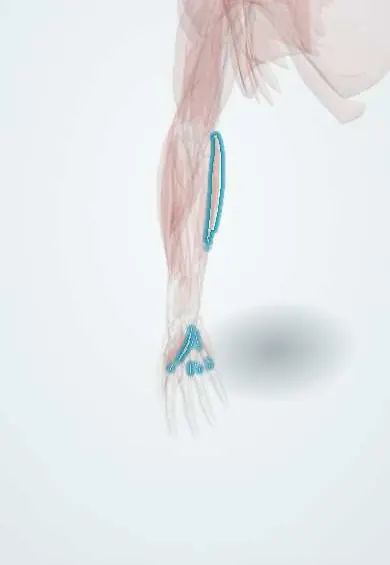
Palmaris longus !
The palmaris longus is a slender forearm muscle with a long tendon to the palm; it tightens the palm, weakly bends the wrist and is absent in some people.
Opens in the Durgical app, no sign-up needed.
What it is
A small forearm muscle with a long thin tendon to the palm; missing in some people.
What it does
Tightens the palm and weakly bends the wrist.
Key facts
- Origin
- Medial epicondyle
- Insertion
- Flexor retinaculum and palmar aponeurosis
- Action
- Flexes the wrist; tenses the palmar aponeurosis
- Nerve
- Median nerve (C7–C8)
- Blood supply
- Ulnar artery
Relations
- Superficial
- Antebrachial fascia and skin; at the wrist it crosses in front of the flexor retinaculum, with the palmar cutaneous branch of the median nerve close to its radial side
- Deep
- Flexor digitorum superficialis (FDS) in the forearm; at the wrist, the median nerve
- Lateral
- Flexor carpi radialis
- Medial
- Flexor carpi ulnaris, with the ulnar artery and nerve running under cover of it
How to find it
Touching the thumb tip to the little-finger tip while flexing the wrist slightly makes its thin tendon stand out in the middle of the front of the wrist; if no cord appears the muscle is probably absent.
Examination
- Schaeffer test (thumb-to-little-finger opposition with slight wrist flexion): a visible tendon shows the muscle is present; no tendon suggests it is absent, checked before planning a graft
On imaging
Ultrasound confirms whether it is present before it is taken as a tendon graft: in a transverse view at the wrist it is a thin, flat tendon superficial to the flexor retinaculum, just in front of the median nerve. Absence on one or both sides is a normal variant, not a finding. Radiographs do not show it; MRI shows it only incidentally.
Clinical notes
- Harvested through small transverse incisions; when it is absent, the median nerve has been taken by mistake, so the tendon is identified before it is cut
- Camitz opponensplasty: the tendon, lengthened with a strip of palmar aponeurosis, is moved to the abductor pollicis brevis (APB) insertion to restore thumb abduction in severe carpal tunnel syndrome
- Can be rerouted to the extensor pollicis longus (EPL) in radial nerve palsy transfers
Anatomical variants
- One of the most variable muscles: absent, reversed (belly at the wrist, tendon above), duplicated or with a belly in the middle
- A reversed or distal belly can present as a wrist mass or compress the median nerve
Related conditions
Test yourself
Think of the answer, then tap the question to see it.
How often is the palmaris longus absent, and what is the functional cost?
In a sizeable minority, up to about a quarter in some series (it varies by population), with little loss of function.
What is the Schaeffer test for the palmaris longus?
Thumb-to-little-finger opposition with slight wrist flexion: a visible tendon shows the muscle is present; it is checked before planning a graft.
Why must the palmaris longus tendon be identified before harvest?
The median nerve lies just deep and slightly lateral to it; when the muscle is absent, the nerve has been taken by mistake.
Educational information, not medical advice. For any symptom, see a health professional.
Its names
- Official Latin (TA2)
- musculus palmaris longus TA2 2482
- Official Spanish (DeCS)
- Músculo palmar largo
- English (TA2)
- Palmaris longus
Related
Sources: Terminologia Anatomica (TA2); Anatomy, Shoulder and Upper Limb, Hand Palmaris Tendon; Anatomy, Shoulder and Upper Limb, Forearm Compartments.
Spotted a mistake?We are always improving for the community. Tell us what is wrong and our team will review it.Report a mistake
Representative model, for educational purposes only.