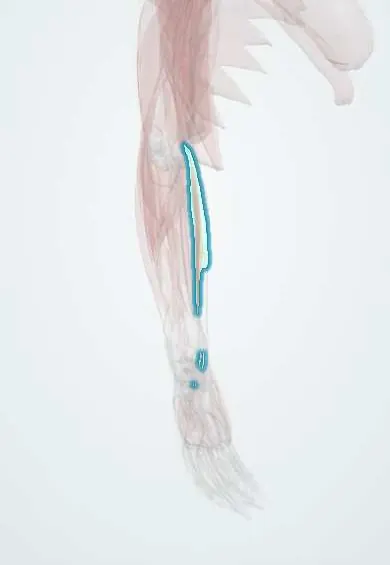
Medial epicondylitis (golfer's elbow) !
Golfer's elbow (medial epicondylitis) is wear of the tendon that anchors the wrist flexors to the inner elbow; it hurts with gripping and wrist bending.
Updated 2026-10-29
Structures involved
Tap one to see what it is and open it in 3D.
- Flexor carpi radialis
- Pronator teres
- Humerus
- Palmaris longus
- Flexor carpi ulnaris
- FDS
- UCL (elbow)
- Ulnar nerve
Why it happens
What it is
A degenerative tendinopathy of the common flexor-pronator origin at the medial epicondyle of the humerus, caused by repeated wrist flexion and forearm pronation. Known as golfer's elbow.
Who gets it
Much less common than lateral epicondylitis. Usually affects adults in their 40s and 50s, manual workers and people in throwing, racquet or golf sports.
Causes
- Repetitive wrist flexion and forearm pronation
- Repeated valgus stress in throwing sports
- Forceful gripping with manual tools or heavy lifting
Risk factors
- Manual labour with repetitive forceful gripping
- Golf, throwing sports, racquet sports and weight training
- Age between about 40 and 60
- Smoking, obesity and diabetes (reported in some studies)
Pathophysiology
The common flexor origin gives rise to pronator teres, flexor carpi radialis, palmaris longus, flexor digitorum superficialis and flexor carpi ulnaris; pronator teres and flexor carpi radialis are most often affected. Repeated microtears fail to heal and lead to angiofibroblastic degeneration (tendinosis) rather than true inflammation.
Symptoms and signs
- Pain and tenderness just distal and anterior to the medial epicondyle
- Pain worse with gripping, wrist flexion and pronation
- Weak grip
- Gradual onset, sometimes after a change in activity
Diagnosis
- Clinical
- Tenderness over the common flexor origin; pain on resisted wrist flexion and resisted forearm pronation. Clinicians also check the ulnar nerve and the ulnar collateral ligament (valgus stress), which can be injured at the same time.
- Tests
- Not usually needed. Nerve studies if ulnar neuropathy is suspected.
- Imaging
- Diagnosis is clinical. X-ray rules out other bony causes; ultrasound or MRI shows tendon changes and helps in unclear or refractory cases.
Differential diagnosis
- Ulnar collateral ligament injury
- Cubital tunnel syndrome
- Medial epicondyle avulsion (in adolescents)
- Cervical radiculopathy
- Elbow osteoarthritis
Goal of treatment
Reduce pain, restore grip strength and return to work or sport while letting the tendon remodel.
Treatment
- Conservative
- Relative rest, modification of the offending activity, ice and a counterforce strap; most cases improve with time.
- Medical
- Topical or oral NSAIDs for short-term pain relief. Corticosteroid injection gives short-term relief, with care to avoid the ulnar nerve; evidence for longer benefit is limited.
- Rehabilitation
- Physiotherapy with stretching and eccentric strengthening of the wrist flexors and pronators.
- Surgical
- Surgical debridement of the degenerated tendon for symptoms that persist despite months of good conservative care.
Complications
- Chronic pain and recurrence
- Associated ulnar neuropathy
- Tendon weakening after repeated corticosteroid injections
Prognosis
Most patients improve with conservative care over months. Surgery is rarely needed and usually gives good results in refractory cases.
Prevention
- Proper technique and equipment in sport
- Gradual increase in training or work load
- Forearm strengthening and breaks in repetitive tasks
Test yourself
Think of the answer, then tap the question to see it.
Which tendons form the common flexor origin affected in medial epicondylitis?
Pronator teres, flexor carpi radialis, palmaris longus, flexor digitorum superficialis and flexor carpi ulnaris; pronator teres and flexor carpi radialis are most often involved.
Which resisted movements reproduce pain in medial epicondylitis?
Resisted wrist flexion and resisted forearm pronation.
Which nerve is often affected together with medial epicondylitis?
The ulnar nerve, which runs behind the medial epicondyle in the cubital tunnel.
Is medial epicondylitis mainly an inflammatory condition?
No. It is mainly a degenerative tendinosis from repeated microtears that fail to heal.
Related conditions
- Lateral epicondylitis (tennis elbow)
- Cubital tunnel syndrome (ulnar neuropathy at the elbow)
- Elbow dislocation
- Cervical radiculopathy
Educational information, not medical advice. For any symptom, see a health professional.
Sources: Medial Epicondylitis (Golfer's Elbow) (StatPearls (NCBI Bookshelf), 2026).
Spotted a mistake?We are always improving for the community. Tell us what is wrong and our team will review it.Report a mistake
Representative model, for educational purposes only.