Conditions · Pediatrics and neonatology
Duodenal and intestinal atresia !
A newborn's bowel is closed off somewhere along its length, so feeds cannot pass. Babies vomit bile early and need surgery to join the bowel.
Updated 2026-11-01
Structures involved
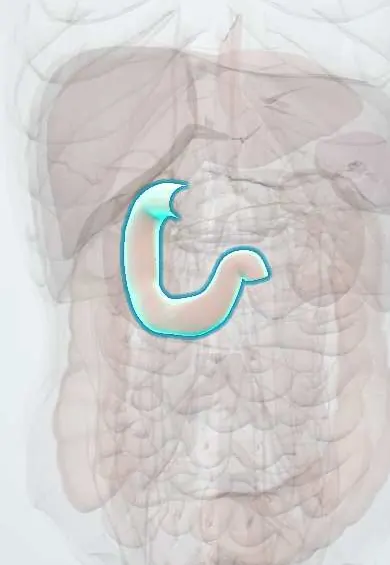
Tap one to see what it is and open it in 3D.
Why it happens
What it is
Congenital complete obstruction (atresia) or narrowing (stenosis) of the bowel lumen. Duodenal atresia usually lies just beyond the ampulla of Vater, so vomiting is bilious; jejunoileal atresia affects the small bowel further down and colonic atresia is rare.
Who gets it
Duodenal atresia occurs in roughly 1 in 5,000–10,000 births, and about a quarter to a third of affected infants have Down syndrome. Jejunoileal atresia has a similar frequency. In Colombia and Latin America it is managed in neonatal surgery units, and prenatal ultrasound increasingly detects it.
Causes
- Duodenal atresia: failure of the duodenal lumen to recanalise after the solid-cord stage in early development
- Duodenal obstruction from an annular pancreas or a preduodenal portal vein
- Jejunoileal and colonic atresia: an intrauterine vascular accident (mesenteric ischaemia) that destroys a bowel segment
- Vascular events secondary to fetal volvulus, intussusception or gastroschisis
Risk factors
- Down syndrome (trisomy 21) for duodenal atresia
- Other anomalies: congenital heart disease, malrotation, oesophageal atresia, VACTERL association
- Gastroschisis (jejunoileal atresia)
- Maternal vasoconstrictive drug use or smoking in pregnancy (jejunoileal atresia)
- Cystic fibrosis with meconium ileus (jejunoileal atresia)
Pathophysiology
Because the fetus swallows amniotic fluid, a high obstruction prevents its absorption and causes polyhydramnios. After birth, swallowed air and feeds collect above the block: in duodenal atresia the stomach and proximal duodenum dilate (the double bubble). Persistent vomiting causes dehydration and loss of gastric acid, with hypochloraemic metabolic alkalosis if losses are mainly gastric. Lower atresias produce progressive abdominal distension and failure to pass meconium.
Classification
- Jejunoileal atresia types: I (mucosal web), II (fibrous cord joining blind ends), IIIa (gap with mesenteric defect), IIIb (apple-peel or Christmas-tree deformity), IV (multiple atresias)
- Duodenal: complete atresia, web (windsock) or stenosis
- By level: duodenal, jejunal, ileal or colonic
Symptoms and signs
- Bilious vomiting within the first day of life (duodenal atresia distal to the ampulla)
- Upper abdominal fullness with a flat lower abdomen in duodenal atresia
- Generalised abdominal distension in lower atresias
- Failure to pass meconium or passage of only small grey plugs
- Feeding intolerance and dehydration
- Polyhydramnios during pregnancy; features of Down syndrome in many infants
Diagnosis
- Clinical
- Suspect in a newborn with early bilious vomiting, especially with polyhydramnios or Down syndrome. Check hydration and look for associated anomalies.
- Tests
- Electrolytes, glucose, blood gas and kidney function to guide fluids; chromosome testing when Down syndrome is suspected. Sweat test or genetic testing for cystic fibrosis in ileal atresia with meconium ileus.
- Imaging
- Plain abdominal radiograph: double-bubble sign with no distal gas in duodenal atresia; multiple dilated loops (triple bubble or more) in jejunoileal atresia. Upper contrast study if distal gas is present to exclude malrotation; contrast enema in low obstruction (microcolon). Echocardiography for heart defects. Prenatal ultrasound shows polyhydramnios and a double bubble.
Differential diagnosis
- Malrotation with midgut volvulus
- Annular pancreas or duodenal web
- Hirschsprung disease
- Meconium ileus
- Hypertrophic pyloric stenosis (non-bilious vomiting, later onset)
Goal of treatment
Decompress the obstructed bowel, correct dehydration and electrolytes, exclude volvulus, and restore bowel continuity surgically while preserving as much bowel length as possible.
Treatment
- Acute
- Nil by mouth and nasogastric or orogastric tube to decompress the stomach and prevent aspiration.
- Acute
- Intravenous fluids and correction of electrolyte and acid–base disturbances; glucose support.
- Surgical
- Surgery once the infant is stable: duodenoduodenostomy (diamond-shaped bypass) for duodenal atresia; resection and anastomosis for jejunoileal atresia, with checks for further atresias. Urgent if volvulus cannot be excluded.
- Medical
- Parenteral nutrition until enteral feeds are tolerated, then gradual feeding.
- Follow-up
- Nursing monitoring: gastric tube output, fluid balance, glucose, abdominal girth and feeding tolerance after repair.
Complications
- Aspiration pneumonia
- Dehydration and electrolyte disturbances
- Anastomotic leak or stricture
- Short bowel syndrome after extensive resection
- Prolonged dysmotility and megaduodenum
- Perforation and peritonitis if diagnosis is delayed
Prognosis
Survival after repair is high; mortality relates mainly to prematurity, heart disease and other anomalies. Untreated atresia is fatal.
Test yourself
Think of the answer, then tap the question to see it.
What is the classic radiographic sign of duodenal atresia?
The double-bubble sign with no gas beyond the duodenum.
Which chromosomal disorder is most associated with duodenal atresia?
Down syndrome (trisomy 21).
What prenatal finding is typical of a high intestinal atresia?
Polyhydramnios.
What causes jejunoileal atresia?
An intrauterine vascular accident that destroys a bowel segment.
Why is vomiting usually bilious in duodenal atresia?
The block usually lies distal to the ampulla of Vater.
Related conditions
- Down syndrome (trisomy 21)
- Intestinal malrotation with midgut volvulus
- Infantile hypertrophic pyloric stenosis
- Hirschsprung disease
- Esophageal atresia and tracheoesophageal fistula
- Gastroschisis and omphalocele
Educational information, not medical advice. For any symptom, see a health professional.
Sources: Duodenal atresia: MedlinePlus Medical Encyclopedia (MedlinePlus (U.S. National Library of Medicine), 2024); Anatomic Problems of the Lower GI Tract - NIDDK (National Institute of Diabetes and Digestive and Kidney Diseases, 2024).
Spotted a mistake?We are always improving for the community. Tell us what is wrong and our team will review it.Report a mistake
Representative model, for educational purposes only.