Conditions · Pediatrics and neonatology
Intestinal malrotation with midgut volvulus !
The bowel did not settle in its normal place before birth and can twist around its blood supply. Green vomiting in a baby is an emergency.
Updated 2026-11-01
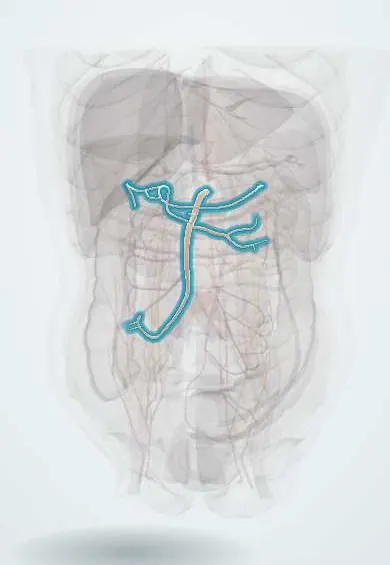
Structures involved
Tap one to see what it is and open it in 3D.
Why it happens
What it is
Malrotation is an abnormal rotation and fixation of the midgut during fetal life, leaving a narrow mesenteric base. The midgut can then twist around the superior mesenteric artery (midgut volvulus), cutting off blood flow to most of the small bowel and the right colon. It is a surgical emergency.
Who gets it
Most symptomatic cases present in the first month of life, and the majority within the first year, though malrotation can be found at any age. Many people with malrotation never have symptoms. In Colombia and Latin America, as elsewhere, delayed recognition of bilious vomiting is the main cause of extensive bowel loss.
Causes
- Arrested or abnormal 270-degree counterclockwise rotation of the midgut around the superior mesenteric artery axis during weeks 5–12
- Abnormal peritoneal (Ladd) bands crossing the duodenum from a malpositioned caecum
- Short, narrow mesenteric pedicle that predisposes to twisting
Risk factors
- Congenital diaphragmatic hernia, gastroschisis or omphalocele (malrotation is part of these)
- Heterotaxy syndromes and congenital heart disease
- Duodenal atresia or web
- Neonatal age
Pathophysiology
With a narrow mesenteric base, the small bowel twists clockwise around the superior mesenteric vessels. Venous and lymphatic outflow is blocked first, causing congestion and oedema, then arterial inflow stops and the whole midgut from the duodenum to the mid-transverse colon becomes ischaemic within hours. Ladd bands or the twist itself also obstruct the duodenum, causing bilious vomiting. Necrosis leads to bleeding, perforation, sepsis and shock.
Symptoms and signs
- Sudden bilious (green) vomiting in a previously well infant
- Abdominal distension may be absent early; later the abdomen becomes distended and tender
- Irritability, pain and refusal to feed
- Blood in the stool or dark red stools (late sign of ischaemia)
- In older children: intermittent abdominal pain, vomiting, failure to thrive or malabsorption
Diagnosis
- Clinical
- Treat bilious vomiting in an infant as midgut volvulus until proven otherwise. A stable infant needs urgent imaging; an infant with peritonitis or shock needs surgery without delay.
- Tests
- Blood count, electrolytes, blood gas with lactate, coagulation and blood group and crossmatch. Acidosis and rising lactate suggest bowel ischaemia.
- Imaging
- Upper gastrointestinal contrast study is the test of choice: the duodenojejunal junction lies right of the midline and below the pylorus, with a corkscrew pattern when volvulus is present. Ultrasound can show the superior mesenteric vein to the left of the artery and the whirlpool sign. Plain films may be normal or show a gasless abdomen.
Differential diagnosis
- Duodenal or jejunal atresia
- Necrotising enterocolitis
- Intussusception
- Hirschsprung disease
- Sepsis with ileus
Goal of treatment
Untwist the bowel as fast as possible to restore blood flow, remove dead bowel while preserving length, and widen the mesenteric base to prevent recurrence.
Treatment
- Acute
- Resuscitation: nil by mouth, gastric decompression, intravenous fluids, correction of acidosis, broad-spectrum antibiotics, and urgent transfer to surgery.
- Surgical
- Emergency Ladd procedure: counterclockwise detorsion, division of Ladd bands, widening of the mesentery, placing small bowel on the right and colon on the left, and appendectomy.
- Surgical
- Resection of frankly necrotic bowel; doubtful bowel may be left and reassessed at a planned second-look operation.
- Follow-up
- Postoperative monitoring: perfusion, urine output, lactate, nasogastric output and feeding progress; long-term follow-up for short bowel syndrome if bowel was lost.
Complications
- Extensive midgut necrosis and death
- Short bowel syndrome and intestinal failure
- Sepsis and peritonitis
- Adhesive small bowel obstruction
- Recurrent volvulus (uncommon after a Ladd procedure)
Prognosis
With early detorsion before necrosis, survival is very high and bowel function normal. Loss of most of the midgut carries high mortality and lifelong intestinal failure, sometimes needing intestinal transplantation.
Test yourself
Think of the answer, then tap the question to see it.
What symptom in a newborn should be treated as midgut volvulus until proven otherwise?
Bilious (green) vomiting.
Around which vessel does the midgut twist in volvulus?
The superior mesenteric artery.
What is the imaging test of choice in a stable infant with suspected malrotation?
An upper gastrointestinal contrast study.
What surgical procedure treats malrotation with volvulus?
The Ladd procedure.
Why is an appendectomy done during a Ladd procedure?
The appendix ends up in the left abdomen, which would confuse a later diagnosis of appendicitis.
Related conditions
- Duodenal and intestinal atresia
- Intussusception (children)
- Necrotising enterocolitis
- Short bowel syndrome
- Acute mesenteric ischaemia
- Peritonitis
Educational information, not medical advice. For any symptom, see a health professional.
Sources: Volvulus - childhood: MedlinePlus Medical Encyclopedia (MedlinePlus (U.S. National Library of Medicine), 2024); Anatomic Problems of the Lower GI Tract - NIDDK (National Institute of Diabetes and Digestive and Kidney Diseases, 2024).
Spotted a mistake?We are always improving for the community. Tell us what is wrong and our team will review it.Report a mistake
Representative model, for educational purposes only.