
Esophageal stricture
A narrowing of the food pipe, usually from scar tissue. Solid food starts to stick, and it slowly gets worse.
What it is
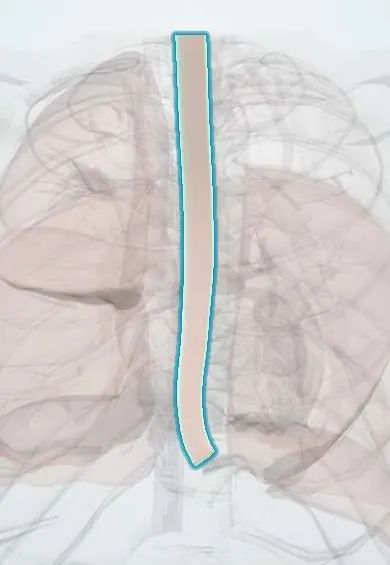
A fixed narrowing of the esophageal lumen. Benign strictures are scars after injury: in Western countries most are peptic (from reflux), and others follow eosinophilic esophagitis, caustic ingestion, radiation, surgery or endoscopic resection. A malignant stricture is caused by cancer. The typical complaint is dysphagia for solids.
Who gets it
In Western populations peptic strictures make up about 60–70% of benign esophageal strictures, eosinophilic esophagitis about 15–30% (a leading cause of dysphagia under the age of 40) and surgical, endoscopic and radiation injury about 10–20%. Caustic strictures remain common where access to care is limited. Strictures after eosinophilic esophagitis and wide endoscopic resection are being seen more often.
Causes
- Peptic: long-standing gastro-oesophageal reflux, at the lower esophagus
- Eosinophilic esophagitis: fibrosis after years of allergic inflammation
- Caustic ingestion (alkali or acid)
- Radiation to the chest
- Surgical anastomosis and wide endoscopic resection (more than three quarters of the circumference)
- Medicines that injure the lining
- Malignant: esophageal cancer
Risk factors
- Long-standing heartburn and reflux, especially untreated
- Eosinophilic esophagitis diagnosed late
- Past caustic ingestion
- Chest radiotherapy
- Esophageal surgery or extensive endoscopic resection
Pathophysiology
Injury breaks the epithelial barrier → chronic inflammation → fibroblasts turn into myofibroblasts (mainly through TGF-β signalling) and lay down collagen → the scar contracts and narrows the lumen → a solid bolus meets resistance and sticks, while liquids still pass. If the injury goes on, each dilation is followed by new scarring and the stricture returns.
Classification
- By cause: benign (peptic, eosinophilic, caustic, radiation, anastomotic, after endoscopic resection, medicine-induced) or malignant
- Simple (short, straight, an endoscope can pass) or complex (long, angulated or very tight)
- Refractory: a target diameter of 14 mm cannot be reached despite repeated dilations every 2 weeks; recurrent: the diameter reached cannot be kept for 4 weeks
Symptoms and signs
- Dysphagia for solids that slowly progresses; liquids pass until late
- Food sticking behind the breastbone, sometimes a food bolus impaction
- Regurgitation of undigested food
- A long history of heartburn in peptic strictures
- Weight loss when eating becomes difficult
Diagnosis
- Clinical
- Dysphagia to solids, more than liquids and getting worse, points to a mechanical narrowing. A long heartburn history without weight loss favours a peptic stricture; an older patient with marked weight loss and a short history needs cancer excluded; intermittent food impaction in a young man suggests eosinophilic esophagitis.
- Tests
- Upper endoscopy is the first test: it shows the stricture and allows biopsies, taken to exclude cancer and to look for eosinophilic esophagitis. Blood count if bleeding or anaemia is suspected.
- Imaging
- Barium swallow (with a barium tablet for subtle narrowing) shows the length, diameter and number of strictures and helps plan the dilation of complex strictures; CT stages a suspected cancer.
Differential diagnosis
- Esophageal cancer
- Achalasia and other motility disorders
- Schatzki ring and esophageal web
- Eosinophilic esophagitis without a fixed stricture
- Compression from outside the esophagus (mediastinal mass)
- Oropharyngeal dysphagia
Strictures by cause: the history gives it away
| Cause | Typical patient | What it looks like | Treat the cause |
|---|---|---|---|
| Peptic (reflux) | Long heartburn history, no weight loss | Short, smooth, at the lower end | Long-term acid suppression after dilation |
| Eosinophilic esophagitis | Young adult, often a man with allergies, with episodes of food impaction | Rings or a long narrow segment | Treat the eosinophilic inflammation; dilate gently |
| Caustic or radiation | Past ingestion or chest radiotherapy | Often long, tight and complex; recurs easily | Repeated dilations; some need stents or surgery |
| Malignant | Older patient, short history, marked weight loss | Irregular, firm narrowing; biopsy shows cancer | Cancer treatment; dilation is not the answer |
Goal of treatment
Let the person eat normally by widening the lumen, and stop the injury that made the scar so that it does not narrow again.
Treatment
- Procedure
- Endoscopic dilation with bougies (Savary, passed over a guide wire) or balloons, usually over several sessions until a target diameter is reached; the diameter is increased in small steps to limit perforation.
- Medical
- Treat the cause: long-term proton pump inhibitor for peptic strictures, which reduces the need for repeat dilation; treatment of the inflammation in eosinophilic esophagitis.
- Procedure
- Refractory strictures: steroid injection into the stricture with dilation, incisional therapy for short rings and anastomotic strictures, temporary stents, or self-dilation at home in selected patients.
- Surgical
- Surgery (resection or replacement of the esophagus) for strictures that fail endoscopic treatment, as after severe caustic injury; antireflux surgery as an alternative to acid suppression in selected patients.
Complications
- Food bolus impaction
- Weight loss and malnutrition
- Aspiration of retained food
- Perforation or bleeding after dilation
- Recurrence and refractory stricture
Common traps
- A smooth stricture is surely benign: every new stricture is biopsied, because a cancer can look like a scar
- Dilation cures the stricture: it only stretches the scar; without treating the cause (acid, eosinophils) it comes back
- Dysphagia to solids and liquids from the start means a stricture: a fixed narrowing stops solids first; both from the start suggests a motility disorder such as achalasia
- In a young adult a stricture must be from reflux: under 40, eosinophilic esophagitis is a leading cause, especially with episodes of food impaction
Prognosis
Most peptic strictures respond to a few dilations plus acid suppression. Caustic, radiation and long complex strictures recur more often and may need many sessions, stents or surgery. Malignant strictures carry the prognosis of the cancer.
Prevention
- Treat reflux early and keep it controlled
- Diagnose and treat eosinophilic esophagitis early
- Store caustic products safely, out of children's reach
- Preventive steroid treatment after wide circumferential endoscopic resection
Test yourself
Think of the answer, then tap the question to see it.
Why does a stricture cause dysphagia for solids before liquids?
A fixed narrowing holds back a solid bolus but lets liquids through until the lumen becomes very narrow.
Why is every new esophageal stricture biopsied?
To exclude cancer, which can mimic a benign scar, and to look for eosinophilic esophagitis.
What is the most common cause of benign esophageal stricture in Western countries?
Peptic stricture from long-standing gastro-oesophageal reflux (about 60–70%).
Why is acid suppression continued after dilating a peptic stricture?
It stops the ongoing acid injury and reduces the need for repeat dilations.
Which features of dysphagia suggest cancer rather than a peptic stricture?
A short history (under about 4 months), steady progression, older age and marked weight loss.
Connections
Educational information, not medical advice. For any symptom, see a health professional.
Sources: Endoscopic treatment of benign esophageal strictures: Advances and challenges (World Journal of Gastrointestinal Surgery, 2025); The occurrence and development mechanisms of esophageal stricture: state of the art review (Journal of Translational Medicine, 2024); Dysphagia (WGO Global Guidelines) (World Gastroenterology Organisation, 2014).
Spotted a mistake?We are always improving for the community. Tell us what is wrong and our team will review it.Report a mistake
Representative model, for educational purposes only.