Follicular, oncocytic (Hürthle cell) and anaplastic thyroid carcinoma !
Thyroid cancers of the follicular cells other than papillary: follicular and oncocytic types spread through the blood; anaplastic grows fast and is deadly.
Updated 2026-11-01
Structures involved
Tap one to see what it is and open it in 3D.
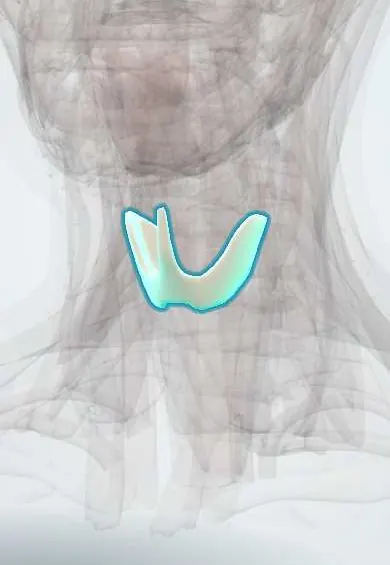
- Thyroid gland
- Trachea
- Neck lymph nodes
- Recurrent laryngeal nerves
- Parathyroid glands
- Esophagus
- Inferior thyroid artery
Why it happens
- Invasion and metastasis: the metastatic cascade, step by step
- Oncogenes: RAS, MYC, HER2, BCR-ABL and the table to know
- Differentiation and anaplasia: how a tumour cell looks under the microscope
- Frozen section: the intraoperative consultation
- Cytology: the Pap test, fine-needle aspiration and body fluids
- Pathways of spread and the usual metastatic sites
Show 1 more
What it is
A group of cancers arising from the thyroid follicular cells. Follicular carcinoma and its oncocytic (Hürthle cell) relative are well-differentiated tumours defined by invasion of the capsule or blood vessels, and they spread mainly through the bloodstream. Anaplastic (undifferentiated) carcinoma has lost thyroid features, grows within weeks and is one of the most lethal human cancers.
Who gets it
Follicular carcinoma makes up roughly a tenth of thyroid cancers, is more frequent in women and in middle age, and is relatively more common where dietary iodine has been low; mountainous areas of Colombia and the Andes had endemic goitre before salt iodisation. Oncocytic carcinoma affects mostly people over 40. Anaplastic carcinoma accounts for under 2% of thyroid cancers and usually occurs after age 60, often in someone with a long-standing goitre.
Causes
- Follicular: RAS mutations and PAX8-PPARG rearrangements; iodine deficiency is a background factor
- Oncocytic: follicular-cell tumour made mostly of mitochondria-rich oncocytes, now classed separately from follicular carcinoma
- Anaplastic: dedifferentiation of a pre-existing well-differentiated cancer, with TP53 and TERT promoter mutations; about a quarter carry BRAF V600E
- Prior neck irradiation raises the risk of differentiated thyroid cancer
Risk factors
- Iodine deficiency and long-standing goitre
- Female sex (follicular) and older age (oncocytic and anaplastic)
- Radiation exposure of the neck in childhood
- Pre-existing untreated differentiated thyroid cancer (anaplastic)
Pathophysiology
Follicular carcinoma looks like a benign follicular adenoma on cytology; only invasion through the capsule or into vessels proves malignancy, which is why fine-needle aspiration cannot tell them apart. Because the tumour invades vessels, it seeds lung and bone rather than neck lymph nodes. Differentiated tumours keep TSH dependence, iodine uptake and thyroglobulin secretion, which treatment and follow-up exploit; oncocytic tumours take up radioiodine poorly. Anaplastic carcinoma loses all of these features and invades the trachea, oesophagus and recurrent laryngeal nerves.
Classification
- Follicular carcinoma: minimally invasive (capsular only), encapsulated angioinvasive, widely invasive
- Oncocytic (Hürthle cell) carcinoma
- Poorly differentiated thyroid carcinoma (intermediate behaviour)
- Anaplastic carcinoma: always stage IV (IVA in the thyroid, IVB with neck extension, IVC with distant metastases)
Symptoms and signs
- Solitary painless thyroid nodule, usually without palpable neck nodes (follicular)
- Bone pain or pathological fracture, or lung nodules, as the first sign of metastatic follicular cancer
- Rapidly enlarging hard, fixed neck mass over weeks (anaplastic)
- Hoarseness from vocal cord paralysis
- Difficulty swallowing and breathing, stridor
Diagnosis
- Clinical
- Neck examination of the nodule, its fixation and the lymph nodes; laryngoscopy to check vocal cord movement before surgery; history of goitre, iodine deficiency and neck irradiation.
- Tests
- TSH first. Fine-needle aspiration: a follicular or oncocytic neoplasm is reported as indeterminate, and the diagnosis needs surgical removal and histology showing capsular or vascular invasion; molecular testing can refine risk. In suspected anaplastic carcinoma, FNA or core biopsy with urgent pathology and BRAF V600E testing. Serum thyroglobulin is a tumour marker only after total thyroidectomy.
- Imaging
- Neck ultrasound for the nodule and nodes. For anaplastic carcinoma, urgent CT or MRI of the neck and chest and PET-CT for staging. After treatment of differentiated cancer, whole-body radioiodine scanning looks for iodine-avid metastases.
Differential diagnosis
- Follicular adenoma and benign nodular goitre
- Papillary thyroid carcinoma, including its follicular variant
- Medullary thyroid carcinoma
- Primary thyroid lymphoma (fast-growing mass, often with Hashimoto thyroiditis)
- Subacute or Riedel thyroiditis
Goal of treatment
For differentiated tumours, remove the cancer, destroy residual iodine-avid tissue when risk is high and follow with thyroglobulin. For anaplastic carcinoma, secure the airway, treat fast with a team, and choose targeted therapy when BRAF V600E is present.
Treatment
- Surgical
- Diagnostic lobectomy for an indeterminate follicular or oncocytic nodule, followed by completion or total thyroidectomy when carcinoma is confirmed and the risk warrants it.
- Medical
- Radioactive iodine after total thyroidectomy for higher-risk differentiated disease and iodine-avid metastases, with levothyroxine afterwards at a TSH target set by recurrence risk. Kinase inhibitors for progressive radioiodine-refractory disease.
- Acute
- Anaplastic carcinoma: urgent airway assessment, with tracheostomy when needed; resection only when the tumour is localised.
- Medical
- Anaplastic carcinoma with BRAF V600E: combined BRAF and MEK inhibitors; otherwise chemotherapy (taxanes, anthracyclines, platinum agents) with external beam radiotherapy; early palliative care.
- Follow-up
- Differentiated cancer: serum thyroglobulin with thyroglobulin antibodies and neck ultrasound; calcium and voice checks after surgery.
Complications
- Distant metastases to lung and bone (follicular and oncocytic)
- Radioiodine-refractory disease
- Airway obstruction and death from uncontrolled neck disease (anaplastic)
- Hypoparathyroidism and recurrent laryngeal nerve palsy after surgery
- Hypothyroidism requiring lifelong replacement
Prognosis
Follicular carcinoma without vascular invasion is usually cured; prognosis worsens with wide invasion, older age and radioiodine-resistant metastases. Oncocytic carcinoma behaves similarly or somewhat worse. Anaplastic carcinoma has a median survival measured in months, although BRAF-targeted therapy has improved outcomes for some patients.
Prevention
- Adequate iodine intake (salt iodisation)
- Avoiding unnecessary neck irradiation in children
Test yourself
Think of the answer, then tap the question to see it.
Why can fine-needle aspiration not distinguish follicular carcinoma from follicular adenoma?
Malignancy is defined by capsular or vascular invasion, which only histology of the removed nodule can show.
How does follicular thyroid carcinoma usually spread, compared with papillary carcinoma?
Through the blood to lung and bone, whereas papillary carcinoma spreads mainly to neck lymph nodes.
An older adult with a long-standing goitre develops a hard neck mass that grows over weeks with hoarseness and stridor. Likely diagnosis?
Anaplastic thyroid carcinoma (primary thyroid lymphoma is the key differential).
Which tumour marker is followed after total thyroidectomy for follicular carcinoma?
Serum thyroglobulin, interpreted together with thyroglobulin antibodies.
Which mutation should be tested in anaplastic thyroid carcinoma, and why?
BRAF V600E, because positive tumours can be treated with combined BRAF and MEK inhibitors.
Related conditions
- Thyroid cancer (papillary)
- Medullary thyroid carcinoma
- Thyroid nodule
- Goitre
- Hypothyroidism
- Hypoparathyroidism (incl. post-thyroidectomy hypocalcaemia)
- Non-Hodgkin lymphoma
- Thyroiditis (subacute, painless and postpartum)
Educational information, not medical advice. For any symptom, see a health professional.
Sources: Thyroid Cancer Treatment (PDQ®)–Health Professional Version (National Cancer Institute (PDQ), 2025); Thyroid Cancer | American Thyroid Association (American Thyroid Association, 2025); Anaplastic Thyroid Cancer (American Thyroid Association, 2025).
Spotted a mistake?We are always improving for the community. Tell us what is wrong and our team will review it.Report a mistake
Representative model, for educational purposes only.