
Hepatoblastoma
The main liver cancer of toddlers: a big belly lump in a child who looks well. Most children are cured if the whole tumour can be removed.
Quick facts
- Key signs
- Painless · A child who otherwise looks well
- Diagnosis
- Biopsy
Red flags ↓
No doses: the clinician sets them by the current guideline.
What it is
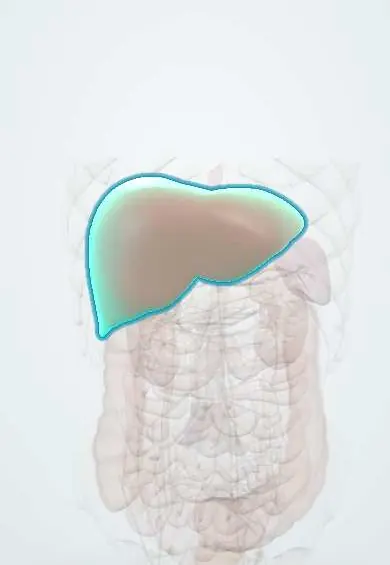
Hepatoblastoma is a malignant embryonal tumour of the liver built from cells that resemble the immature liver of the fetus (hepatoblasts). It is the most common primary liver cancer in children and appears mostly before age 3. It usually secretes alpha-fetoprotein (AFP), which serves for diagnosis and follow-up. Cure needs complete surgical removal, usually after chemotherapy has shrunk the tumour, or a liver transplant when it cannot be removed.
Who gets it
Rare, about 1 in a million children per year, but the most common liver cancer of childhood, with a median age of about 18 months; boys are affected somewhat more often. Its incidence has been rising, largely because more very premature babies now survive. In Colombia, childhood cancer is a notifiable event monitored by the national public health surveillance system (INS), and children with abdominal masses are referred to paediatric oncology units with surgical and transplant support.
Causes
- Activation of the Wnt/β-catenin pathway, most often through CTNNB1 mutations
- Germline APC mutations in familial adenomatous polyposis
- Imprinting defects at chromosome 11p15 in Beckwith–Wiedemann syndrome and isolated hemihyperplasia
Risk factors
- Very low birth weight and extreme prematurity (the strongest known risk)
- Beckwith–Wiedemann syndrome and isolated hemihyperplasia
- Familial adenomatous polyposis in the family
- Trisomy 18
- Parental smoking around conception and pregnancy (reported association)
Pathophysiology
A growth signal stuck on (β-catenin, 11p15 imprinting) → hepatoblasts keep dividing instead of maturing → a usually single, large, well-defined tumour, more often in the right lobe → it secretes AFP (and rarely β-hCG) and releases cytokines that raise the platelet count → it grows into the hepatic veins, inferior vena cava or portal vein → blood-borne spread mostly to the lungs → if it ruptures, intra-abdominal bleeding. The tumour is chemosensitive (cisplatin-based), so shrinking it first often turns an unresectable mass into a resectable one.
Classification
- Histology: epithelial (fetal, embryonal, macrotrabecular) or mixed epithelial and mesenchymal; pure well-differentiated fetal type has the best outlook, small cell undifferentiated (often with low AFP) the worst
- PRETEXT stage (before treatment) I–IV: how many of the four liver sections must be removed to clear the tumour; POST-TEXT is the same after chemotherapy
- PRETEXT annotation factors: V (hepatic veins or vena cava), P (portal vein), E (extrahepatic spread), F (multifocal), R (rupture), C (caudate lobe), N (nodes), M (distant metastases)
- Risk groups (very low, low, intermediate, high) combining PRETEXT, AFP level, age and metastases
Symptoms and signs
- Painless, enlarging abdominal mass or swelling, often noticed by a parent while bathing or dressing the child
- A child who otherwise looks well; anorexia, weight loss and pain come late
- Pallor or sudden abdominal pain and shock if the tumour bleeds or ruptures
- Rarely early puberty in boys from β-hCG secretion
- Cough or breathlessness only with large lung metastases
Diagnosis
- Clinical
- A firm right upper quadrant or epigastric mass that moves with breathing and is continuous with the liver edge, in a child under 3 who looks well. Ask about prematurity, overgrowth features (large tongue, hemihyperplasia) and family history of colon polyps.
- Tests
- Serum AFP is raised in most cases, often hugely; it must be compared with normal values for age because AFP is very high at birth and falls during the first year. A low AFP for age suggests an aggressive subtype. Blood count (anaemia, thrombocytosis), liver function and β-hCG. Biopsy confirms the diagnosis in most protocols, especially in children under 6 months or over 3 years, or with low AFP.
- Imaging
- Abdominal ultrasound first: a solid, heterogeneous liver mass, sometimes with calcifications, with Doppler of the hepatic and portal veins. Contrast CT or MRI of the abdomen to stage by PRETEXT and map the vessels; chest CT for lung metastases.
Differential diagnosis
- Infantile hepatic haemangioma
- Mesenchymal hamartoma of the liver
- Hepatocellular carcinoma (older children and adolescents)
- Neuroblastoma with liver metastases
- Wilms tumour (kidney mass pushing on the liver)
- Undifferentiated embryonal sarcoma of the liver (school-age children)
Liver masses in young children
| Lesion | Typical age | AFP | Distinguishing clue |
|---|---|---|---|
| Hepatoblastoma | 6 months to 3 years | Very high for age | Solid single mass in a well child; thrombocytosis |
| Hepatocellular carcinoma | Older children and adolescents | Often high | Often on top of liver disease (hepatitis B, metabolic disease) |
| Infantile hepatic haemangioma | First months of life | Normal for age | Vascular, may cause heart failure and hypothyroidism; skin haemangiomas |
| Mesenchymal hamartoma | Under 2 years | Normal or mildly raised | Large multicystic benign mass |
| Neuroblastoma with liver spread | Infants | Normal | Adrenal primary, raised urine catecholamines |
| Wilms tumour | 2 to 5 years | Normal | Arises from the kidney (claw sign on imaging) |
Goal of treatment
Remove all of the tumour with clear margins, using chemotherapy to make it resectable and to treat metastases, or a liver transplant when it cannot be removed, while limiting long-term toxicity.
Treatment
- Surgical
- Upfront resection (partial hepatectomy) for small, low-stage tumours that can be removed safely at diagnosis; some very low risk tumours need little or no chemotherapy afterwards.
- Medical
- Neoadjuvant chemotherapy for most tumours: cisplatin-based regimens, with doxorubicin and other agents added in higher-risk disease, shrink the tumour so it can be resected; given according to paediatric oncology protocols.
- Surgical
- Delayed resection after chemotherapy, and removal of residual lung metastases when they persist.
- Surgical
- Liver transplantation for tumours that remain unresectable (for example POST-TEXT IV or central tumours involving all hepatic veins), planned early with a transplant centre; results are good when metastases are controlled.
- Medical
- Otoprotection with sodium thiosulfate given after cisplatin reduces hearing loss; heart monitoring when anthracyclines are used; supportive care for fever with neutropenia.
- Follow-up
- AFP measured regularly during and after treatment (a falling AFP shows response, a rise suggests relapse), with imaging, hearing tests, kidney function and growth follow-up.
- Follow-up
- Screening of children with Beckwith–Wiedemann syndrome or hemihyperplasia with abdominal ultrasound and AFP every few months in early childhood, to find tumours small.
Complications
- Tumour rupture and haemorrhage
- Lung metastases and relapse
- Hearing loss from cisplatin
- Kidney damage and low magnesium from cisplatin
- Heart muscle damage from doxorubicin
- Liver failure, bile leak or bleeding after major hepatectomy
- Rejection, infection and long-term immunosuppression after transplant
Common traps
- A high AFP in a 2-month-old with a liver mass proves hepatoblastoma: AFP is physiologically very high in early infancy, so the value must be compared with age-specific normal ranges
- Hepatoblastoma is just childhood hepatocellular carcinoma: it affects much younger children, usually without underlying liver disease, and responds far better to chemotherapy
- An unresectable tumour at diagnosis means incurable cancer: chemotherapy makes most tumours resectable, and liver transplant cures many that stay unresectable
- A normal AFP rules out hepatoblastoma: low-AFP tumours exist and are the most aggressive
- Hepatitis B vaccination prevents childhood liver cancer of every kind: it prevents hepatocellular carcinoma, not hepatoblastoma, which is an embryonal tumour
Prognosis
Overall survival is about 80%: more than 90% for low-risk tumours that are fully removed, much lower when there are lung metastases, the tumour stays unresectable, AFP is low for age or the histology is small cell undifferentiated.
Prevention
- No primary prevention; neonatal care of very premature babies continues to improve survival, which modestly raises the number at risk
- Surveillance by ultrasound and AFP in Beckwith–Wiedemann syndrome and hemihyperplasia
- Consider screening in children of families with familial adenomatous polyposis
- Prompt imaging of any abdominal mass in a young child
Test yourself
Think of the answer, then tap the question to see it.
A 15-month-old born at 27 weeks has a painless right upper abdominal mass and a high platelet count. What tumour is likely, and how is AFP interpreted?
Hepatoblastoma; extreme prematurity is its strongest risk factor. AFP is usually very high but must be read against normal values for age, since AFP is naturally high in infancy.
Why is chemotherapy usually given before surgery in hepatoblastoma?
Cure depends on complete resection; cisplatin-based chemotherapy shrinks most tumours and clears lung metastases, turning many unresectable tumours into resectable ones.
Why do children with Beckwith–Wiedemann syndrome have regular abdominal ultrasound and AFP in early childhood?
The 11p15 imprinting defect raises the risk of hepatoblastoma and Wilms tumour in the first years; screening finds tumours small, when they are easier to remove.
What does a rising AFP mean in a child who finished treatment for hepatoblastoma 6 months ago?
Probable relapse, often in the lungs or liver; it needs imaging. AFP is the main follow-up marker for this tumour.
Why it happens
Connections
Educational information, not medical advice. For any symptom, see a health professional.
Sources: Hepatoblastoma (StatPearls (NCBI Bookshelf), 2025); Childhood Liver Cancer Treatment (PDQ®)–Health Professional Version (National Cancer Institute, 2025); Beckwith-Wiedemann Syndrome (StatPearls (NCBI Bookshelf), 2025); Alpha-Fetoprotein Analysis (StatPearls (NCBI Bookshelf), 2025).
Spotted a mistake?We are always improving for the community. Tell us what is wrong and our team will review it.Report a mistake
Representative model, for educational purposes only.