Lambert-Eaton myasthenic syndrome !
An autoimmune disease of the nerve-muscle junction that weakens the hips and shoulders. It is often the first sign of small cell lung cancer.
Updated 2026-11-01
Structures involved
Tap one to see what it is and open it in 3D.
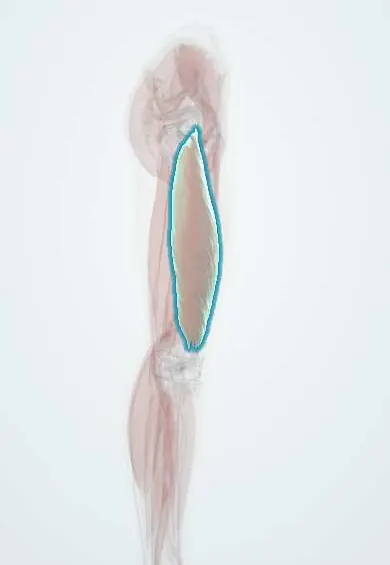
- Vastus lateralis
- Middle deltoid
- Biceps (long head)
- Right upper lobe
- Vastus medialis
- Gluteus medius
- Front deltoid
- Biceps (short head)
- Left upper lobe
- Main bronchi
In histology
Why it happens
What it is
An autoimmune disorder in which antibodies against presynaptic voltage-gated calcium channels reduce acetylcholine release at the neuromuscular junction. It causes proximal limb weakness, reduced reflexes and autonomic symptoms, and about half of cases are paraneoplastic.
Who gets it
Rare, much less common than myasthenia gravis. The paraneoplastic form mainly affects middle-aged and older smokers with small cell lung cancer; the non-paraneoplastic form can occur at any age and is associated with other autoimmune diseases. In Latin America, as elsewhere, it is under-recognized and often first labelled as myasthenia gravis or a myopathy.
Causes
- Antibodies against P/Q-type voltage-gated calcium channels on the presynaptic nerve terminal
- Paraneoplastic: small cell lung cancer expresses the same calcium channels and triggers the immune response
- Non-paraneoplastic: autoimmune, associated with other autoimmune diseases and certain HLA types
Risk factors
- Smoking (risk of small cell lung cancer)
- Age over 50
- Personal or family history of autoimmune disease
Pathophysiology
Antibodies block presynaptic calcium channels, so less calcium enters the nerve terminal and fewer vesicles of acetylcholine are released. Each nerve impulse produces a small end-plate potential, causing weakness and low reflexes. With repeated or sustained contraction, calcium builds up in the terminal and release improves, which explains the temporary increase in strength and reflexes after brief exercise (facilitation). The same failure at autonomic synapses causes dry mouth, constipation and erectile dysfunction.
Classification
- Paraneoplastic (cancer-associated, mostly small cell lung cancer)
- Non-paraneoplastic (primary autoimmune)
Symptoms and signs
- Proximal leg weakness first (difficulty climbing stairs or rising from a chair), then proximal arm weakness
- Strength and reflexes improve briefly after exercise
- Reduced or absent tendon reflexes
- Dry mouth, constipation, erectile dysfunction and orthostatic dizziness (autonomic involvement)
- Mild ptosis or double vision in some patients, less prominent than in myasthenia gravis
- Fatigue; weight loss or cough when a lung tumour is present
Diagnosis
- Clinical
- Triad of proximal weakness, reduced reflexes and autonomic symptoms. Post-exercise facilitation of strength or reflexes is a useful bedside sign.
- Tests
- Antibodies against P/Q-type voltage-gated calcium channels are positive in most patients. Repetitive nerve stimulation at high frequency or after brief maximal exercise shows a marked increase in the compound muscle action potential (incremental response); low-frequency stimulation shows a decrement.
- Imaging
- Chest CT (and PET-CT if negative) to look for small cell lung cancer, with repeated screening for about two years if the first search is negative.
Differential diagnosis
- Myasthenia gravis (ocular and bulbar onset, worsens with exercise, preserved reflexes)
- Inflammatory myopathy
- Botulism (descending paralysis, prominent cranial nerve signs)
- Guillain-Barré syndrome and chronic inflammatory demyelinating polyneuropathy
- Amyotrophic lateral sclerosis
Goal of treatment
Find and treat any underlying cancer, improve neuromuscular transmission, and suppress the autoimmune response when symptoms persist.
Treatment
- Medical
- Treatment of the underlying small cell lung cancer (chemotherapy, radiotherapy), which often improves the weakness.
- Medical
- Amifampridine (3,4-diaminopyridine), a potassium channel blocker that prolongs nerve depolarization and increases acetylcholine release, is first-line symptomatic therapy; cholinesterase inhibitors give a modest extra effect.
- Medical
- Immunosuppression with corticosteroids and steroid-sparing agents (e.g. azathioprine) for persistent disease; intravenous immunoglobulin or plasma exchange for severe weakness.
- Follow-up
- Monitoring of respiratory function and swallowing, review of all drugs that can worsen neuromuscular transmission, and warning the anaesthesia team before surgery.
Complications
- Respiratory failure (uncommon)
- Prolonged paralysis after neuromuscular blocking agents
- Falls from proximal weakness
- Complications of the associated lung cancer
Prognosis
Depends mostly on the cancer. In the non-paraneoplastic form, symptoms are usually controlled with treatment and life expectancy is near normal. Patients with Lambert-Eaton and small cell lung cancer may have a somewhat better cancer survival than those without it.
Test yourself
Think of the answer, then tap the question to see it.
Against which channel are the antibodies in Lambert-Eaton syndrome directed?
Presynaptic P/Q-type voltage-gated calcium channels.
Which cancer is most often associated with Lambert-Eaton syndrome?
Small cell lung cancer.
How does strength change with repeated effort in Lambert-Eaton compared with myasthenia gravis?
It improves briefly after exercise in Lambert-Eaton, whereas it worsens with exercise in myasthenia gravis.
What does high-frequency repetitive nerve stimulation show in Lambert-Eaton?
An incremental response: a large increase in the compound muscle action potential.
Which drug is first-line symptomatic treatment and how does it work?
Amifampridine; it blocks presynaptic potassium channels, prolonging depolarization and increasing acetylcholine release.
Related conditions
- Myasthenia gravis
- Lung cancer
- Paraneoplastic syndromes
- Botulism
- Guillain-Barré syndrome
- Inflammatory myopathies (dermatomyositis, polymyositis)
- Amyotrophic lateral sclerosis
- Tobacco use disorder
Educational information, not medical advice. For any symptom, see a health professional.
Sources: Lambert-Eaton myasthenic syndrome: MedlinePlus Medical Encyclopedia (MedlinePlus (U.S. National Library of Medicine), 2026).
Spotted a mistake?We are always improving for the community. Tell us what is wrong and our team will review it.Report a mistake
Representative model, for educational purposes only.