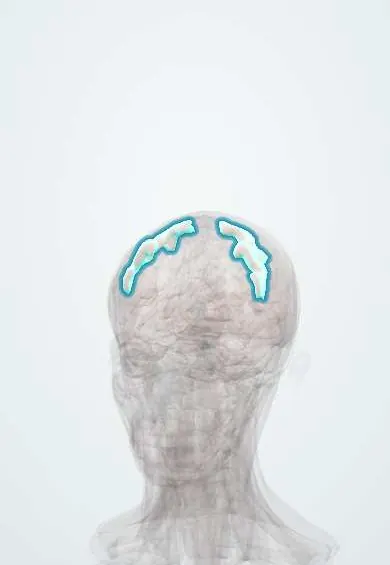
Amyotrophic lateral sclerosis !
ALS is a disease in which the nerve cells that control muscles die, causing growing weakness, trouble speaking and swallowing, and finally breathing failure.
Updated 2026-11-01
Structures involved
Tap one to see what it is and open it in 3D.
- Motor cortex
- Spinal cord
- Medulla oblongata
- Hypoglossal nerve (XII)
- Frontal lobe
- White matter
- Pons
- Vagus nerve
- Accessory nerve (XI)
Why it happens
- Endoplasmic reticulum stress and the unfolded protein response
- Atrophy
- Upper versus lower motor neuron lesions
- Glutamate (glutamic acid)
- Superoxide dismutase (SOD)
- The neuron and synapse
What it is
A progressive neurodegenerative disease that destroys both upper motor neurons (motor cortex and corticospinal tracts) and lower motor neurons (brainstem motor nuclei and anterior horn of the spinal cord). It is the most common motor neuron disease in adults and has no cure.
Who gets it
Incidence is about 1–2 per 100,000 people per year worldwide, with onset usually between 50 and 70 years and slightly more in men. Studies from Latin America generally report similar or somewhat lower figures, with fewer registries. About 5–10% of cases are familial.
Causes
- Most cases are sporadic, with unknown cause
- About 5–10% are familial, mostly autosomal dominant; C9orf72 repeat expansion and SOD1 mutations are the best known
- Proposed mechanisms: glutamate excitotoxicity, protein aggregation (TDP-43), oxidative stress and mitochondrial dysfunction
Risk factors
- Age, with peak onset at 50 to 70 years
- Family history of ALS or frontotemporal dementia
- Male sex (slight excess)
- Possible associations with smoking, military service and some environmental exposures, not proven
Pathophysiology
Motor neurons in the precentral gyrus, brainstem nuclei (including the hypoglossal nucleus in the medulla) and anterior horns degenerate, and the lateral corticospinal tracts lose fibres and harden ("lateral sclerosis"). Loss of lower motor neurons causes weakness, wasting and fasciculations ("amyotrophic"); loss of upper motor neurons causes spasticity and brisk reflexes. Sensation, eye movements and sphincters are usually spared, and death is usually from respiratory muscle failure.
Classification
- Limb-onset (about two thirds): asymmetric weakness of a hand or foot
- Bulbar-onset: dysarthria and dysphagia first, more common in older women
- Respiratory-onset (rare)
- Related phenotypes: progressive muscular atrophy (lower motor neuron only) and primary lateral sclerosis (upper motor neuron only); ALS with frontotemporal dementia
Symptoms and signs
- Painless, asymmetric, progressive weakness, often first in a hand (clumsiness, dropping things) or foot (foot drop, tripping)
- Muscle wasting, fasciculations (twitching) and cramps
- Spasticity, stiffness and brisk reflexes with a Babinski sign in the same limb as wasting
- Slurred speech, difficulty swallowing, drooling, tongue wasting with fasciculations
- Shortness of breath, orthopnoea and morning headache from nocturnal hypoventilation
- Emotional lability (pseudobulbar affect) and, in some people, behavioural or language changes of frontotemporal dementia
Diagnosis
- Clinical
- Combination of upper and lower motor neuron signs in several body regions (bulbar, cervical, thoracic, lumbosacral) with progressive spread, and exclusion of other causes (Gold Coast or revised El Escorial criteria). Sensation is normal.
- Tests
- Electromyography and nerve conduction studies show widespread active and chronic denervation with normal sensory nerves. Blood tests (CK, thyroid, B12, calcium, protein electrophoresis) exclude mimics; genetic testing when there is a family history. Forced vital capacity tracks respiratory function.
- Imaging
- MRI of the brain and cervical spine is done mainly to exclude mimics such as cervical myelopathy or a structural lesion.
Differential diagnosis
- Cervical spondylotic myelopathy with radiculopathy
- Multifocal motor neuropathy with conduction block
- Myasthenia gravis (bulbar onset)
- Inclusion body myositis and other myopathies
- Spinal muscular atrophy (adult-onset) and Kennedy disease
Goal of treatment
Slow progression modestly, maintain function, nutrition and breathing for as long as possible, control symptoms and support the person and family with early palliative and advance-care planning.
Treatment
- Medical
- Riluzole (a glutamate-release inhibitor) modestly prolongs survival; edaravone (an antioxidant) is used in some countries. Gene-directed therapy exists for SOD1-related ALS.
- Procedure
- Non-invasive ventilation for respiratory insufficiency improves survival and quality of life; tracheostomy with mechanical ventilation is an option some people choose.
- Procedure
- Gastrostomy (PEG or radiologically placed) for dysphagia and weight loss, ideally before vital capacity falls too much.
- Rehabilitation
- Multidisciplinary care: physiotherapy, occupational therapy, speech therapy and communication aids, nutrition support.
- Follow-up
- Regular forced vital capacity, weight and swallowing assessment; nursing priorities are aspiration precautions, airway clearance, skin care and fall prevention.
- Medical
- Symptom relief: drugs for spasticity, cramps, sialorrhoea and pseudobulbar affect; palliative care and advance directives from early on.
Drugs for this condition
Complications
- Respiratory failure, the main cause of death
- Aspiration pneumonia
- Malnutrition and dehydration from dysphagia
- Falls, pressure ulcers and contractures
- Depression and caregiver burden
Prognosis
Relentlessly progressive. Median survival is about 2–5 years from symptom onset, mostly ending in respiratory failure, but about 10% live more than 10 years. Bulbar onset and older age carry a worse prognosis; non-invasive ventilation and multidisciplinary care prolong survival.
Test yourself
Think of the answer, then tap the question to see it.
What combination of signs defines amyotrophic lateral sclerosis?
Upper motor neuron signs (spasticity, brisk reflexes, Babinski) together with lower motor neuron signs (weakness, wasting, fasciculations), progressive and spreading.
Which functions are typically spared in ALS?
Sensation, eye movements and bladder and bowel sphincter control.
Which drug modestly prolongs survival in ALS and how does it work?
Riluzole, which reduces glutamate release and excitotoxicity.
What is the usual cause of death in ALS?
Respiratory failure from weakness of the respiratory muscles, often with aspiration pneumonia.
What is a key nursing priority in a patient with bulbar ALS?
Aspiration prevention: swallowing assessment, upright position and adapted textures for meals, suction available, and monitoring weight and breathing.
Related conditions
- Myasthenia gravis
- Degenerative cervical myelopathy
- Spinal muscular atrophy
- Guillain-Barré syndrome
- Multiple sclerosis
- Frontotemporal dementia
- Community-acquired pneumonia
- Huntington disease
Educational information, not medical advice. For any symptom, see a health professional.
Sources: Amyotrophic lateral sclerosis (ALS) (MedlinePlus (U.S. National Library of Medicine), 2024); Amyotrophic lateral sclerosis (MedlinePlus Genetics (U.S. National Library of Medicine), 2024).
Spotted a mistake?We are always improving for the community. Tell us what is wrong and our team will review it.Report a mistake
Representative model, for educational purposes only.