
Orbital tumours
Masses in the orbit push the eye forward and can compress the optic nerve. Types differ by age: cysts and rhabdomyosarcoma in children, lymphoma in adults.
What it is
Benign and malignant growths in the orbit, usually causing gradual proptosis, eye displacement, double vision or optic nerve compression. Type depends on age: dermoid cyst, capillary haemangioma and rhabdomyosarcoma in children; cavernous venous malformation, lymphoma, lacrimal and nerve sheath tumours and metastases in adults.
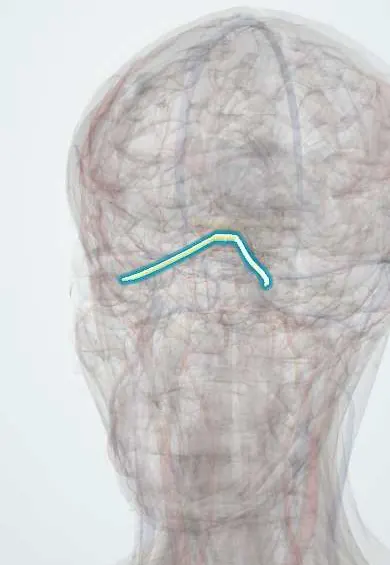
See it in 3D
Who gets it
Uncommon. Thyroid eye disease remains the commonest cause of proptosis in adults; among tumours, lymphoma predominates in older adults and dermoid cysts in children.
Causes
- Developmental (dermoid cysts)
- Vascular lesions (capillary haemangioma, cavernous venous malformation, lymphatic malformation)
- Lymphoproliferative (lymphoma)
- Neural (optic nerve glioma, meningioma, schwannoma)
- Lacrimal gland tumours
- Metastases (breast, lung, prostate; neuroblastoma in children)
Risk factors
- Neurofibromatosis type 1 (optic nerve glioma)
- Previous cancer (metastasis)
- Autoimmune disease (lymphoma)
Pathophysiology
The orbit is a closed bony space, so any growing mass pushes the eye forward or aside, restricts its movement and can compress the optic nerve at the apex.
Classification
- Children: dermoid cyst, capillary haemangioma, lymphatic malformation, rhabdomyosarcoma, optic nerve glioma, neuroblastoma metastasis
- Adults: cavernous venous malformation, lymphoma, lacrimal gland tumours, meningioma, metastases
Symptoms and signs
- Gradual painless proptosis or displacement of the eye
- Double vision
- Reduced vision or colour vision
- A palpable mass, often at the upper outer orbit
- Lid swelling
Diagnosis
- Clinical
- Measurement of proptosis, eye movements, visual acuity, colour vision and pupils; palpation of the orbital rim and lymph nodes.
- Tests
- Biopsy for most solid lesions; staging tests for lymphoma or metastasis.
- Imaging
- Contrast MRI or CT of the orbits defines the site, shape and extent.
Differential diagnosis
- Thyroid eye disease
- Orbital cellulitis
- Idiopathic orbital inflammation
- Carotid-cavernous fistula
- Pseudoproptosis from high myopia
Proptosis: what is behind the eye?
| Feature | Orbital tumour | Thyroid eye disease | Idiopathic orbital inflammation | Carotid-cavernous fistula |
|---|---|---|---|---|
| Onset | Gradual (rapid in rhabdomyosarcoma) | Gradual, with active and inactive phases | Acute, hours to days | Sudden after trauma, gradual if dural |
| Pain | Usually painless | Mild | Marked, worse on eye movement | Variable, with headache |
| Typical signs | Eye displaced away from the mass, sometimes a palpable mass | Lid retraction and lid lag, often both eyes | Red, swollen lids, painful eye movements | Corkscrew vessels, bruit, raised eye pressure |
| Imaging | Discrete mass | Enlarged muscle bellies with tendons spared | Enhancing muscle with tendon, gland or diffuse tissue | Enlarged superior ophthalmic vein |
Goal of treatment
Establish the diagnosis, protect the optic nerve and treat the tumour with the least harm to the eye.
Treatment
- Surgical
- Complete excision of well-defined benign lesions (dermoid, cavernous malformation, pleomorphic adenoma).
- Medical
- Chemotherapy and radiotherapy for rhabdomyosarcoma and lymphoma under oncology.
- Follow-up
- Observation of small, stable lesions that do not threaten vision.
Complications
- Compressive optic neuropathy
- Exposure of the cornea
- Restrictive strabismus
- Metastatic spread
Common traps
- Most adult proptosis is caused by a tumour: thyroid eye disease is the commonest cause of proptosis in adults, on one side or both; imaging separates muscle enlargement from a mass
- Proptosis in a child that grows over days is probably cellulitis: rapidly progressive proptosis in a child without clear infection may be rhabdomyosarcoma and needs urgent imaging and biopsy
- A painless mass in the upper outer orbit is always benign: lacrimal gland lesions include pleomorphic adenoma but also lymphoma and carcinoma; pain, rapid growth or bone erosion suggest malignancy
- A suspected pleomorphic adenoma of the lacrimal gland should be biopsied first: incisional biopsy can seed recurrence and malignant change, so it is removed whole
- Optic nerve glioma is a tumour of adults: it is mainly a childhood tumour linked to neurofibromatosis type 1; optic nerve sheath meningioma is the adult counterpart
Prognosis
Excellent for most benign tumours; good for orbital lymphoma and rhabdomyosarcoma treated early; poor for metastases.
Test yourself
Think of the answer, then tap the question to see it.
A 6-year-old develops proptosis and downward displacement of one eye over two weeks. Which tumour must be excluded urgently?
Rhabdomyosarcoma, the commonest primary orbital malignancy of childhood; urgent MRI and biopsy, because early chemotherapy and radiotherapy give good survival.
Why can an orbital mass threaten vision even when the eye itself is healthy?
The orbit is a closed bony space, so the mass compresses the optic nerve at the apex, reducing acuity and colour vision and causing an afferent pupillary defect.
What does the direction of eye displacement suggest about an orbital mass?
The eye moves away from the mass: a lacrimal gland tumour in the upper outer orbit pushes it down and in; a mass inside the muscle cone pushes it straight forward.
A child with neurofibromatosis type 1 has slowly falling vision in one eye. Which orbital tumour is likely?
Optic nerve glioma.
An older adult has slowly progressive painless proptosis and a salmon-pink mass under the conjunctiva. What is likely and what follows?
Orbital lymphoma; biopsy to type it, then systemic staging with oncology.
Why it happens
In ophthalmology
Connections
Educational information, not medical advice. For any symptom, see a health professional.
Sources: Malignant Orbital Tumors (StatPearls Publishing (NCBI Bookshelf), 2024).
Spotted a mistake?We are always improving for the community. Tell us what is wrong and our team will review it.Report a mistake
Representative model, for educational purposes only.