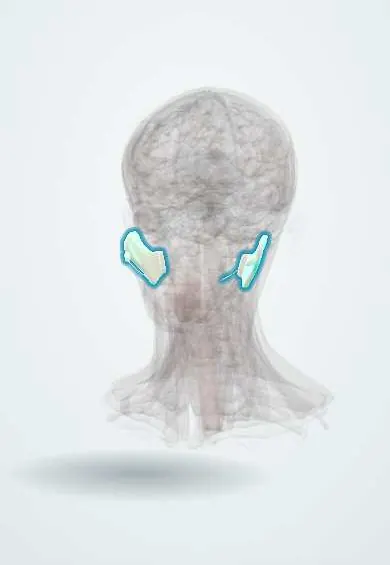
Parotid gland tumours !
Parotid tumours are growths in the large salivary gland in front of the ear; most are benign, usually showing as a painless lump.
Updated 2026-10-29
Structures involved
Tap one to see what it is and open it in 3D.
- Parotid gland
- Facial nerve branches
- Facial nerve (VII)
- Stylomastoid foramen
- Retromandibular vein
- Masseter
- Neck lymph nodes
In histology
In physiology
Why it happens
- Naming tumours: -oma, carcinoma, sarcoma, and the misleading names
- Benign vs malignant tumours: the comparison table
What it is
A benign or malignant neoplasm of the parotid gland. Most are benign, chiefly pleomorphic adenoma and Warthin tumour; malignant ones include mucoepidermoid and adenoid cystic carcinoma.
Who gets it
The parotid is the most common site of salivary gland tumours, and most parotid tumours are benign. Warthin tumour is linked to smoking and older age.
Causes
- Benign: pleomorphic adenoma (most common), Warthin tumour
- Malignant: mucoepidermoid carcinoma (most common), adenoid cystic carcinoma, acinic cell carcinoma, others
- Metastasis from skin cancer of the scalp and face to intraparotid nodes
Risk factors
- Prior radiation to the head and neck
- Smoking (Warthin tumour)
- Older age
- Some occupational exposures
Pathophysiology
Tumours arise from ductal or acinar cells and grow as a mass in the gland. Pleomorphic adenoma has an incomplete capsule with projections, so simple enucleation leads to recurrence. Malignant tumours can invade the facial nerve that runs through the gland and spread to neck nodes; adenoid cystic carcinoma is known for perineural spread.
Classification
- Benign versus malignant (WHO histological classification)
- Low-grade versus high-grade malignancy
- TNM staging for carcinomas
Symptoms and signs
- Slow-growing, painless lump in front of or below the ear
- Rapid growth, pain or fixation to skin or deeper tissue suggesting malignancy
- Facial weakness on the same side
- Neck lumps (nodal spread)
Diagnosis
- Clinical
- Examination of the mass, facial nerve function, oral cavity (deep lobe tumours push the tonsil medially) and neck nodes.
- Tests
- Ultrasound-guided fine-needle aspiration or core biopsy for cytology or histology; open biopsy is avoided.
- Imaging
- Ultrasound first; MRI defines extent, deep-lobe involvement and perineural spread; CT or PET for staging of malignancy.
Differential diagnosis
- Intraparotid or cervical lymphadenopathy
- Sialadenitis or sialolithiasis
- Lymphoma
- Metastatic skin cancer
- Branchial cleft cyst
Goal of treatment
Remove the tumour completely while preserving the facial nerve, and control malignant disease locally and in the neck.
Treatment
- Surgical
- Parotidectomy (superficial or total) with identification and preservation of the facial nerve; neck dissection for nodal disease.
- Medical
- Radiotherapy after surgery for high-grade, incompletely excised or advanced cancers; systemic therapy in selected advanced cases.
- Follow-up
- Watchful follow-up for selected benign tumours in frail patients, and long-term surveillance after cancer treatment.
Complications
- Facial nerve weakness after surgery
- Gustatory sweating (Frey syndrome)
- Salivary fistula
- Recurrence; rare malignant change of a long-standing pleomorphic adenoma
Prognosis
Excellent for benign tumours after complete excision. In cancer it depends on grade and stage: low-grade tumours do well; high-grade tumours carry a guarded outlook.
Test yourself
Think of the answer, then tap the question to see it.
What is the most common benign parotid tumour?
Pleomorphic adenoma.
Which benign parotid tumour is strongly linked to smoking and can be bilateral?
Warthin tumour.
What is the most common malignant salivary gland tumour?
Mucoepidermoid carcinoma.
Facial weakness with a parotid mass suggests what?
Malignancy invading the facial nerve until proven otherwise.
What is Frey syndrome?
Gustatory sweating and flushing of the cheek after parotidectomy, from misdirected regrowth of parasympathetic fibres.
Related conditions
Educational information, not medical advice. For any symptom, see a health professional.
Sources: Parotid Cancer (StatPearls (NCBI Bookshelf), 2023).
Spotted a mistake?We are always improving for the community. Tell us what is wrong and our team will review it.Report a mistake
Representative model, for educational purposes only.