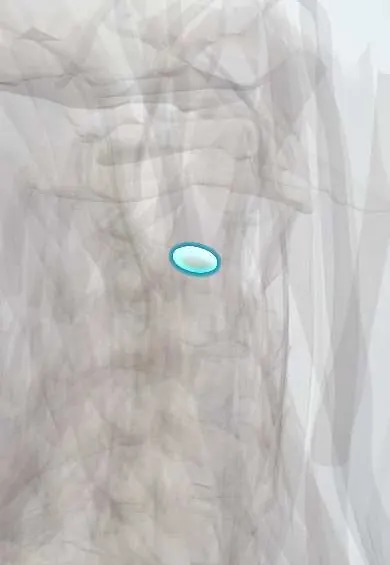
C2–C3 nucleus !
The nucleus pulposus is the soft, gel-like centre of the C2-C3 disc in the neck; it works like a water cushion that spreads the load.
Official name: C2-C3
Opens in the Durgical app, no sign-up needed.
What it is
The soft, gel-like centre (nucleus pulposus) of the C2–C3 disc.
What it does
Works like a water cushion: it turns pressure from above into outward push on the fibre ring, spreading the load. It is under the most pressure when you bend forward and lift.
Key facts
- Where
- Centre of the C2–C3 disc, slightly toward the back, inside the annulus fibrosus
- Function
- Notochord-derived gel (about 70–90% water, proteoglycans); turns axial load into annulus tension; herniates posterolaterally toward the C3 root
Relations
- Behind
- Back of the annulus fibrosus and the posterior longitudinal ligament, broad here and continuing upward as the tectorial membrane, then the spinal cord
- Lateral
- Uncovertebral joints of C3, with the C3 root behind them and the vertebral artery in the transverse foramina further out
How to find it
From the front, at about the height of the angle of the mandible, just above the hyoid bone (about C3). The nucleus sits in the middle of the disc, deep behind the pharynx.
On imaging
In a congenital C2–C3 block, the lateral X-ray shows a narrow «wasp waist» where the disc should be, and MRI shows no nucleus.
Common problems
- Squeezes out through a tear in the ring (herniation), usually backward and to one side, toward a nerve root.
- Loses water with age, so the disc gets thinner and stiffer.
How it is diagnosed
On MRI a healthy nucleus is bright on T2 images; a worn one turns dark ('black disc').
Treatment
- In a microdiscectomy only the loose piece that has pushed out is removed; most of the disc stays.
Clinical notes
- A C3 root lesion gives upper neck and back-of-head pain with no dependable weakness or reflex change, so it is hard to tell from facet or muscle pain
- Anterior surgery at C2–C3 lies high under the jaw, near the hypoglossal and superior laryngeal nerves, which makes it harder than at lower levels
Anatomical variants
- Congenital fusion of C2 and C3, alone or as part of Klippel–Feil syndrome, is the most frequent cervical fusion; the disc and its nucleus are then absent or reduced to a thin remnant
Development
Like every nucleus pulposus it comes from the notochord. There is no disc above it: the dens is the body of the atlas fused to the axis, and the cartilage line at its base (subdental synchondrosis), a remnant of a disc, can be mistaken for a fracture in young children.
Test yourself
Think of the answer, then tap the question to see it.
Which root does a posterolateral herniation of the C2–C3 nucleus reach, and why does a foraminal one reach the same root?
The C3 root; each cervical root runs almost horizontally out of its foramen, so both herniation sites hit the same root.
Why is a soft herniation of the C2–C3 nucleus rare?
Cervical nuclei are small and, by middle age, largely fibrous.
How does a congenital C2–C3 block look on imaging?
The lateral X-ray shows a narrow «wasp waist» where the disc should be, and MRI shows no nucleus.
Educational information, not medical advice. For any symptom, see a health professional.
Its names
- Official Latin (TA2)
- nucleus pulposus C2-C3 TA2 1686
- Official Spanish (DeCS)
- Núcleo pulposo C2-C3 DeCS D000070614
- English (TA2)
- C2-C3
Related
Sources: Terminologia Anatomica (TA2); DeCS; Anatomy, Back, Nucleus Pulposus; Anatomy, Back, Intervertebral Discs; Anatomy of the Human Body (20th ed.): Articulations of the Vertebral Column (Lea & Febiger (Gray's Anatomy, 1918), 1918) · adapted, Public domain.
Spotted a mistake?We are always improving for the community. Tell us what is wrong and our team will review it.Report a mistake
Representative model, for educational purposes only.