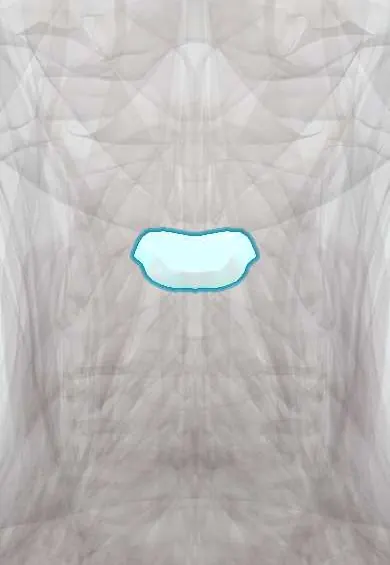
C2–C3 disc !
The C2-C3 disc is the cushion between the C2 and C3 neck vertebrae; it absorbs load and lets the neck bend and turn.
Official name: C2-C3
Opens in the Durgical app, no sign-up needed.
What it is
The cushion between C2 and C3: a tough outer ring of fibres (annulus fibrosus) around a soft centre.
What it does
Absorbs load and lets the neck bend and turn. C5-C6 is the most mobile and most worn neck level.
Key facts
- Where
- Between C2 and C3 bodies; first disc of the spine (none at C0–C1 or C1–C2)
- Attaches
- Annulus fibrosus anchored to the endplates and ring apophyses of C2 and C3; anterior and posterior longitudinal ligaments
- Function
- Absorbs and spreads load; posterolateral herniation usually compresses the C3 root
Relations
- In front
- Prevertebral fascia and the longus colli, then the retropharyngeal space and the pharynx; from the front the level lies near the angle of the mandible and just above the hyoid
- Behind
- Posterior longitudinal ligament, which continues upward as the tectorial membrane, the epidural space, the dural sac and the upper cervical spinal cord
- Lateral
- Uncovertebral joints and, further out, the vertebral artery in the transverse foramina of the axis (C2) and the C3 vertebra; the C3 root leaves through the foramen at this level
- Above
- Body of the axis (C2), with the dens rising from it
How to find it
From behind, the C2 spinous process is the first large bony point felt in the midline below the occiput; the C2–C3 disc lies just below it. From the front it is roughly level with the angle of the mandible. In surgery the level is confirmed on a lateral X-ray.
On imaging
Lateral X-ray in children: a slight forward shift of C2 on C3 is often normal (pseudosubluxation, which can also affect C3–C4); a line drawn along the front of the spinous processes of C1 to C3 (posterior cervical or Swischuk line) helps tell it from an injury.
Common problems
- Herniation pressing on the C6 nerve root: neck pain and pain, numbness or weakness down the arm into the thumb side of the hand.
- Degeneration with bone spurs, which can narrow the canal and press on the spinal cord (myelopathy: clumsy hands, unsteady walking).
How it is diagnosed
Exam of arm strength, reflexes and feeling, plus signs of cord pressure. MRI shows the disc, nerve roots and cord.
Treatment
- Most arm pain from a disc improves with time, physical therapy, medicine and sometimes an injection.
- Lasting arm pain, weakness or cord pressure: anterior cervical discectomy and fusion (ACDF), or disc replacement in selected patients.
Clinical notes
- Anterior surgery at C2–C3 is among the hardest in the neck: the mandible limits the view and the hypoglossal and superior laryngeal nerves cross the high exposure
- Pain referred to the back of the head and the upper neck from this segment is easily mistaken for a primary headache
- Pain from the C2–C3 facet joint travels through the third occipital nerve; a block of that nerve that briefly removes the headache supports the diagnosis and can lead to radiofrequency denervation
Anatomical variants
- Congenital fusion of C2 and C3 (block vertebra) is the most common site of congenital cervical fusion, as in Klippel–Feil syndrome; no disc forms and the segments next to it wear faster
Development
In young children the upper cervical ligaments are lax and the facets shallow, so C2 normally glides forward on C3 in flexion (pseudosubluxation, until about age 8); a line along the backs of the C1–C3 arches (Swischuk line) helps tell it from a true injury.
Test yourself
Think of the answer, then tap the question to see it.
Which joint beside the C2–C3 disc is a classic source of cervicogenic headache, and through which nerve?
The C2–C3 facet joint, through the third occipital nerve.
In a hangman's fracture, what does angulation or forward slip of C2 on C3 mean for the C2–C3 disc?
The C2–C3 disc and ligaments are torn, which makes the injury unstable.
What is the most common site of congenital cervical fusion, as in Klippel–Feil syndrome?
C2–C3: no C2–C3 disc forms, and the segments next to the block wear faster.
Educational information, not medical advice. For any symptom, see a health professional.
Its names
- Official Latin (TA2)
- discus intervertebralis C2-C3 TA2 1684
- Official Spanish (DeCS)
- Disco C2-C3 DeCS D007403
- English (TA2)
- C2-C3
- Also called
- fibrous ring · fibrocartilago intervertebralis
Related
Sources: Terminologia Anatomica (TA2); DeCS; Anatomy, Back, Intervertebral Discs.
Spotted a mistake?We are always improving for the community. Tell us what is wrong and our team will review it.Report a mistake
Representative model, for educational purposes only.