Joints and ligaments · Lower limb
MTP ligaments and plantar plate !
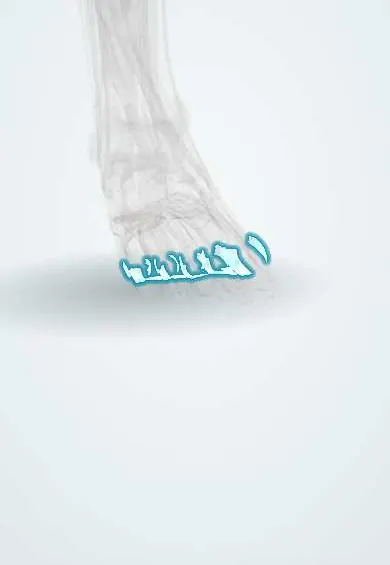
The MTP (metatarsophalangeal) ligaments and plantar plate hold the base of each toe to its metatarsal at the ball of the foot.
Official name: Collateral metatarsophalangeal ligaments
Opens in the Durgical app, no sign-up needed.
What it is
The ligaments around the joints at the base of the toes: side (collateral) ligaments, the thick plantar plate under each joint, and bands linking the metatarsal heads and the sesamoids.
What it does
Hold each toe in line with its metatarsal and stop the toes from bending up too far.
Key facts
- Attaches
- Collateral ligaments: metatarsal heads to proximal phalanx bases; plantar plates joined by deep transverse metatarsal ligaments
- Function
- Stabilize MTP joints; plantar plate resists hyperextension (turf toe)
- Tight in
- MTP extension (dorsiflexion of toes)
Relations
- Above
- Extensor tendons and their hood; the interossei pass above the deep transverse metatarsal ligament
- Below
- Long and short flexor tendons in their fibrous sheaths, anchored to the plate; slips of the plantar fascia; below the deep transverse metatarsal ligament, the lumbricals and the common plantar digital nerves and vessels
How to find it
Each MTP joint lies a short way behind its toe web. With the toe bent, the collateral ligaments can be felt on either side of the joint; the plantar plate lies under the metatarsal head, where a plate tear gives point tenderness.
Examination
- Vertical drawer (Lachman) test of the MTP joint: the proximal phalanx is pushed upward with the metatarsal held; pain or excess movement suggests a plantar plate tear
- Paper pull-out test: the toe cannot grip a strip of paper against the floor when the plantar plate fails
- Turf toe: pain on passive dorsiflexion of the big toe and instability on drawer testing
On imaging
Standing AP X-ray shows the toe drifting; at the big toe, sesamoids that sit more proximally than on the other side suggest a plantar plate rupture, and a forced dorsiflexion lateral view can show it. MRI or ultrasound shows the plate.
Common problems
- Turf toe: a sprain or tear of the plantar plate under the big toe, from forcing the toe up, as in football on artificial turf.
- Plantar plate tear of the second toe: pain under the ball of the foot, and the toe slowly drifting or lifting.
- When these ligaments weaken, toes can become hammer toes or claw toes.
How it is diagnosed
A physical exam (drawer test of the toe); X-rays; MRI or ultrasound to see the tear.
Treatment
- Taping, stiff shoes or inserts, and rest; a boot for more severe sprains.
- Physical therapy and a gradual return to activity.
- Surgery to repair the plantar plate for large tears or toes that keep drifting.
Clinical notes
- Turf toe grades: I stretch, II partial tear, III complete tear with sesamoid displacement
- Second MTP plantar plate tears are linked to a long second metatarsal and can end in a 'crossover' toe
- Morton neuroma surgery may divide the deep transverse metatarsal ligament to free the nerve, most often in the third web space
Anatomical variants
- A bipartite sesamoid, more often the medial (tibial) one and often on both feet, can be mistaken for a fracture
Related conditions
Test yourself
Think of the answer, then tap the question to see it.
Where does the plantar plate of an MTP joint usually tear, and why?
At its distal end, because it is firmly attached to the base of the proximal phalanx and only loosely to the metatarsal neck.
What is turf toe?
A hyperextension injury of the big toe's plantar plate and sesamoid complex; grade III is a complete tear with sesamoid displacement.
Which test checks a lesser-toe plantar plate tear, and what is positive?
The vertical drawer (Lachman) test of the MTP joint: pain or excess upward movement of the proximal phalanx.
Which nerve runs just below the deep transverse metatarsal ligament, and what forms there?
The common plantar digital nerve; a Morton neuroma forms there, most often in the third web space.
Educational information, not medical advice. For any symptom, see a health professional.
Its names
- Official Latin (TA2)
- ligamenta metatarsophalangea collateralia; ligamenta metatarsophalangea plantaria TA2 1965
- Official Spanish (DeCS)
- Ligamentos metatarsofalángicos colaterales y plantares (placa plantar) DeCS D008683
- English (TA2)
- Collateral metatarsophalangeal ligaments
- Also called
- ligamenta collateralia
Related
- Sesamoids
- Toe joint capsules
- Toe ligaments
- Toe nerves
- First metatarsal
- Second metatarsal
- Third metatarsal
- Fourth metatarsal
Sources: Terminologia Anatomica (TA2); DeCS; Anatomy, Bony Pelvis and Lower Limb, Foot Joints; Anatomy of the Human Body (20th ed.): Surface Markings of the Lower Extremity (Lea & Febiger (Gray's Anatomy, 1918), 1918) · adapted, Public domain; Anatomy of the Human Body (20th ed.): Metatarsophalangeal Articulations (Lea & Febiger (Gray's Anatomy, 1918), 1918) · adapted, Public domain.
Spotted a mistake?We are always improving for the community. Tell us what is wrong and our team will review it.Report a mistake
Representative model, for educational purposes only.